African Civet
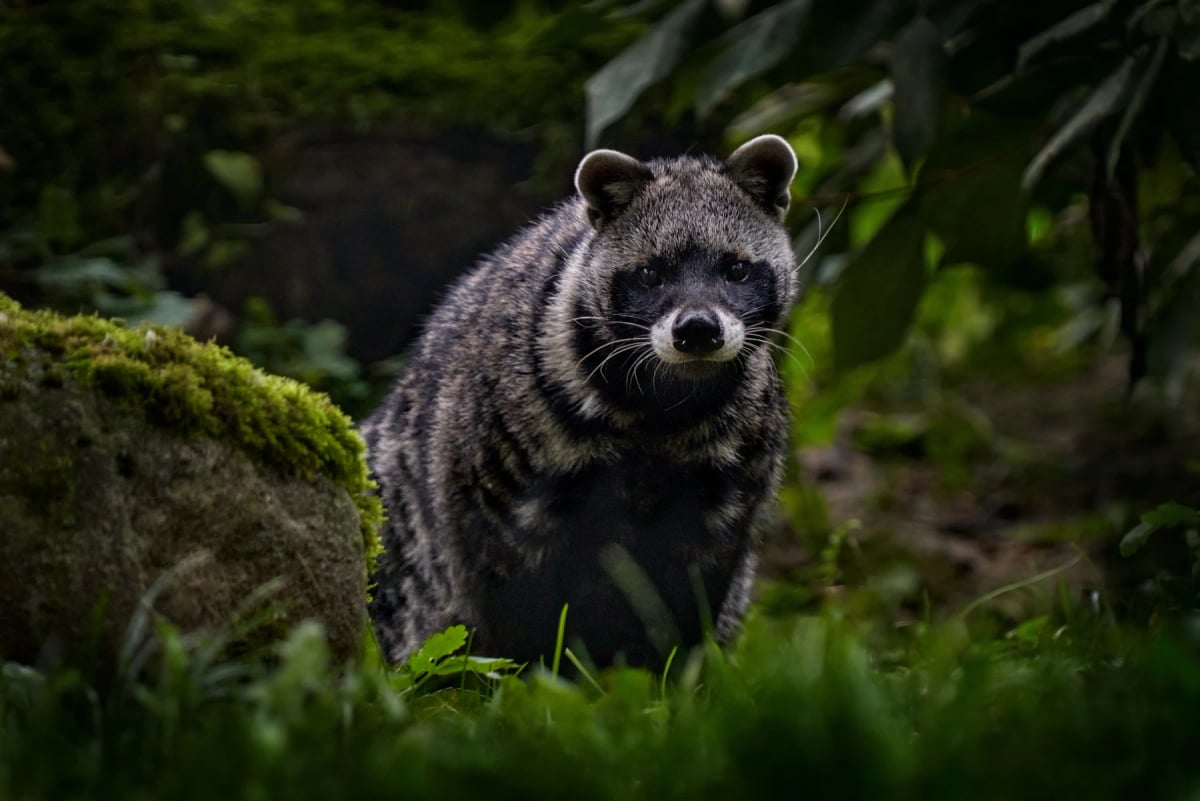
The African civet (Civettictis civetta) is a medium sized nocturnal mammal recognized by its coarse black and gray patterned coat, bold spots and black facial mask. Widespread in sub-Saharan Africa, it inhabits savannas, forests and wetlands, often near water sources. African civets are omnivores with a varied diet including rodents, birds, reptiles, insects and fruits. They are known for producing a musky secretion historically prized in perfumery. Despite being hunted for this substance and their pelts, the species remains common and is listed as Least Concern by the IUCN.
Habitat and distribution
The African civet is one of the most widespread carnivores on the continent, ranging from Senegal and Gambia in the west across to Ethiopia, Somalia, and south through East and southern Africa. It favors areas with dense cover: riverine forests, woodland edges, moist savannas, and wetland margins. The species avoids true deserts like the Sahara and the Namib, and does not penetrate deep into equatorial rainforest interiors. It adapts well to secondary vegetation and the edges of agricultural land, provided water and sufficient ground cover remain available throughout its territory.
Diet
The African civet is among the least selective feeders of any African carnivore. Its diet shifts with what is available: small mammals, birds, reptiles, frogs, insects, millipedes, crabs, eggs, carrion, wild fruits and fungi are all consumed regularly. It is particularly capable of eating prey that other predators avoid, including toxic millipedes and certain venomous species. Fruit forms a significant part of its diet during seasons of abundance, making it an important seed disperser in woodland and forest habitats. This flexibility underpins its success across such a wide and varied geographic range.
Behavior
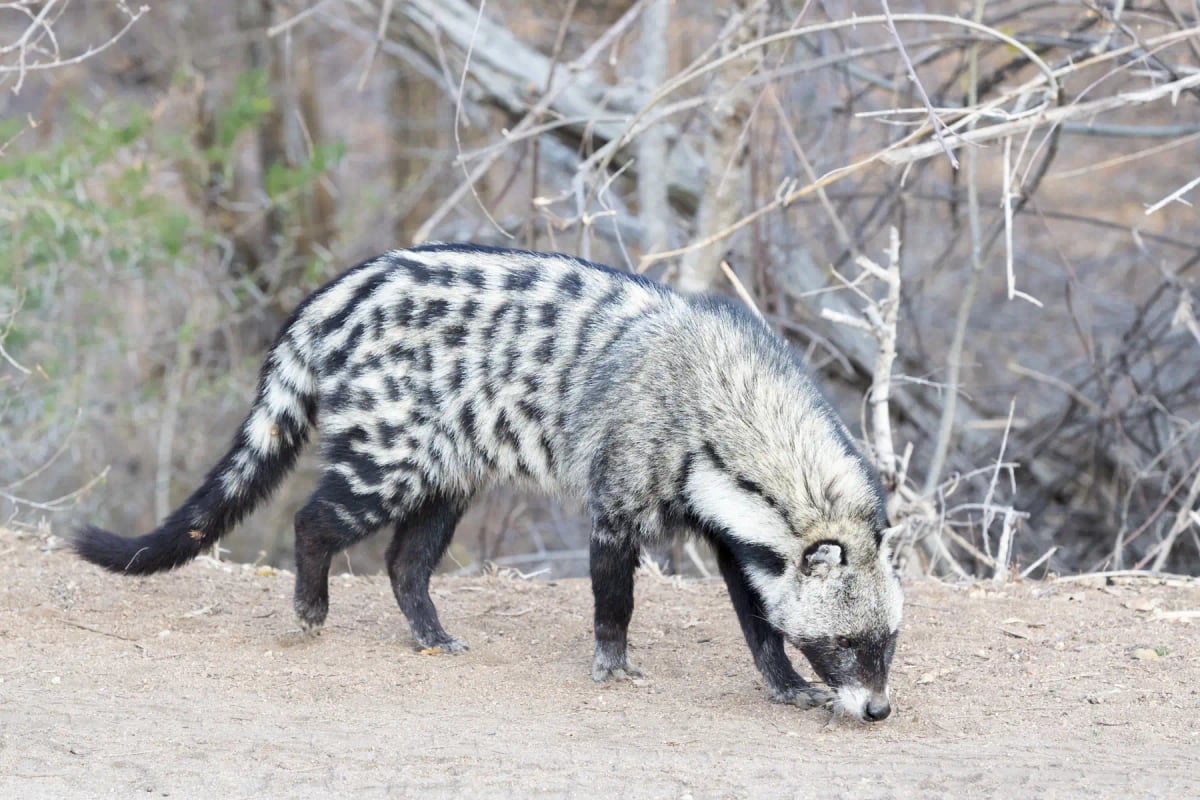
African civets are strictly solitary and nocturnal, emerging after dark to patrol territories of several square kilometers. They communicate through communal latrines called civetries, where multiple individuals deposit feces and scent secretions, building a chemical map of local activity. Despite their robust build, civets prefer to flee rather than confront threats. They are capable swimmers and cross rivers and wetlands without hesitation. Their movement pattern is distinctive: low slung and deliberate, often following the same trails night after night. During the day they rest in dense thickets or tall grass, rarely venturing into open ground.
Special traits
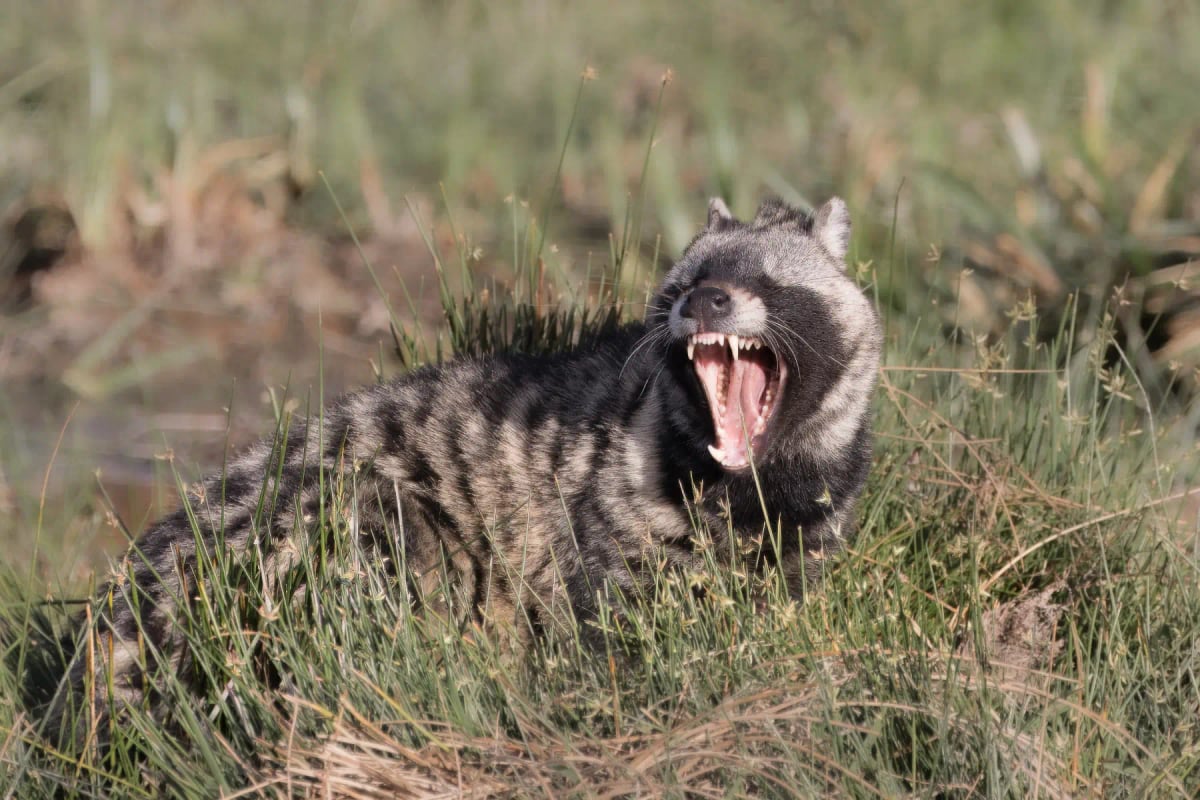
The African civet possesses perineal glands that produce civetone, a thick, intensely scented musk used for centuries as a fixative in perfumery. It extends the life of fragrances and was once among the most valued animal products in the trade. Ethiopia has historically been the main supplier, where civets are kept in small cages and the musk is scraped from their glands every few days, a practice that continues today in small operations. Synthetic civetone has largely replaced the natural product in modern perfumery, reducing but not eliminating demand for farmed civet musk across parts of East Africa.
Conservation
The African civet is classified as Least Concern by the IUCN, reflecting its wide distribution and ability to tolerate modified habitats. Even so, it faces persistent pressure across much of its range. In parts of West and Central Africa it is hunted for bushmeat and its distinctive pelt. In East Africa, civet farming for musk production remains a welfare concern. Habitat loss, particularly the conversion of woodlands to farmland, is reducing suitable cover in some areas. Populations in heavily fragmented landscapes tend to be more isolated and more vulnerable to local hunting pressure and habitat degradation over time.
Where it is found
The African Civet can be found in places such as:
Researched and written by Juan Pablo. Sources: IUCN Red List, scientific literature and regional field guides. Last updated: .
Technical factsheet







Frequently Asked Questions
What does the African civet eat?
The African civet is one of Africa's least selective feeders. Its diet includes small mammals, birds, reptiles, frogs, insects, millipedes, crabs, eggs, carrion, wild fruits, and fungi. It can eat prey that most predators avoid, including toxic millipedes and venomous species. During seasons of abundance, fruit makes up a large portion of its intake, making the civet an important seed disperser in woodland and forest habitats across sub-Saharan Africa.
Where does the African civet live?
The African civet is found across most of sub-Saharan Africa, from Senegal and Gambia in the west to Ethiopia and Somalia in the east, and south through East and southern Africa. It favors areas with dense cover such as riverine forests, woodland edges, moist savannas, and wetland margins. It avoids true deserts like the Sahara and Namib, and does not penetrate deep into equatorial rainforest interiors. It adapts well to secondary vegetation and agricultural edges.
Why is the African civet famous in perfumery?
The African civet produces a thick, intensely scented secretion called civetone from its perineal glands. For centuries this musk was prized as a fixative in perfumery because it extends the life of fragrances. Ethiopia became the main supplier, where civets were kept in small cages and the secretion scraped from their glands every few days. Synthetic civetone has largely replaced the natural product in modern perfumery, though small-scale civet farming still continues in parts of East Africa.
Is the African civet dangerous?
The African civet poses very little danger to people. It is a shy, nocturnal animal that prefers to flee rather than confront any threat. Despite its robust build, it is not aggressive and avoids contact with humans. In the rare case of being cornered, it may bite or scratch, but unprovoked attacks are essentially unheard of. Its secretion has a very strong odor and can cause irritation, but the animal itself is not considered hazardous.
How does the African civet communicate?
The African civet communicates primarily through scent. It uses communal latrines called civetries, where multiple individuals deposit feces and glandular secretions, building a shared chemical map of local activity and territory. Individual animals can identify the age, sex, and reproductive status of others through these scent deposits. Visual and vocal communication is minimal given the species' nocturnal and solitary lifestyle. Scent marking along regular patrol routes is the dominant form of social signaling.
Is the African civet endangered?
The African civet is classified as Least Concern by the IUCN, reflecting its wide distribution and ability to adapt to modified habitats. Populations are considered stable overall. Even so, it faces persistent pressure in parts of its range: it is hunted for bushmeat and its pelt in West and Central Africa, and civet farming for musk remains a welfare concern in East Africa. Habitat loss from woodland conversion to farmland is also reducing suitable cover in several areas.