Secretary Bird
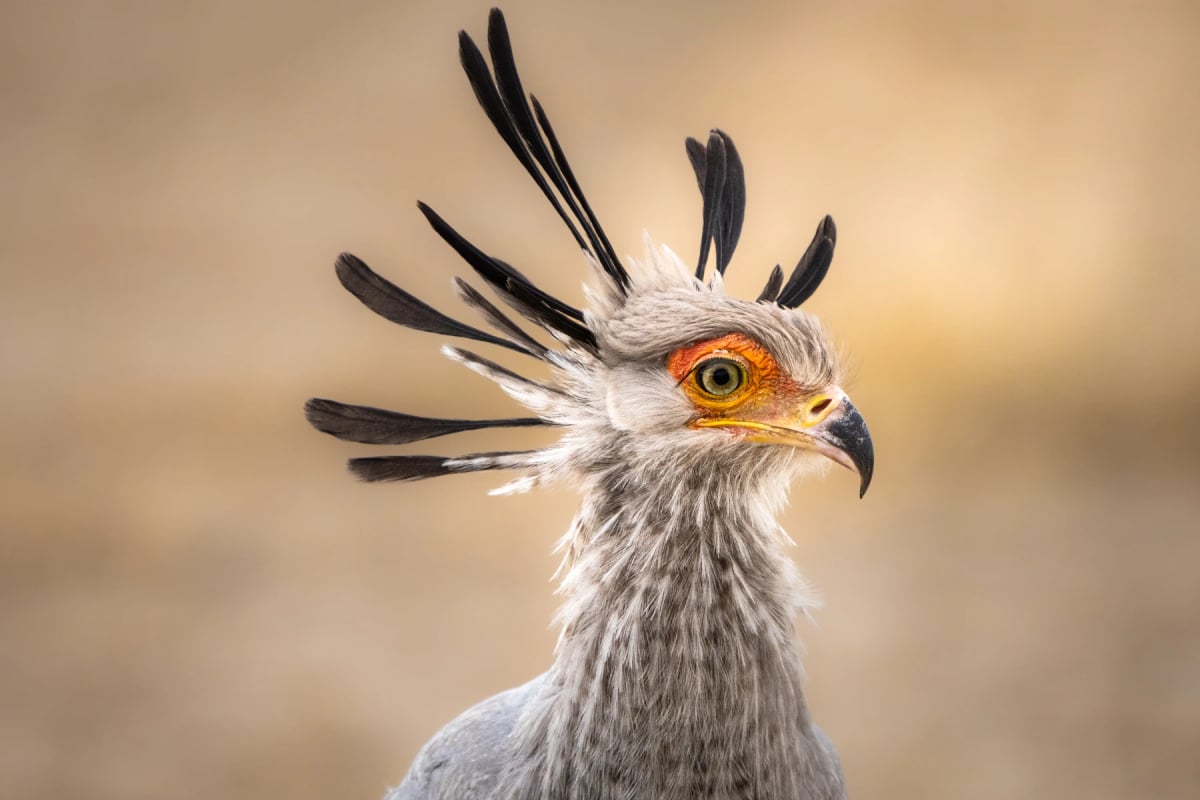
The secretary bird is one of Africa's most distinctive birds of prey. Unlike most raptors, it hunts entirely on foot, stalking through open grasslands and savannas across sub-Saharan Africa on legs that can reach nearly a meter in length. It is famous for killing snakes, including venomous species, by stomping on them with repeated, forceful kicks that can strike with several times the force of its own body weight. It also takes rodents, lizards, frogs, and large insects. A crest of long black feathers at the back of the head, a bare orange-red face, and slate-gray body plumage make it instantly recognizable. Pairs bond for life and build large stick nests on flat-topped trees, which they return to each season. Habitat loss driven by agricultural expansion has caused sharp population declines, and the IUCN now lists it as Endangered.
Appearance
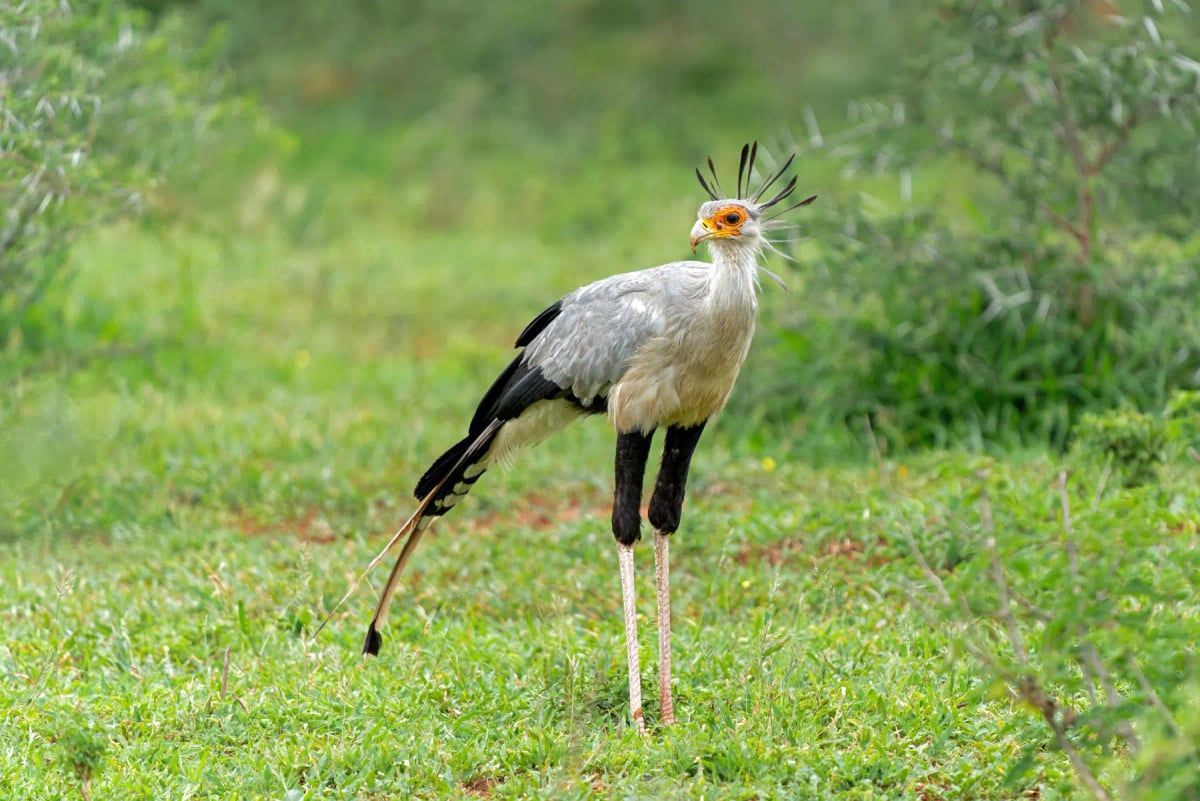
Few birds anywhere in the world are as instantly recognizable as the secretary bird. It stands up to 1.3 meters tall on bare, scaly legs that account for much of its height, giving it a silhouette unlike any other raptor. The body is covered in pale gray feathers, while the flight feathers and the long central tail plumes are black. A cluster of loose black crest feathers trails from the back of the head, thought to resemble the quill pens that clerks once tucked behind their ears. The face is bare and covered in bright orange-red skin, contrasting sharply with the gray plumage. When it spreads its wings across nearly 2.1 meters, the combination of size and bold coloring makes it an unforgettable sight across the open grasslands it calls home.
Hunting strategy
What makes the secretary bird truly remarkable is the way it hunts. Rather than diving from the air like most birds of prey, it walks through tall grass covering up to 30 kilometers a day and flushes prey from the ground. When it locates a target, whether a snake, rodent, lizard, frog, or large insect, it delivers rapid, powerful stamps with its feet. Research has shown these kicks can generate a force several times the bird's own body weight and last for as little as 15 milliseconds, too fast for most snakes to react. Venomous species such as cobras and puff adders are taken this way with remarkable regularity. The thick scales on its legs offer some protection against bites during these close encounters.
Habitat and distribution
Across sub-Saharan Africa, from Senegal and The Gambia in the west to Somalia and Ethiopia in the east, and south through much of the continent to South Africa, the secretary bird occupies open country where visibility is good and walking is easy. It favors grasslands and savannas with short to medium vegetation, and it also uses open shrublands and lightly wooded areas. Dense forest is avoided entirely, as the bird depends on being able to spot and chase prey on foot over large distances. It is not migratory but will move locally in response to rainfall and the availability of food. Nesting pairs tend to stay within a familiar territory, often returning to the same tree year after year as long as conditions remain suitable.
Behavior
Secretary birds form pairs that last for life, and the bond between two partners is maintained through aerial displays in which both birds soar together over their territory. Most activity happens on the ground, where a pair may walk side by side for much of the day while foraging. Nests are broad, flat platforms built from sticks and lined with grass, placed on top of flat-topped acacia and other trees, sometimes reaching a diameter of over two meters after years of reuse. Females lay one to three eggs per clutch, and both parents share incubation duties over roughly 45 days. Chicks are fed regurgitated food and take about three months to fledge. Outside the breeding season, individuals are sometimes seen alone, though pairs generally remain together.
Conservation
The IUCN currently lists the secretary bird as Endangered, a significant worsening from its earlier status as Vulnerable. Population surveys point to steep declines across much of its range over recent decades, driven mainly by the conversion of grassland and savanna to farmland. Overgrazing by livestock degrades the open habitat the bird depends on, and collisions with fences and power lines add further pressure. Persecution and collection for traditional use also occur in parts of its range. Because the species is tied to large stretches of intact open land, it is particularly sensitive to fragmentation. Conservation efforts focus on protecting key grassland areas, monitoring populations through citizen science programs such as the Southern African Bird Atlas Project, and raising awareness among farming communities about the bird's value as a natural controller of rodents and snakes.
Where it is found
The Secretary Bird can be found in places such as:
Researched and written by Juan Pablo. Sources: IUCN Red List, scientific literature and regional field guides. Last updated: .
Technical factsheet



Frequently Asked Questions
What does the secretary bird eat?
The secretary bird eats snakes, rodents, lizards, frogs, and large insects. Snakes are a favorite, including venomous species like cobras and puff adders. It kills them by stamping repeatedly with its powerful feet rather than using its beak. This stomping technique is so fast and forceful that most prey has no chance to escape or fight back effectively.
Can the secretary bird fly?
Yes, the secretary bird can fly and has a wingspan of nearly 2.1 meters. However, it spends most of its time walking on the ground rather than soaring through the air. It uses flight mainly to reach its nest, which is built high in a tree, and to perform aerial displays with its mate. Day to day, it covers ground on foot, sometimes walking up to 30 kilometers in a single day.
Why is it called the secretary bird?
The most widely accepted explanation is that the long black crest feathers trailing from the back of its head reminded early European observers of the quill pens that office clerks, known as secretaries, used to tuck behind their ears. Another theory links the name to an Arabic or French phrase meaning "hunter bird," though the quill pen story remains the most popular and memorable explanation.
Is the secretary bird endangered?
Yes, the IUCN lists the secretary bird as Endangered, which is a step up in concern from its previous status of Vulnerable. The main threat is the loss of grassland and savanna habitat as land is converted to farmland. Overgrazing, collisions with power lines and fences, and persecution in some areas also contribute to its decline. Populations have dropped sharply across much of sub-Saharan Africa in recent decades.
Where does the secretary bird live?
The secretary bird lives across sub-Saharan Africa, from Senegal and The Gambia in the west to Ethiopia and Somalia in the east, and south all the way to South Africa. It favors open grasslands and savannas where it can walk freely and spot prey from a distance. It avoids dense forest entirely. The bird does not migrate but may move locally depending on rainfall and food availability.
How does the secretary bird kill venomous snakes without getting bitten?
The secretary bird relies on speed and the thick scales covering its legs for protection. Its kicks last as little as 15 milliseconds, far too fast for a snake to react and strike back. It also uses its wings to distract or shield itself during the attack. The scaly skin on its legs offers a degree of resistance to bites, though avoiding a strike in the first place is clearly its main defense.
Do secretary birds mate for life?
Yes, secretary birds form pairs that stay together for life. The bond is reinforced through aerial displays in which both birds soar over their territory together. They share incubation duties and both parents care for the chicks. Pairs often return to the same nest year after year, adding material to it each season until it can exceed two meters in diameter. It is a genuinely committed, long-lasting partnership.