Gaur
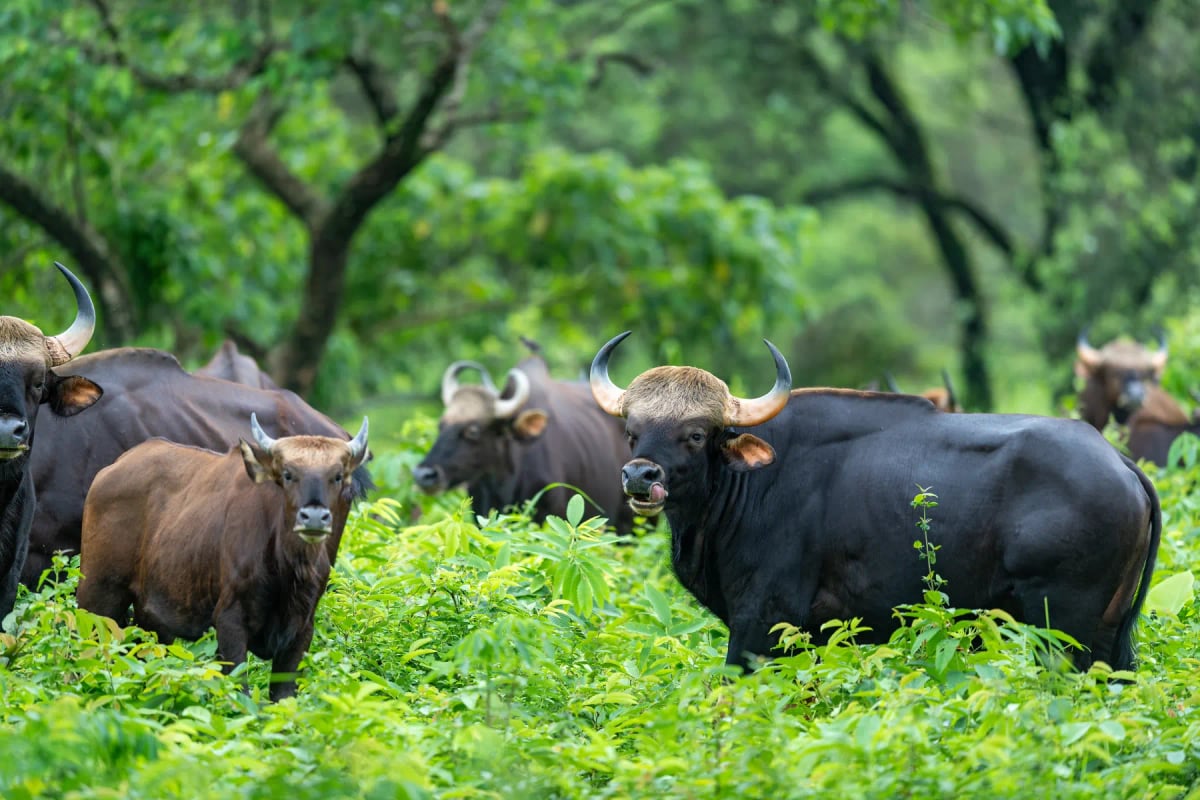
The gaur (Bos gaurus) is the largest wild bovine on Earth and one of the most impressive mammals in Asia. Found across South and Southeast Asia, it lives in evergreen forests, deciduous woodlands, and grassy hills. Adult males stand up to 220 cm at the shoulder and can weigh more than 1,500 kg, making them heavier than any domestic bull. The coat is dark brown to nearly black, with pale lower legs that look almost white. A steep, muscular ridge runs over the shoulders, giving the animal a distinctly powerful profile. Both sexes carry thick, curved horns. Gaurs browse on grasses, bamboo shoots, leaves, and fruit, often feeding at forest edges in the early morning and evening. They live in herds of around 10 to 30 animals led by a senior female. Habitat loss, livestock diseases, and poaching have pushed the species to Vulnerable status on the IUCN Red List.
Habitat and distribution
Gaurs range across a broad sweep of South and Southeast Asia, from India, Nepal, and Bhutan through Myanmar, Thailand, Cambodia, Laos, Vietnam, Malaysia, and into parts of southern China. They favour a mix of evergreen forest, deciduous woodland, and open glades where grasses grow tall at the edges of the trees. Hilly terrain up to around 2,500 metres suits them well, provided thick cover is nearby. They tend to avoid wide open plains with little shade and densely farmed lowlands where human activity is constant. Salt licks are important gathering points, and gaurs will travel considerable distances to reach them. Populations have become fragmented across much of their former range, and the largest numbers today are found in protected areas of India, particularly in the Western Ghats and central Indian forests.
Diet
Feeding takes up a large part of the gaur's day, and its diet shifts with the seasons. Coarse grasses make up the bulk of what it eats, but gaurs also browse on bamboo shoots, leaves, bark, and a variety of shrubs and herbs. Fallen fruit is eaten when available. In the dry season, when fresh grass is scarce, the animals rely more heavily on leaves and woody plants. Gaurs are most active at dawn and in the late afternoon, moving to open forest edges and clearings to graze. They need to drink daily and are rarely found far from a reliable water source. Minerals from soil and natural salt licks also form a regular part of their intake, helping to meet nutritional needs that grasses alone cannot fully satisfy.
Behavior
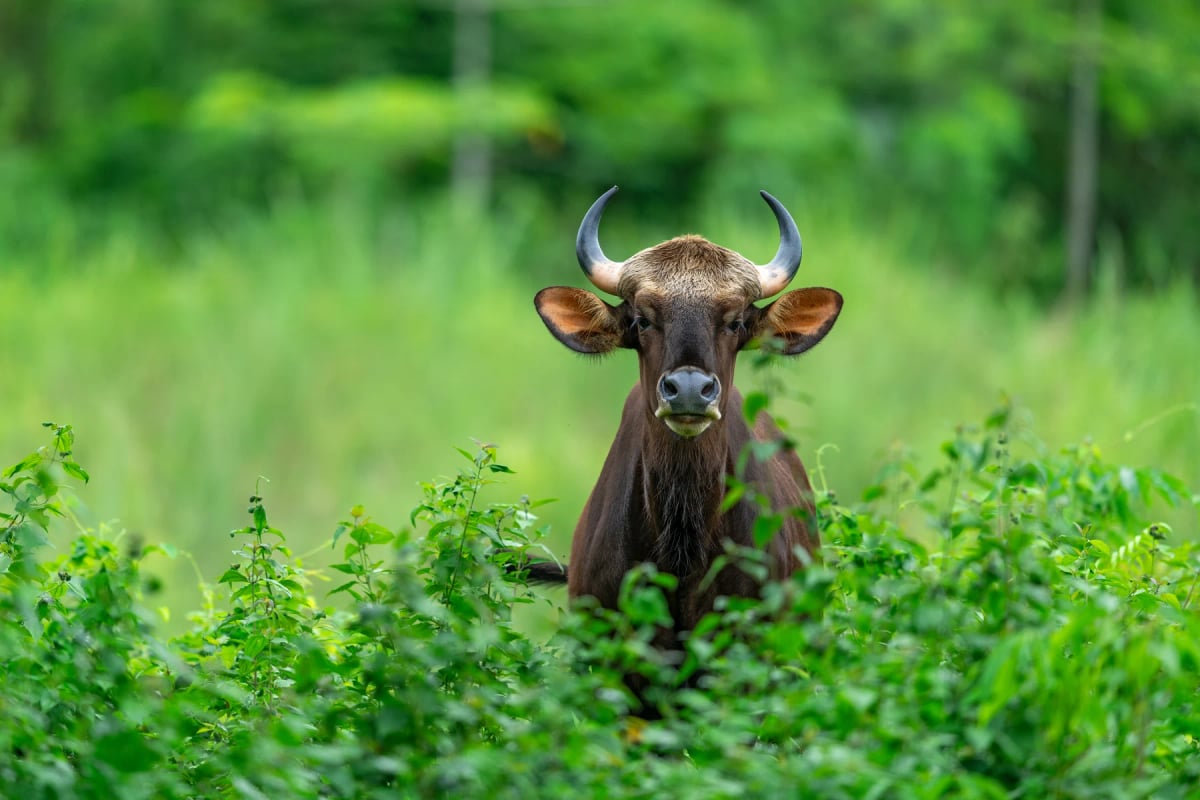
Gaurs are social animals that live in herds typically numbering between 10 and 30 individuals. A senior female leads the group and guides decisions about where to move and feed. Adult bulls often spend time on their own or in small bachelor groups, joining female herds only during the breeding season. Despite their enormous size, gaurs are generally cautious around people and will retreat into thick forest if disturbed. However, a cornered or wounded gaur can be extremely dangerous. Communication within the herd includes a range of calls: a clear, resonant whistle signals alarm, while a low moo is used in calmer situations. Calves are born after a gestation of roughly 270 to 280 days and stay close to their mothers for their first year of life.
Physical characteristics
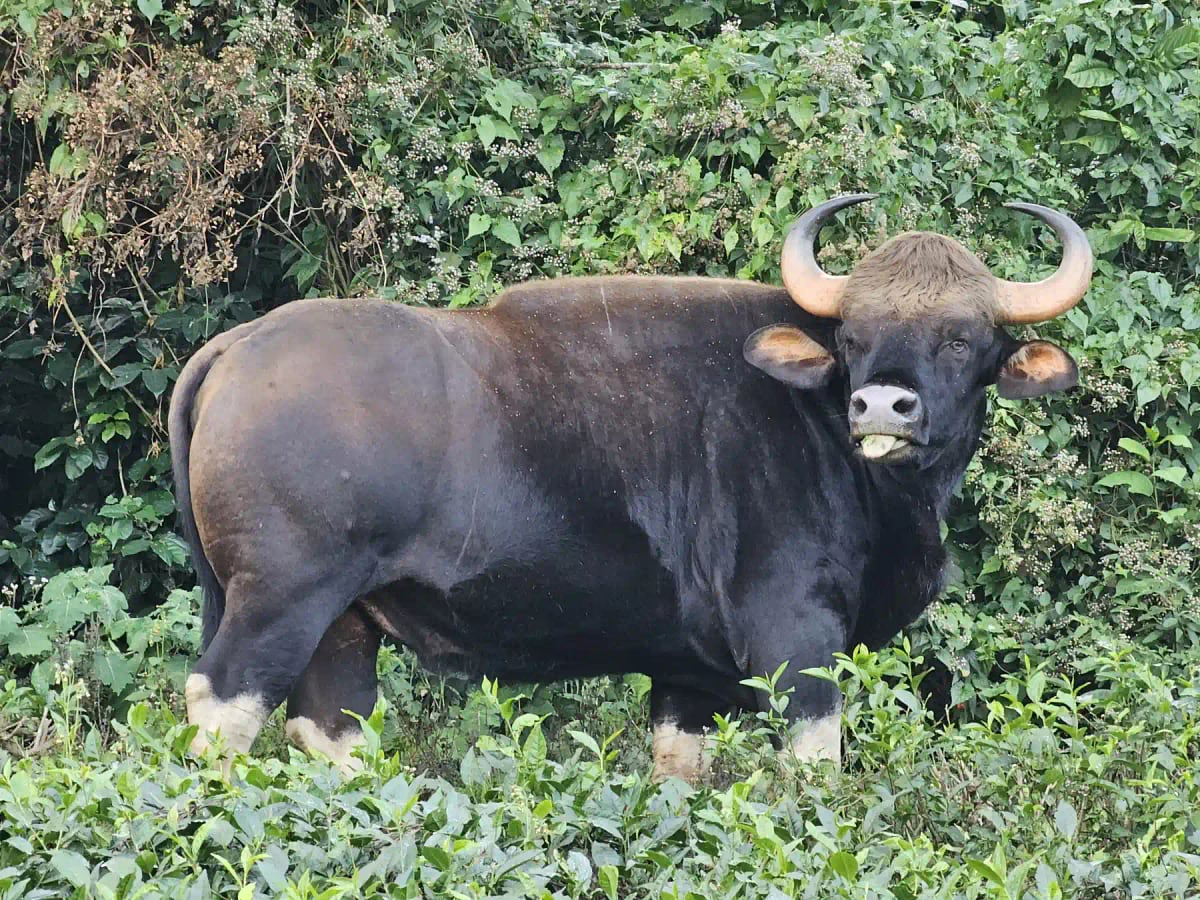
Among all wild bovines on Earth, the gaur stands out as the largest. Adult males can reach 220 cm at the shoulder and tip the scales at over 1,500 kg, easily outweighing a domestic bull. The body is covered in a coat that ranges from deep brown to almost black, contrasting sharply with the lower legs, which are pale cream or white, as if the animal were wearing stockings. A high, muscular ridge runs from the neck to the middle of the back, formed by elongated vertebrae, and gives the gaur its distinctively powerful silhouette. Both males and females carry thick horns that curve upward and inward, pale yellow at the base and dark at the tips. Females are noticeably smaller than males but share the same striking coloration and horn shape.
Conservation
The IUCN lists the gaur as Vulnerable, and its numbers have fallen by more than 70 percent over the past three generations according to survey data. The main pressures are the loss of forest cover to agriculture and logging, poaching for meat and traditional medicine, and diseases such as rinderpest and foot-and-mouth disease passed on by domestic cattle grazing near wild populations. Protected areas like Nagarhole, Kaziranga, and the Cardamom Mountains have become vital refuges. Across its range, conservation work focuses on reducing conflict with livestock herders, strengthening anti-poaching patrols, and restoring wildlife corridors that connect fragmented forest patches. Captive breeding programmes also exist, though the best hope for the species over the long term lies in securing and expanding wild habitat.
Where it is found
The Gaur can be found in places such as:
Researched and written by Juan Pablo. Sources: IUCN Red List, scientific literature and regional field guides. Last updated: .
Technical factsheet


Frequently Asked Questions
What does a gaur eat?
Gaurs eat mostly coarse grasses, but they also feed on bamboo shoots, leaves, bark, shrubs, and fallen fruit. In the dry season, when fresh grass is hard to find, they rely more on leaves and woody plants. They need to drink every day, so they stay close to water sources. Minerals from natural salt licks are also a regular part of their diet.
How big is a gaur?
The gaur is the largest wild bovine on Earth. Adult males can stand up to 220 cm at the shoulder and weigh more than 1,500 kg, which is heavier than any domestic bull. Females are noticeably smaller but still very large animals. A tall muscular ridge along the back, formed by elongated vertebrae, makes the gaur look even more imposing.
Where do gaurs live?
Gaurs are found across South and Southeast Asia, including India, Nepal, Bhutan, Myanmar, Thailand, Cambodia, Laos, Vietnam, Malaysia, and parts of southern China. They prefer evergreen forests, deciduous woodlands, and grassy clearings, especially in hilly areas. They avoid open plains and heavily farmed land. Today, the largest populations live inside protected areas, particularly in the forests of India.
Are gaurs dangerous to humans?
Gaurs are generally shy and will move away from people if they sense them nearby. But if one is cornered or injured, it can become very dangerous. Given their enormous size and strength, a charging gaur is a serious threat. In areas where humans and gaurs share the same land, encounters do happen, though unprovoked attacks are rare.
Why is the gaur endangered?
The gaur is listed as Vulnerable by the IUCN, and its population has dropped by more than 70 percent over the past three generations. The main threats are the loss of forest to farming and logging, poaching for meat and traditional medicine, and diseases like foot-and-mouth disease spread by domestic cattle. Fragmented habitats make it harder for populations to recover and connect with one another.
How do gaurs behave in a herd?
Gaurs live in herds of around 10 to 30 animals led by a senior female, who guides the group to food and water. Adult males often roam alone or in small groups, only joining the herd during the breeding season. Gaurs communicate through calls: a sharp whistle means danger, while a soft moo signals calm. Calves stay close to their mothers for the first year of life.
What is the difference between a gaur and a gayal?
The gayal, also known as the mithun, is a domesticated form of the gaur. Over many centuries, people in northeastern India and parts of Southeast Asia bred gaurs in captivity for use in ceremonies, trade, and as a source of meat. The gayal looks similar to the gaur but tends to be smaller and less muscular. Wild gaurs and gayals can interbreed where their ranges overlap.