Himalayan Monal
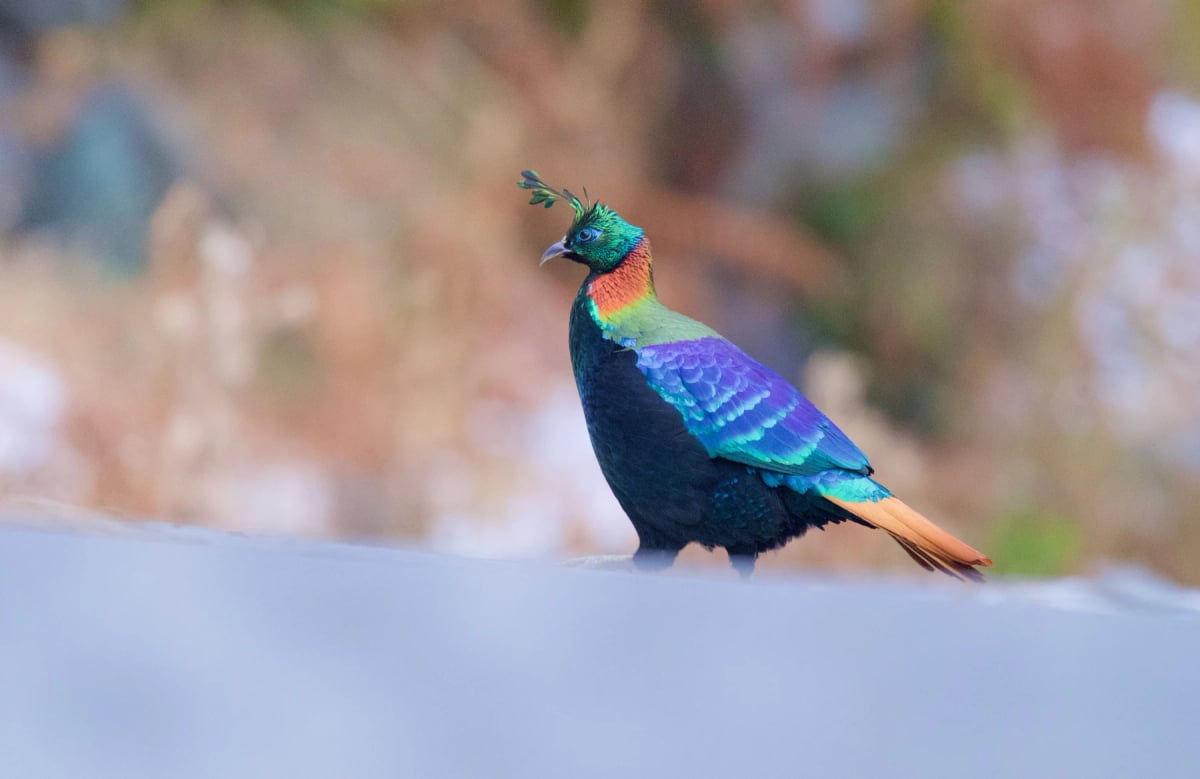
The Himalayan monal is one of the most brilliantly colored birds on Earth. Males carry a coat of iridescent feathers in metallic greens, deep blues, rich copper, and purple that shifts in the mountain light, along with a fan-shaped crest on their head. Females are dressed in warm brown tones that help them blend into rocky slopes. This large pheasant lives across the Himalayas and surrounding ranges, from Afghanistan east to Myanmar, at elevations between roughly 2,500 and 4,500 meters. It digs into soil and snow with its sturdy, curved bill to uncover roots, tubers, bulbs, insects, and seeds. Most active during the day, birds typically move in pairs or small groups. Nepal has honored it as the national bird. The IUCN considers the species to be of least concern, though hunting and habitat disturbance remain localized pressures.
Habitat and range
The Himalayan monal spans a vast arc of mountain country, from the ranges of Afghanistan and Pakistan eastward through India, Nepal, Bhutan, southern Tibet, and into northern Myanmar. It is a bird of high elevations, typically found between 2,500 and 4,500 meters above sea level, though it can descend lower in winter when deep snow covers its feeding grounds. Through the warmer months it favors open alpine meadows, rocky slopes with scattered scrub, and the upper edges of conifer and rhododendron forest. These mixed environments provide both foraging ground and shelter. Birds tend to move downslope as temperatures drop, retreating to denser forest belts where snow cover is lighter and food is easier to reach.
Appearance and dimorphism
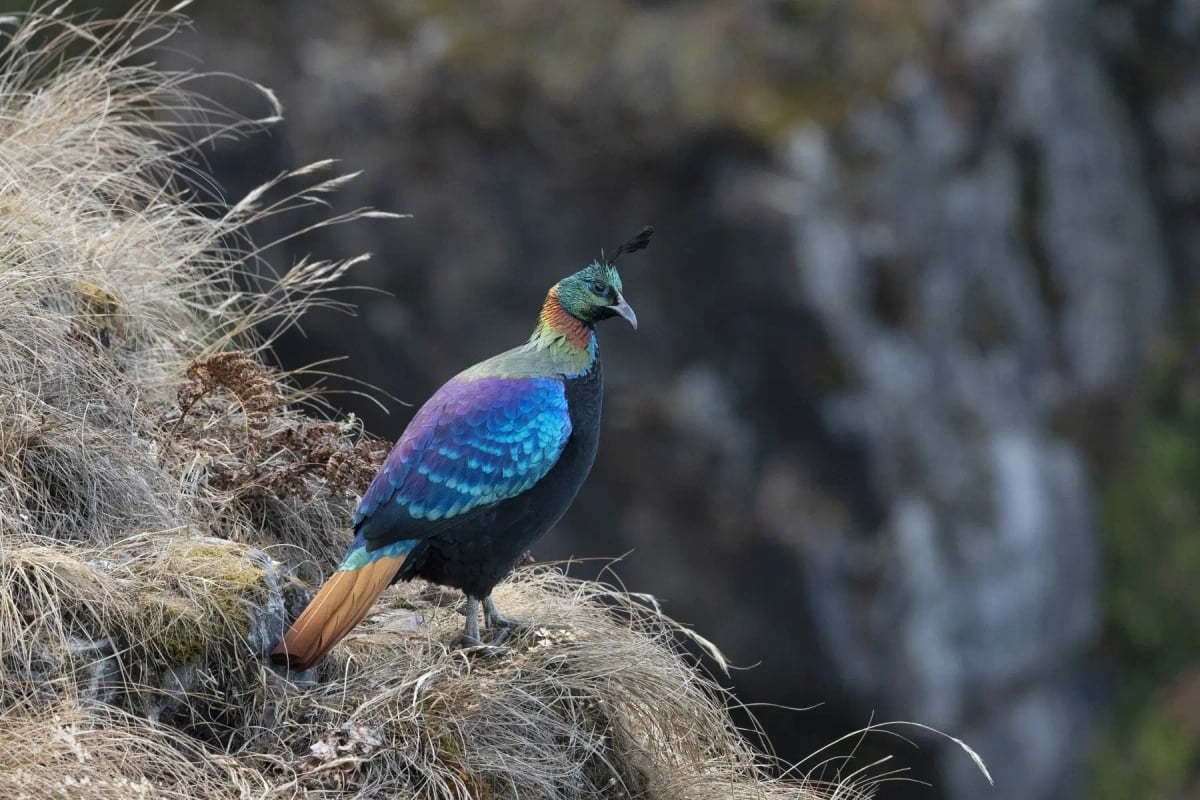
Few birds in the world are as striking as the male Himalayan monal. His plumage combines metallic greens, deep cobalt blue, rich copper on the back, and hints of purple, all of it shifting color as the mountain light changes angle. A fan of feathers curves forward from the crown into a distinctive crest that bobs as he walks. The bare skin around his eye is a vivid turquoise. Females look entirely different. Their plumage is a warm mix of brown, buff, and white, streaked in patterns that break up their outline against bare rock and scrub. This difference in appearance between the sexes, known as sexual dimorphism, is among the most pronounced of any pheasant species found across Asia.
Diet
Foraging takes up a large part of the Himalayan monal's day. Its sturdy, curved bill works like a small pick, breaking into hard soil, lifting rocks, and probing beneath snow to expose food hidden below the surface. Roots, tubers, and bulbs make up much of what it eats, particularly in colder months when other food is scarce. It also takes seeds, berries, and a range of invertebrates including grubs and insects. In spring and summer, when the alpine ground softens, birds can dig surprisingly deep holes in pursuit of a single root. This digging behavior can be so thorough that patches of turned earth often reveal where a monal has been feeding.
Behavior
Throughout the day the Himalayan monal moves steadily across slopes, pausing often to dig and probe the ground. It is active during daylight hours and tends to rest in trees or on rocky ledges at night. Outside the breeding season, birds gather in pairs or small loose groups, often working the same stretch of hillside together. When the breeding season arrives in spring, the behavior of males changes noticeably. They call loudly from prominent perches, producing a far-carrying whistle that echoes across mountain valleys. Display flights and posturing with fanned crest and wings spread wide are used to compete for females. The species generally avoids dense forest interiors, keeping to more open terrain where its foraging style is most effective.
Cultural significance
Nepal named the Himalayan monal its national bird, a status it has held since 1973. Known locally as the danphe, it appears on official emblems and holds a special place in Nepali identity. Across the broader Himalayan region the bird has long been admired, and its feathers were traditionally used to decorate the caps and headdresses of local communities in parts of Nepal, India, and Pakistan. This practice led to significant hunting pressure in past centuries. Today the collection of feathers is restricted or prohibited in most of its range countries. The monal also appears frequently in regional folklore and art, where its dazzling colors have made it a natural symbol of the richness of mountain life.
Conservation
The IUCN classifies the Himalayan monal as Least Concern, reflecting a population that remains broadly stable across most of its range. Protected areas in Nepal, India, and Bhutan provide important refuges, and the species adapts reasonably well to moderate levels of habitat disturbance. That said, pressures exist in certain areas. Hunting, both for feathers used in traditional ornamentation and for meat, has historically reduced numbers in accessible valleys. Livestock grazing can degrade alpine meadows that the monal depends on for foraging. Climate change also poses a concern over the long term, as warming temperatures may shift the vegetation zones these birds rely on to higher altitudes where suitable habitat eventually runs out. Continued monitoring and enforcement of hunting restrictions remain important conservation measures.
Where it is found
The Himalayan Monal can be found in places such as:
Researched and written by Juan Pablo. Sources: IUCN Red List, scientific literature and regional field guides. Last updated: .
Technical factsheet




Frequently Asked Questions
What does the Himalayan monal eat?
The Himalayan monal digs into soil and snow with its strong, curved bill to find roots, tubers, and bulbs. It also eats seeds, berries, and insects. In spring, when the ground softens, birds can dig surprisingly deep holes chasing a single root. This makes it one of the most dedicated diggers among all pheasant species found in Asia.
Where does the Himalayan monal live?
The Himalayan monal lives across a wide stretch of mountain country, from Afghanistan and Pakistan through India, Nepal, Bhutan, southern Tibet, and into northern Myanmar. It favors elevations between 2,500 and 4,500 meters, spending warmer months in alpine meadows and rocky slopes. In winter, it moves lower to find food in areas with lighter snow cover.
Is the Himalayan monal endangered?
No, the Himalayan monal is currently listed as Least Concern by the IUCN, meaning its population is broadly stable. However, it does face some localized pressures. Hunting for its feathers and meat has reduced numbers in certain valleys, and livestock grazing can damage the alpine meadows it depends on. Climate change may also become a serious threat over the long term.
Why is the Himalayan monal the national bird of Nepal?
Nepal officially named the Himalayan monal its national bird in 1973. Known locally as the danphe, it is deeply woven into Nepali culture and identity. The bird's extraordinary colors have made it a natural symbol of the richness of mountain life, and it appears on official emblems. Its presence across the Himalayas also reflects Nepal's remarkable natural heritage.
How does the male Himalayan monal attract a mate?
When breeding season arrives in spring, male Himalayan monals become very active in showing off. They call loudly from high, open perches, producing a far-carrying whistle that echoes across mountain valleys. They also perform display flights and spread their wings wide while fanning their crest. The male's dazzling iridescent plumage, which shifts color in the light, plays a central role in attracting females.
What is the difference between male and female Himalayan monals?
The difference is dramatic. Males have brilliant, metallic plumage in shades of green, blue, copper, and purple, along with a fan of feathers on their head and vivid turquoise skin around the eye. Females, on the other hand, are dressed in warm browns and buffs with streaked patterns that help them blend into rocky terrain. This difference in appearance between the sexes is one of the most striking among all Asian pheasants.
At what elevation does the Himalayan monal live?
The Himalayan monal is a true high-altitude bird, typically found between 2,500 and 4,500 meters above sea level. During the warmer months it stays near the upper edges of forests and open alpine meadows. As winter sets in and snow covers its feeding grounds, it moves downslope into denser forest zones where food is easier to reach beneath the lighter snow.