African Manatee
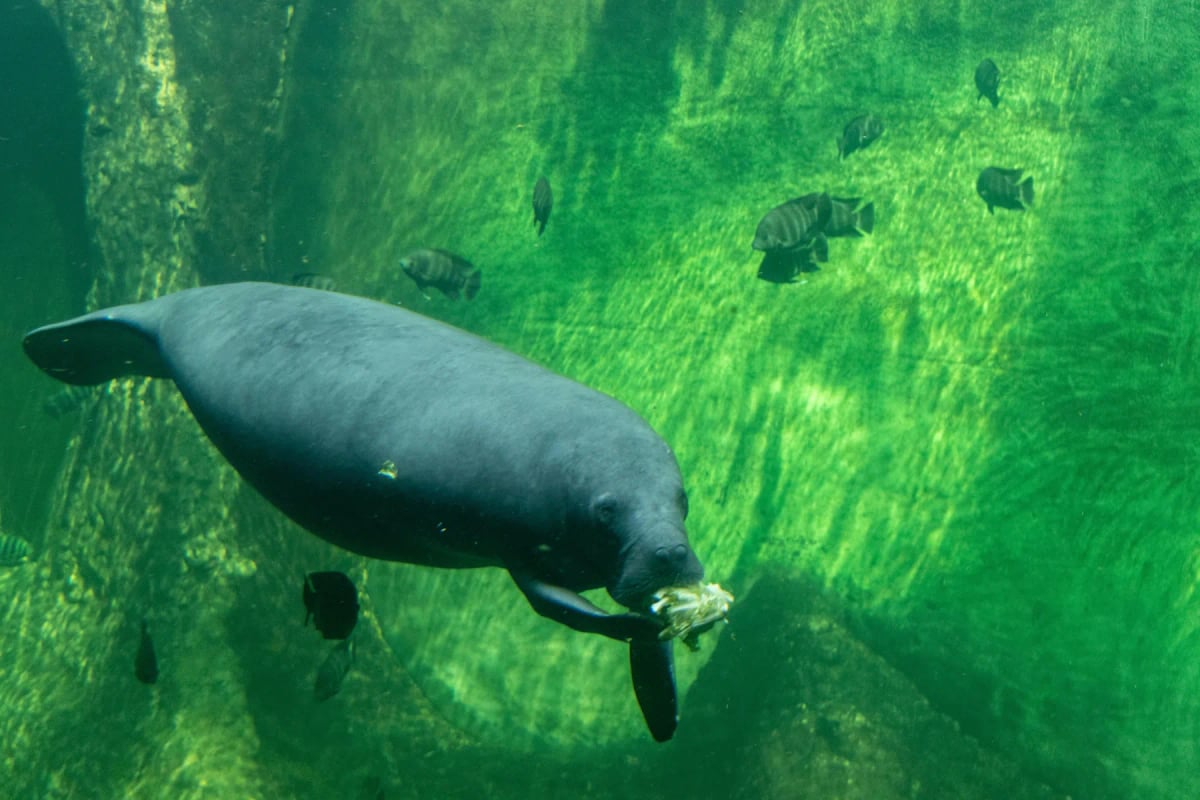
The African manatee is a large aquatic mammal found in rivers, estuaries and coastal lagoons across West and Central Africa. It can reach 4 meters in length and 500 kg in weight, feeding on aquatic plants and helping to keep waterways clear and productive. Shy by nature, it usually lives alone or in pairs and moves at a leisurely pace through calm waters. The IUCN lists it as Vulnerable, facing growing pressure from fishing nets, poaching, dam construction and habitat loss that continue to fragment its populations.
Habitat and range
The African manatee occupies a wide range of aquatic environments across western and central Africa, from Mauritania and Senegal in the north to Angola in the south. It moves freely between coastal marine waters, estuaries, tidal rivers and freshwater systems, making it the only sirenian able to tolerate such a broad range of salinity. Large river basins such as the Niger, Senegal and Congo carry isolated populations deep inland, and the species has been documented as far northeast as Lake Chad. It is rarely found in open ocean waters.
Appearance
The African manatee has a large rounded body that narrows toward a broad flat tail used for propulsion. Its skin is gray to dark brown, often wrinkled and patchy, and may carry algae growth on the surface. The muzzle is blunt and fleshy, lined with stiff bristles that help grasp aquatic vegetation. Two forelimbs have evolved into rounded flippers, each bearing small vestigial nails, while the hind limbs are completely absent. Adults typically reach between 3 and 4 meters in length and can weigh up to 500 kilograms.
Feeding
The African manatee is a dedicated herbivore that feeds on many types of aquatic plants. It grazes on submerged grasses, floating vegetation, mangrove leaves and overhanging plant matter along riverbanks. On rare occasions it has been observed consuming fish taken from nets, though plant material makes up virtually all of its diet. An adult can consume between eight and fifteen percent of its body weight in vegetation each day, making it an important regulator of aquatic plant growth across the river systems and lagoons it inhabits.
Behavior
The African manatee is primarily solitary, though it sometimes forms loose groups at food sources or during the breeding season. It surfaces to breathe every three to five minutes, but can remain submerged for up to twenty minutes when resting. Its movements are slow and deliberate, powered by the broad flat tail. Despite its calm appearance, it can accelerate quickly when alarmed. It communicates through squeaks and chirps, sounds that are especially important between mothers and their calves. Active at any hour of the day, it tends to rest in deeper water during the warmest parts of the afternoon.
Threats
The African manatee faces a combination of pressures that have pushed its populations into a fragmented and declining state. Accidental entanglement in artisanal fishing nets is one of the leading causes of death, and in many communities the animals are kept for meat rather than released. Direct hunting for bushmeat remains common across much of its range, with manatee meat considered a delicacy in some areas. Dam construction disrupts migration routes and isolates populations in disconnected river sections. Water pollution from agriculture and mining, combined with the destruction of wetlands and riparian vegetation, continues to degrade the habitat it depends on.
Conservation
The African manatee is listed on Appendix II of CITES and protected under national legislation in most range countries, though enforcement remains inconsistent. Research is constrained by the animal's secretive habits and the remoteness of many river systems, making accurate population estimates difficult. Community programs in countries such as Senegal, Guinea-Bissau and Nigeria train fishers to release accidentally caught animals and advocate for protected river zones. Protecting wild habitat and reducing hunting pressure remain the most urgent priorities, as the species reproduces slowly and populations cannot recover quickly once they decline.
Where it is found
The African Manatee can be found in places such as:
Researched and written by Juan Pablo. Sources: IUCN Red List, scientific literature and regional field guides. Last updated: .
Technical factsheet
Frequently Asked Questions
Where does the African manatee live?
The African manatee is found in rivers, estuaries and coastal lagoons across West and Central Africa, from Mauritania and Senegal in the north to Angola in the south. It is the only sirenian that tolerates a wide range of salinity, moving freely between saltwater and freshwater. Large river systems such as the Niger, Senegal and Congo carry populations far inland, and the species has been recorded as far northeast as Lake Chad.
What does the African manatee eat?
The African manatee is a dedicated herbivore that feeds on submerged grasses, floating vegetation, mangrove leaves and plant matter along riverbanks. An adult can consume between eight and fifteen percent of its body weight in vegetation each day, making it an important regulator of aquatic plant growth. On very rare occasions it has been observed taking fish from nets, but plant material makes up virtually all of its diet throughout the year.
Is the African manatee endangered?
The African manatee is classified as Vulnerable by the IUCN. Its populations are declining across much of its range due to accidental entanglement in fishing nets, direct hunting for bushmeat, dam construction that isolates river populations, and habitat degradation from agriculture and mining. The species reproduces slowly, with females producing a single calf at a time, which means populations recover very slowly once they decline. Enforcement of existing protections remains inconsistent across most of its range.
How big is the African manatee?
The African manatee is one of the largest aquatic mammals in Africa, reaching up to 4 meters in length and weighing between 300 and 500 kilograms. Its body is large and rounded, narrowing toward a broad flat tail used for propulsion. Despite its size, it moves slowly and calmly through the water, feeding on aquatic vegetation. It can accelerate quickly when alarmed but spends most of its time grazing and resting in calm, shallow waters.
How does the African manatee breathe?
The African manatee is a mammal and breathes air, surfacing every three to five minutes under normal activity. When resting at the bottom, it can remain submerged for up to twenty minutes. It rises slowly to the surface, takes a breath through nostrils on top of its snout, and descends again. This breathing pattern makes it vulnerable to entanglement in fishing nets, since a trapped manatee cannot reach the surface and will drown within minutes.
What are the main threats to the African manatee?
The African manatee faces several combined threats across its range. Accidental entanglement in artisanal fishing nets is one of the leading causes of death, and many captured animals are kept for food rather than released. Direct hunting for bushmeat is common in parts of West and Central Africa, where manatee meat is considered a delicacy. Dam construction disrupts migration routes and isolates populations. Water pollution from agriculture and mining, along with the loss of wetlands and riverside vegetation, continues to degrade its habitat.