Dromedary Camel
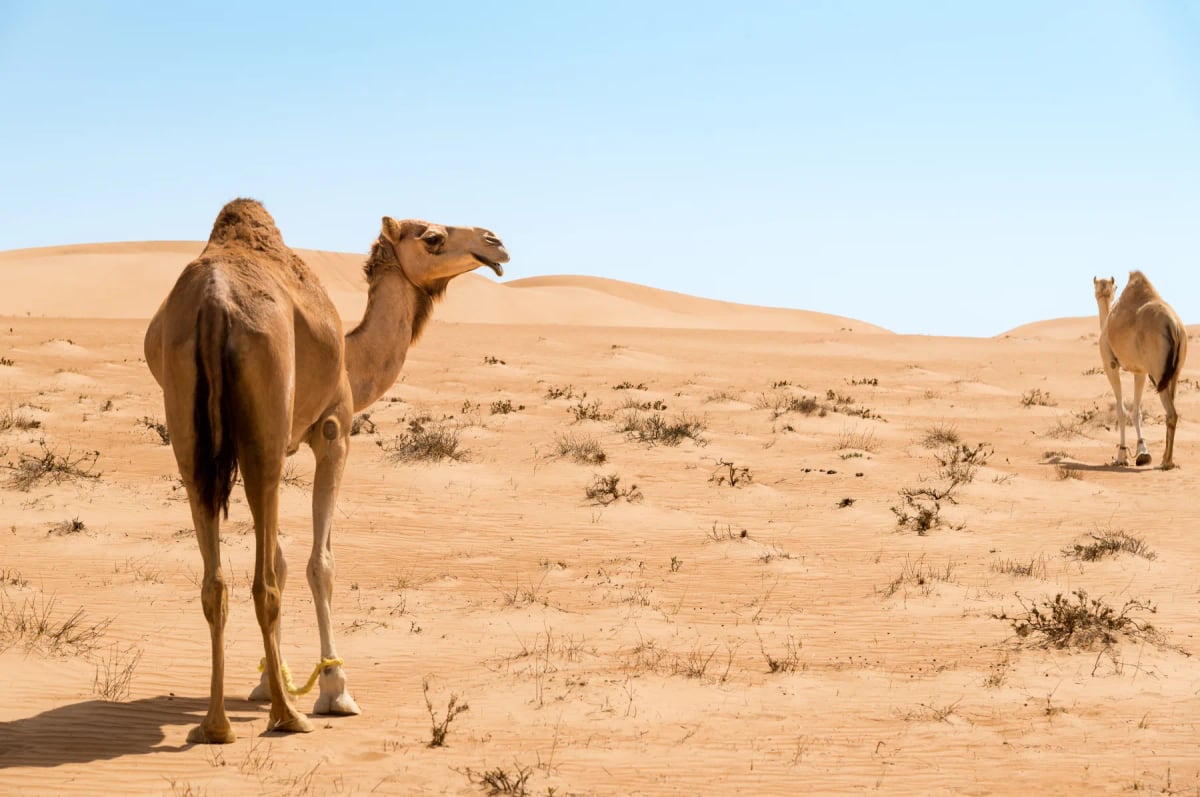
The dromedary camel is the only camel species with a single hump, which stores fat rather than water. That fat reserve is converted into energy and water during long periods without food or drink, letting the animal go up to two weeks without water under mild conditions. Its body temperature swings several degrees throughout the day, which reduces the need to sweat and conserves moisture. Wide, cushioned feet spread its weight across loose sand, and thick eyebrows and closable nostrils keep out blowing dust. Adults stand up to two metres at the shoulder and can carry loads of around 200 kilograms for sustained distances. Domesticated for roughly 4,000 years, dromedaries remain vital across arid regions of Africa, the Middle East, and South Asia for transport, milk, and meat. A separate feral population of several hundred thousand animals also thrives in the Australian outback.
Desert adaptations
Few animals are as well suited to extreme heat and drought as the dromedary. Its single hump holds a reserve of fat, not water, that the body breaks down into both energy and moisture when food and drink run scarce. Body temperature rises through the heat of the day and falls overnight, which means the animal sweats far less than most mammals and loses very little water in the process. The broad, padded feet act like natural snowshoes on loose sand, spreading the animal's weight so it does not sink. Thick brows shade the eyes from glare, and the nostrils can seal almost completely shut during a sandstorm. When water is finally available, a dromedary can drink over 100 litres in a single session to rehydrate rapidly.
Role with humans
Humans first domesticated the dromedary on the Arabian Peninsula around 4,000 years ago, and the partnership has shaped life across deserts ever since. Capable of carrying loads of roughly 200 kilograms over long distances, dromedaries made cross-desert trade routes possible long before modern transport existed. Their milk is highly nutritious, stays fresh longer than cow's milk in hot climates, and remains a dietary staple for many communities across the Horn of Africa and the Arabian Peninsula. Meat, wool, and hides add further value to the animal. In countries such as Saudi Arabia, the UAE, and Somalia, camel racing and beauty contests draw large crowds and serious prize money. The dromedary is not simply a working animal. It is a cultural symbol woven into poetry, religion, and daily life.
Distribution
Wild dromedaries no longer exist. The species survives today entirely through its domesticated and feral populations. Domesticated herds are spread across a broad belt of arid and semiarid land stretching from Morocco and Mauritania in the west, through North Africa and the Horn of Africa, across the Arabian Peninsula, and into Iran, Pakistan, and northwestern India. Central Asian countries including Kazakhstan, Uzbekistan, and Turkmenistan also keep dromedaries, though in smaller numbers. The most remarkable feral population lives in Australia, where camels imported during the 19th century to help explore the interior were released or escaped as roads and railways took over. That population has grown to several hundred thousand animals and now roams across the arid interior of South Australia, Western Australia, and the Northern Territory.
Behavior
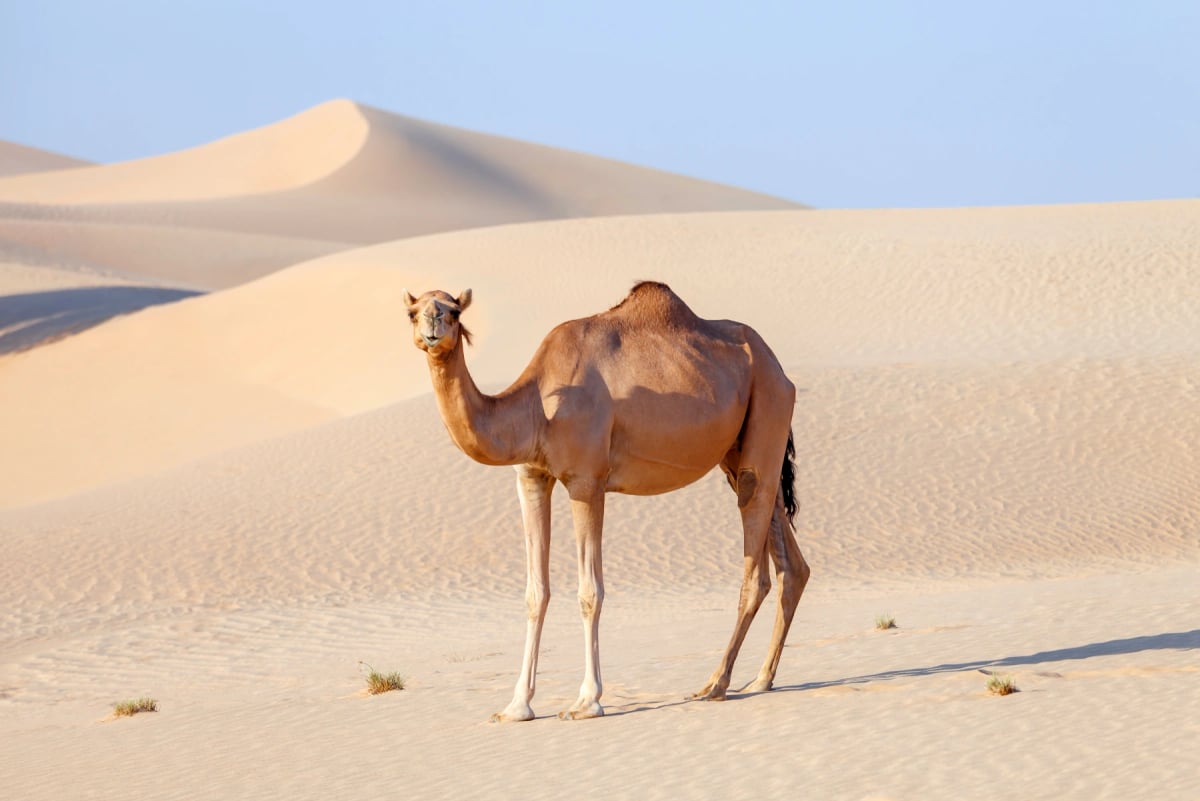
Dromedaries are social animals that naturally form groups, and domesticated herds are managed by herders who guide their movements between grazing areas and water sources. They are generally calm and cooperative, though males become unpredictable and aggressive during the annual breeding season known as rut, sometimes inflating a soft palate sac called a dulla to produce deep gurgling sounds. Females give birth to a single calf after a gestation of around 13 months, and the bond between mother and calf is strong. In Australia, feral dromedaries organize themselves into fluid groups of females with young, while older males tend to be solitary or gather in small bachelor groups. Both domesticated and feral animals are most active during the cooler parts of the day and rest in the shade when temperatures peak.
Conservation
Because the dromedary exists only as a domesticated or feral species, it faces no extinction risk in the conventional sense. Globally, numbers are large and stable, with estimates placing the world population at around 35 million animals. That said, pressures do exist. In parts of the Middle East and South Asia, trucks and motorcycles have replaced camels as a means of transport, reducing the incentive for herders to maintain large herds. Overgrazing around permanent water sources can degrade fragile desert vegetation over time. In Australia, the feral population has grown large enough to damage native ecosystems and water infrastructure, prompting government culling programs and mustering efforts to bring numbers under control. The dromedary's story is therefore one of abundance rather than scarcity, though responsible management matters on both sides of the equation.
Where it is found
The Dromedary Camel can be found in places such as:
Researched and written by Juan Pablo. Sources: IUCN Red List, scientific literature and regional field guides. Last updated: .
Technical factsheet



Frequently Asked Questions
What do dromedary camels eat?
Dromedaries are not picky eaters. They graze on grasses, leaves, thorny shrubs, and dried vegetation that most other animals avoid. They can even eat saltbush and other plants with high salt content. When food is scarce, the fat stored in their hump provides energy to keep them going. In domesticated settings, herders also feed them dates, grains, and hay.
How long can a dromedary camel go without water?
Under mild conditions, a dromedary can survive up to two weeks without drinking. In intense desert heat, that window shortens considerably. Their body temperature shifts several degrees throughout the day, which reduces sweating and conserves moisture. When they finally reach water, they can drink more than 100 litres in a single session, rehydrating faster than almost any other large mammal.
What is the hump of a dromedary camel for?
The hump stores fat, not water, as many people assume. That fat is broken down by the body into both energy and moisture during long stretches without food or drink. A well-fed camel has a firm, upright hump. After a long journey with little food, the hump shrinks and may lean to one side. It recovers once the animal eats and rests properly.
Where do dromedary camels live?
Dromedaries thrive in arid and semiarid regions across North Africa, the Horn of Africa, the Arabian Peninsula, and South Asia as far as northwestern India. All living dromedaries are either domesticated or feral. The most surprising population is in Australia, where descendants of camels brought over in the 1800s now roam wild across the outback, numbering in the hundreds of thousands.
Are dromedary camels dangerous?
Dromedaries are generally calm and manageable, but they can become unpredictable during the breeding season. Males in rut may bite, kick, or spit, and their size alone makes them capable of causing serious injury. Outside of that period, domesticated animals are usually cooperative and even affectionate toward familiar handlers. Feral dromedaries in Australia tend to keep their distance from people.
How long do dromedary camels live?
Dromedaries typically live between 40 and 50 years in captivity, though many working animals have shorter lives due to the physical demands placed on them. In the wild feral population in Australia, lifespans tend to be shorter because of environmental pressures and competition for resources. Females reach reproductive maturity at around three to four years of age and give birth to one calf at a time.
Why are there wild camels in Australia?
Australia has no native camels. During the 1800s, dromedaries were imported from Afghanistan, India, and the Middle East to help explorers and settlers cross the vast dry interior. When railways and motor vehicles took over, many animals were released or simply escaped into the outback. With no natural predators and plenty of space, the population grew steadily and now stands at several hundred thousand.