Bonobo
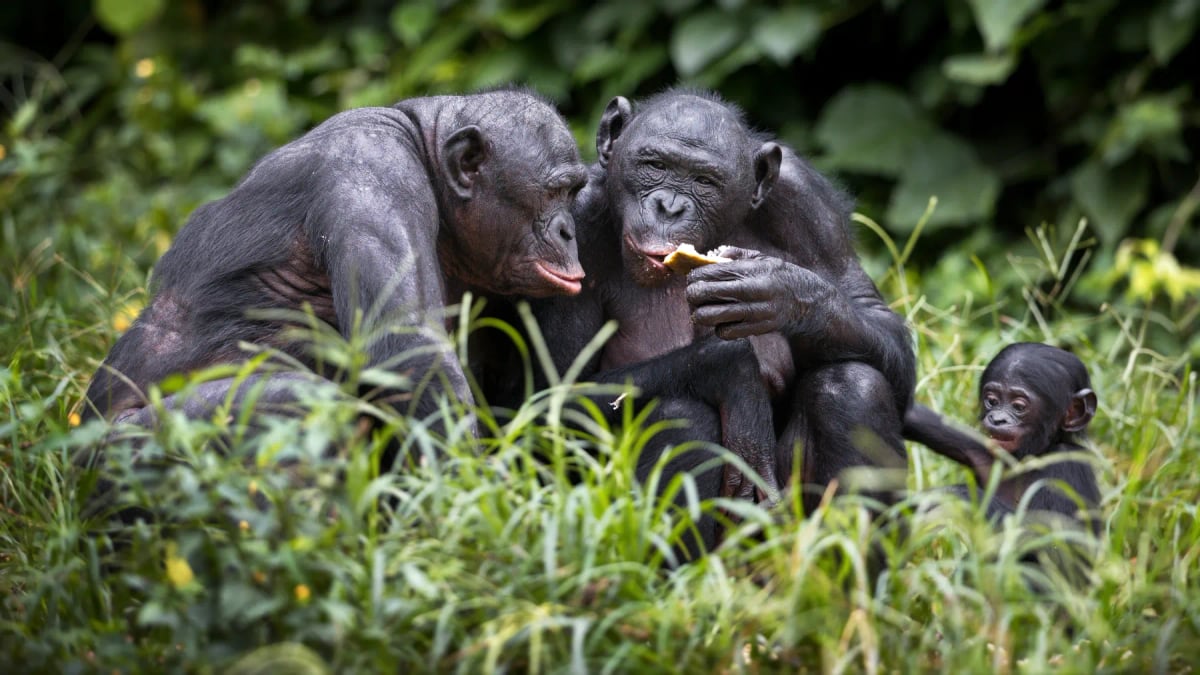
The bonobo is one of humanity's two closest living relatives, sharing roughly 98.7% of our DNA alongside the common chimpanzee. Found only south of the Congo River in the Democratic Republic of Congo, it inhabits dense lowland rainforests that have remained largely isolated for thousands of years. Bonobos have a slender build, a dark face, and a notably upright posture compared to other great apes. Their diet centers on fruit, particularly figs, but also includes leaves, roots, bark, fungi, and occasionally small invertebrates. Society is organized around dominant females, whose alliances keep group tensions low. Rather than resorting to aggression, bonobos rely on affiliative contact to ease conflict and reinforce social bonds. The species is listed as Endangered by the IUCN, with habitat loss from logging, hunting for bushmeat, and prolonged civil instability in the Congo Basin posing the gravest risks to its survival.
Habitat and distribution
Bonobos are found exclusively in the Democratic Republic of Congo, in the vast lowland rainforests that stretch south of the Congo River. This great river acts as a natural boundary that has kept bonobos geographically isolated from chimpanzees for hundreds of thousands of years. Their range covers a substantial portion of the Congo Basin, one of the largest and most biodiverse tropical forest systems on Earth. Bonobos favor dense, humid primary forest at lower elevations, though they also move through secondary forest and swampy areas near rivers. Researchers estimate that suitable habitat still covers hundreds of thousands of square kilometers, yet much of it is difficult to survey due to its remoteness. Core populations are concentrated in areas such as the Salonga National Park and the Lomami Basin.
Built for the treetops and social life
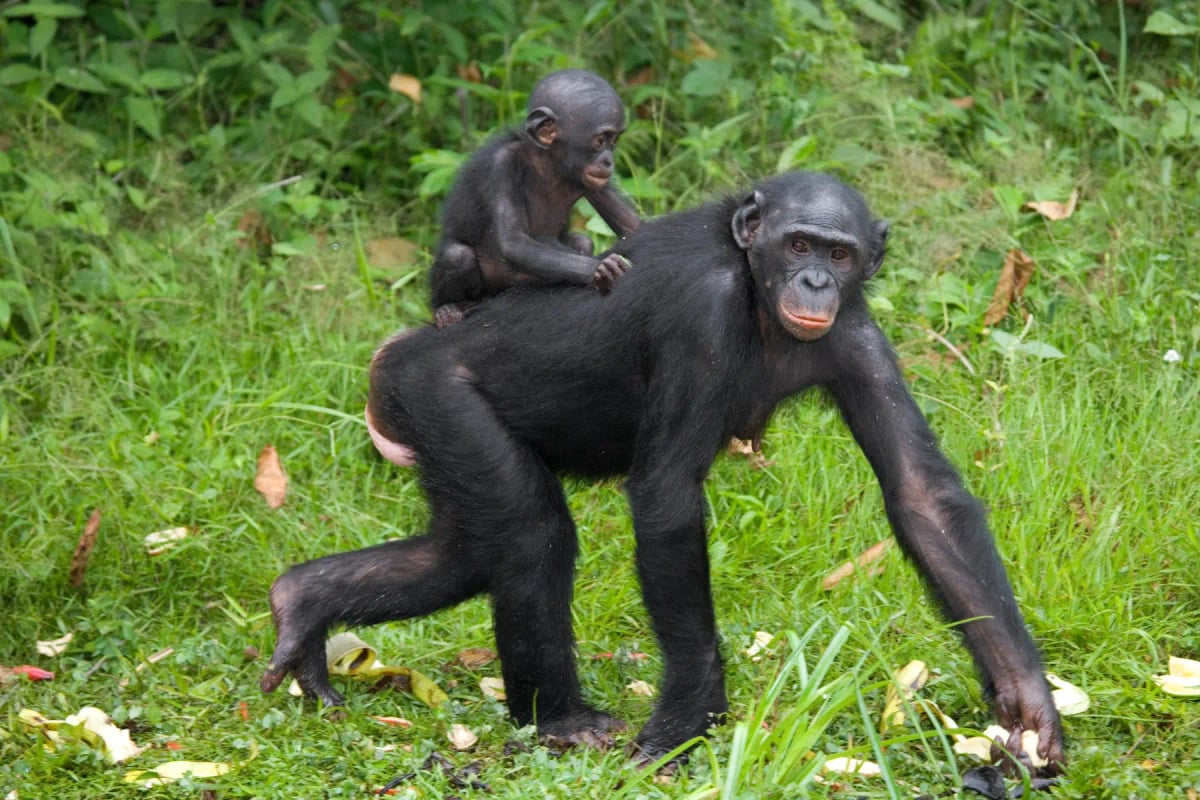
Bonobos are well suited to life in dense tropical forest. Their long, powerful arms and flexible hip joints allow them to climb with ease and travel through the canopy in search of ripe fruit. Compared to chimpanzees, bonobos have a more slender body, longer legs relative to their torso, and a smaller head, giving them a more upright stance both in the trees and on the ground. Their dark faces and pink lips are distinctive from birth. Bonobos possess a remarkable capacity for reading social cues, including the emotional states of others, which supports the complex affiliative behaviors that define their society. Their digestive system handles a heavily fruit based diet efficiently, though they supplement nutrition with leaves, pith, and occasionally small invertebrates when preferred foods are scarce.
Behavior and social life
Bonobo society is structured around females, who form strong coalitions that give them significant influence over group dynamics, an arrangement rare among great apes. Groups typically number between ten and a hundred individuals, though they often split into smaller parties to forage and reunite later, a pattern known as fission fusion. Males remain with their birth group throughout life and their social rank is closely tied to their mother's standing. Bonobos manage conflict through affiliative contact rather than physical aggression, maintaining group cohesion in ways that set them apart from chimpanzees. Vocalizations, facial expressions, and gestures form a rich communication system. Young bonobos have a long developmental period, staying close to their mothers for several years, during which they learn the social rules and foraging strategies they will rely on throughout their lives.
Conservation
The bonobo is listed as En peligro by the IUCN, with the total wild population estimated at somewhere between 15,000 and 50,000 individuals, though precise counts remain elusive given the inaccessibility of much of their range. The primary threats are habitat destruction driven by logging and agricultural expansion, and hunting for bushmeat, which has intensified alongside growing human populations in the Congo Basin. Decades of civil conflict in the Democratic Republic of Congo have weakened law enforcement in protected areas and disrupted conservation programs. Salonga National Park, a UNESCO World Heritage Site, provides critical protection, and organizations such as the Bonobo Conservation Initiative work with local communities to establish community reserves. Sustainable conservation in this region depends on improving local livelihoods and governance alongside direct protection of forest habitat.
Researched and written by Juan Pablo. Sources: IUCN Red List, scientific literature and regional field guides. Last updated: .
Technical factsheet





Frequently Asked Questions
How closely related are bonobos to humans?
Bonobos are one of our two closest living relatives, sharing roughly 98.7% of their DNA with humans. The other is the common chimpanzee. This remarkable genetic proximity means bonobos share a number of traits with us, including complex emotional lives, the ability to learn symbolic communication in research settings, and a capacity for empathy that researchers consider genuinely comparable to our own.
What do bonobos eat?
Fruit makes up the core of a bonobo's diet, with figs being a particular favorite. They round out their meals with leaves, roots, bark, and fungi. When fruit is harder to find, they may also eat small invertebrates such as worms or insect larvae. Unlike chimpanzees, bonobos are not known for hunting other mammals, which reflects both their forest environment and their generally less aggressive social style.
How big do bonobos get?
Adult bonobos typically weigh between 30 and 60 kilograms, with males being somewhat larger than females. They stand roughly 70 to 83 centimeters tall when upright. Despite their muscular build, they are noticeably more slender than chimpanzees. Their longer legs and upright posture give them a silhouette that, among all non-human primates, looks most similar to that of a human being.
How long do bonobos live?
In the wild, bonobos are believed to live around 40 years, though precise data is limited given how difficult these animals are to study in remote forest. In captivity, some individuals have reached their late 50s. They have a slow reproductive rate, with females typically giving birth to a single infant every five to six years, which makes population recovery from any losses especially slow.
Are bonobos dangerous to humans?
Bonobos are wild animals and, like all great apes, capable of causing serious injury if threatened or cornered. That said, they have a well-documented tendency to respond to tension with affiliative rather than aggressive behavior, making unprovoked attacks rare. Indigenous forest communities in the Congo have coexisted alongside bonobos for generations. Researchers who study them in the field describe them as generally curious and tolerant compared to other great apes.
Why do bonobos only live in one country?
The Congo River is the key reason. This massive waterway forms a natural barrier that bonobos, unlike many other animals, have never crossed in large numbers. Over hundreds of thousands of years, the population south of the river evolved separately from the ancestors of chimpanzees to the north, eventually becoming a distinct species. No other country shares the habitat south of the Congo River where bonobos are found.
How do bonobos communicate?
Bonobos use a rich combination of vocalizations, facial expressions, and body gestures to communicate with one another. Their calls range from high-pitched peeps used in friendly contact to loud screams during moments of excitement or alarm. They are also notable for their use of gesture to direct the attention of others. In research settings, some bonobos have demonstrated an ability to associate symbols with objects and actions, pointing to a sophisticated capacity for reference.