Iguana
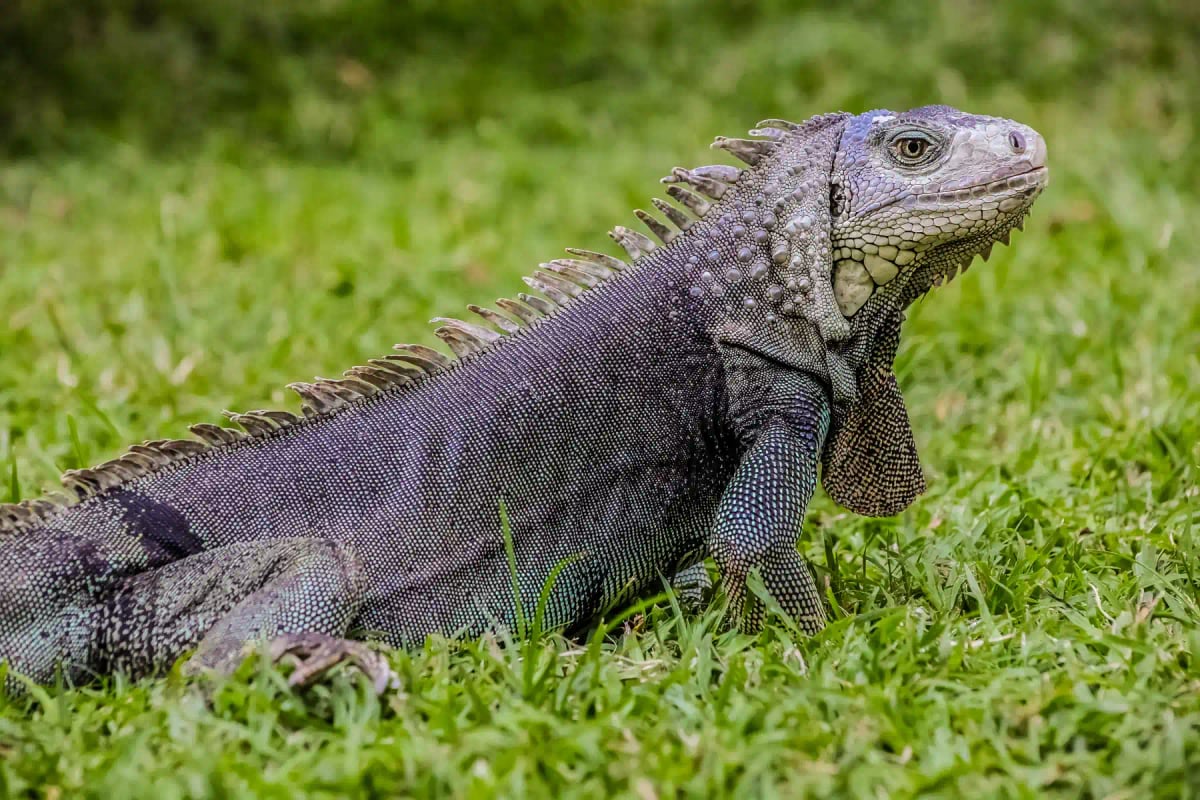
The green iguana is a large arboreal lizard native to Central and South America and the Caribbean. Recognized by its vivid green scales, a spiny crest running along the back and a long lashing tail, it can exceed 1.5 meters from snout to tail tip. Primarily herbivorous, it feeds on leaves, flowers and fruit and plays an important role in seed dispersal across tropical forests. It spends long hours basking to regulate body temperature and is an agile climber and swimmer. Although widely distributed and listed as Least Concern, it faces hunting pressure for meat, capture for the pet trade, and has established invasive populations in Florida, Hawaii and other regions.
Habitat and distribution
The green iguana thrives across a broad range of tropical and subtropical habitats from northern Mexico through Central America and into South America as far south as Paraguay and Brazil. It is most commonly found in lowland tropical forests, along riverbanks and in coastal vegetation where trees grow directly over water. It favors areas near permanent water sources, which allow it to escape predators by diving from branches and swimming away. Outside its native range, feral populations have established in Florida, Hawaii and parts of the Caribbean and Pacific, introduced through decades of activity in the pet trade.
Appearance
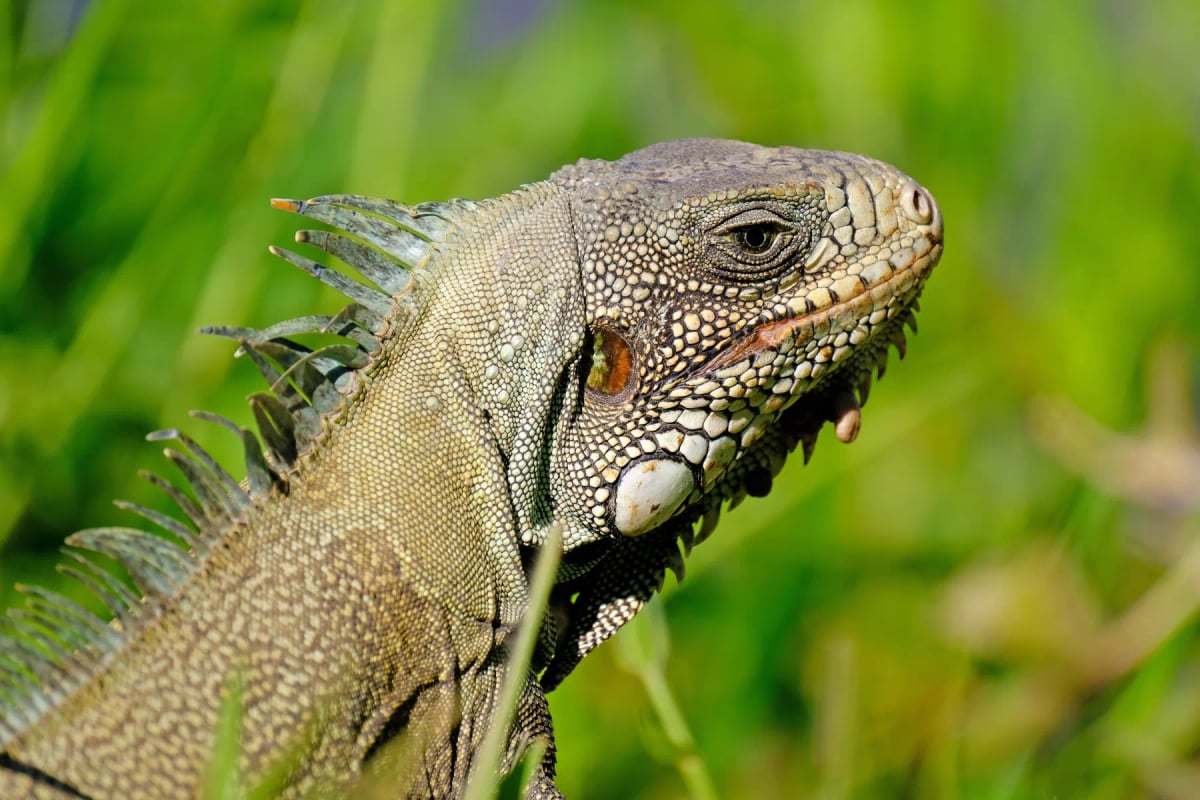
Adult green iguanas are easily recognized by their vibrant green skin, though coloration can vary with age, sex and region, with some adults developing orange or brownish tones. A row of spines runs along the back and tail, and a large rounded scale known as the subtympanic shield sits behind each ear. Males develop a prominent dewlap used in display and thermoregulation. The long muscular tail accounts for more than half the animal's total length and serves both as a counterbalance when climbing and as a powerful defensive weapon when the animal feels threatened.
Diet
The green iguana is primarily herbivorous throughout its adult life, feeding on leaves, flowers, fruit and young shoots from a wide variety of tropical plants. Juveniles may occasionally consume insects or small invertebrates, but this habit largely disappears as they mature. Their digestive system relies on symbiotic bacteria to break down tough plant fibers, and they need warmth to digest food effectively, which makes basking a critical part of the daily routine. In environments with abundant fruit they contribute meaningfully to seed dispersal, helping maintain plant diversity across forest edges and riverine habitats throughout their range.
Behavior
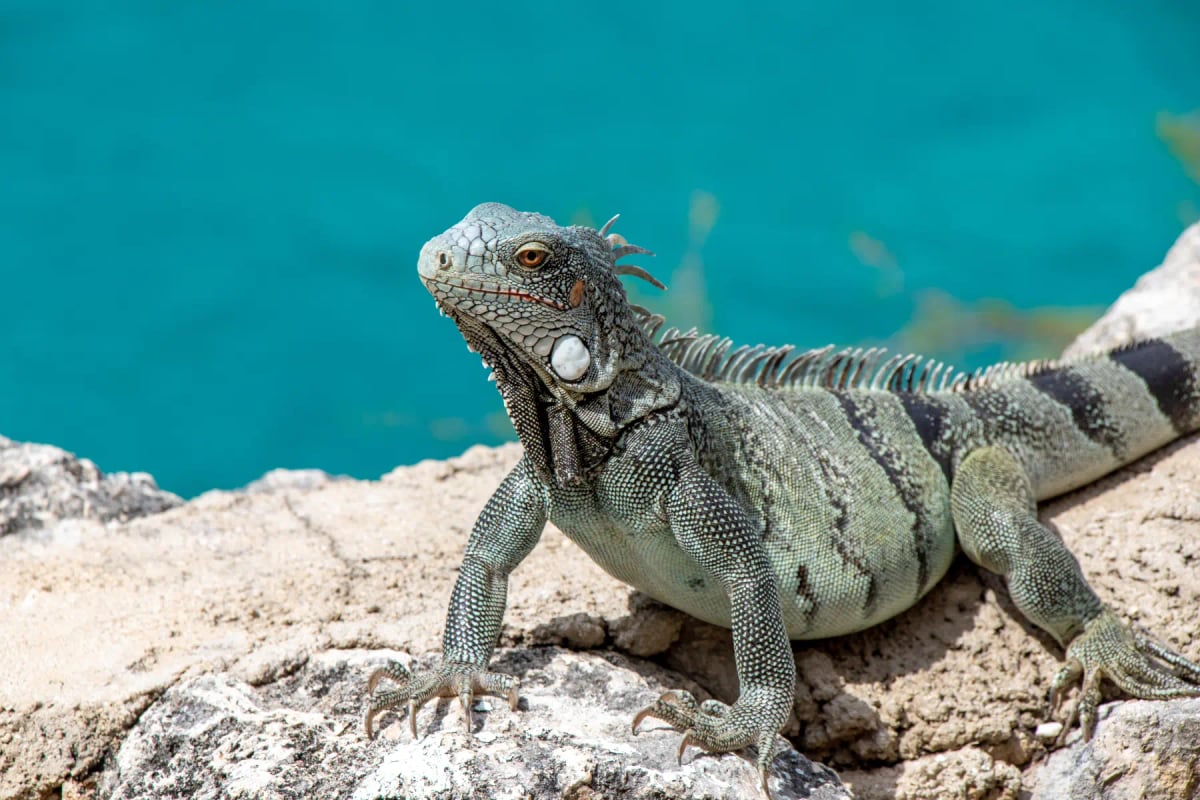
Green iguanas are diurnal and spend much of the day basking on exposed branches above water. They are largely solitary and territorial, with dominant males defending prime basking spots. When threatened, they rely on camouflage first and then flight, dropping from branches directly into water and swimming away with powerful lateral strokes of the tail. They can withstand significant falls without injury. During the breeding season males bob their heads, extend their dewlaps and develop vivid orange coloration to attract females. Females travel considerable distances to find nesting sites and can lay between twenty and seventy eggs per clutch.
Conservation
The green iguana is listed as Least Concern by the IUCN, but its populations face significant local pressure across much of its native range. It is heavily hunted for meat and its eggs are collected as food, particularly in Mexico, Central America and parts of South America. Habitat loss from deforestation and coastal development removes key nesting and foraging areas. The pet trade has taken a large toll, with millions of animals exported globally over recent decades. Paradoxically, in Florida and Hawaii it has become an invasive pest, damaging native vegetation, infrastructure and populations of ground nesting wildlife.
Where it is found
The Iguana can be found in places such as:
Researched and written by Juan Pablo. Sources: IUCN Red List, scientific literature and regional field guides. Last updated: .
Technical factsheet




Frequently Asked Questions
What do iguanas eat?
Green iguanas are mostly herbivorous and eat leaves, flowers, fruit and young shoots from a wide range of tropical plants. Young iguanas sometimes eat insects or small invertebrates, but this habit fades as they grow. Their gut relies on symbiotic bacteria to break down tough plant fibers, so they need warmth to digest properly. Basking before and after meals helps them process food efficiently and stay healthy overall.
Are iguanas dangerous to humans?
Green iguanas are not dangerous to humans the way venomous or aggressive animals are, since they have no venom and avoid confrontation when possible. They can deliver a strong bite and use their thick tail like a whip if cornered or handled roughly, which can cause scratches or bruises. Most incidents happen when people try to catch or corner one. In Florida, where the species is invasive, encounters are increasingly common but rarely serious.
How long do iguanas live?
In the wild, green iguanas typically live between 10 and 20 years, depending on predation, food availability and local conditions. Iguanas kept as pets can sometimes live longer when given proper care, consistent temperatures and a varied herbivorous diet, though many pet iguanas suffer from poor husbandry that shortens their lifespan considerably. Wild populations with few natural predators, such as on some Caribbean islands, tend to show longer average lifespans than those facing heavy hunting pressure.
Do iguanas make good pets?
Iguanas can make rewarding pets for experienced keepers, but they are demanding animals that need a large enclosure, strong UVB lighting, controlled humidity and a strictly herbivorous diet. They can grow over a meter and a half long and require significant space as adults. Many become aggressive during breeding season or if mishandled when young. Because of these needs, they are not recommended as a first reptile or for casual pet owners.
Why are iguanas considered invasive in Florida?
Green iguanas are not native to Florida and arrived through decades of escapes and releases linked to the pet trade beginning in the 1960s. The state's warm climate let them establish breeding populations that have since grown into the hundreds of thousands across South Florida and the Keys. They damage native vegetation, dig into seawalls and levees, and prey on the eggs of native and endangered species, which is why wildlife agencies classify them as a harmful invasive species.
How big do iguanas get?
Adult green iguanas typically measure between 1 and 1.5 meters from snout to tail tip, although some large males can exceed this length. More than half of that total comes from the tail, which is long, muscular and used both for balance while climbing and as a defensive weapon. Most adults weigh between 1 and 9 kilograms. Size varies somewhat by region, with populations in different parts of their range showing slightly different average measurements.