Caracal
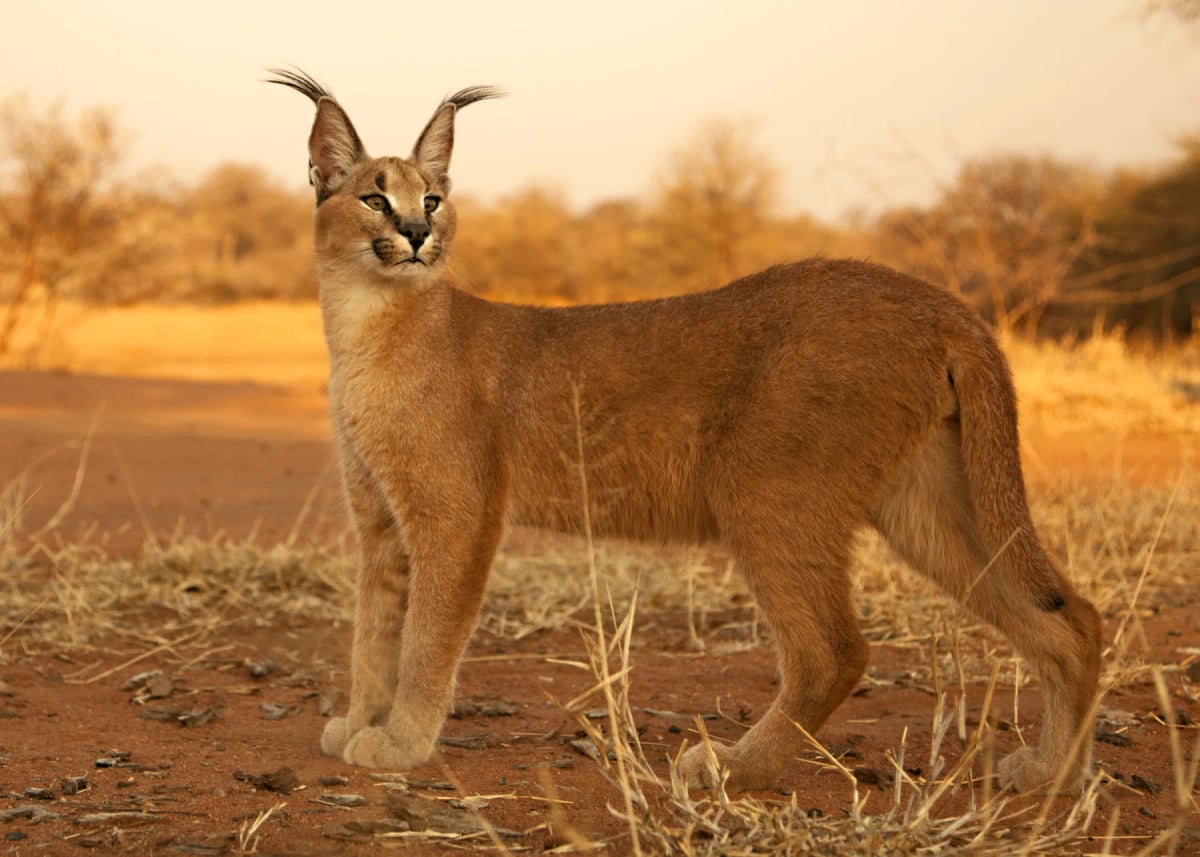
The caracal (Caracal caracal) is a medium-sized wild cat instantly recognizable by the long black tufts that tip its pointed ears. Adults stand roughly 40 to 50 cm at the shoulder and weigh between 8 and 19 kg, with males noticeably larger than females. Its coat is uniformly tawny to reddish brown, and its muscular hindquarters give it an explosive jumping ability that allows it to pluck birds right out of the air. The species ranges across most of Africa, the Middle East, and parts of Central and South Asia, occupying savannas, dry woodlands, scrublands, and rocky semi-arid terrain. It avoids dense tropical forest. Mostly solitary and active at night and during twilight, it hunts hares, rodents, small antelopes, and birds. The IUCN currently lists it as Least Concern, though it faces pressure from habitat loss and persecution by farmers.
Habitat and distribution
Spanning an enormous geographic range, the caracal is found across most of sub-Saharan Africa, through North Africa and the Middle East, and into Central Asia as far as India and parts of Pakistan and Kazakhstan. Within this range it favors savannas, dry woodlands, scrublands, and rocky terrain in areas of low to moderate rainfall. It copes well with arid conditions and is often encountered in semi-desert landscapes where other cats are absent. Dense tropical rainforest is the one habitat type it consistently avoids. In southern Africa it is still relatively common, whereas populations across the Middle East and Central Asia are patchier and less studied. Elevation is not a major barrier, as caracals have been recorded in montane regions well above 3,000 metres in parts of East Africa.
Diet
A versatile and opportunistic predator, the caracal targets a wide variety of prey depending on what is available locally. Across most of its range, small to medium mammals make up the bulk of its diet, including hares, rats, mice, and small antelopes such as steenbok and young impala. Birds are hunted with remarkable skill: the caracal can launch itself into the air and strike multiple birds from a flock in a single leap, sometimes knocking several down before landing. Reptiles and insects supplement the diet when larger prey is scarce. Near farming communities, it occasionally takes sheep, goats, and poultry, which brings it into direct conflict with people. Like most cats, it consumes its kills over several visits and may cache the remains of larger prey under vegetation to protect them from scavengers.
Behavior
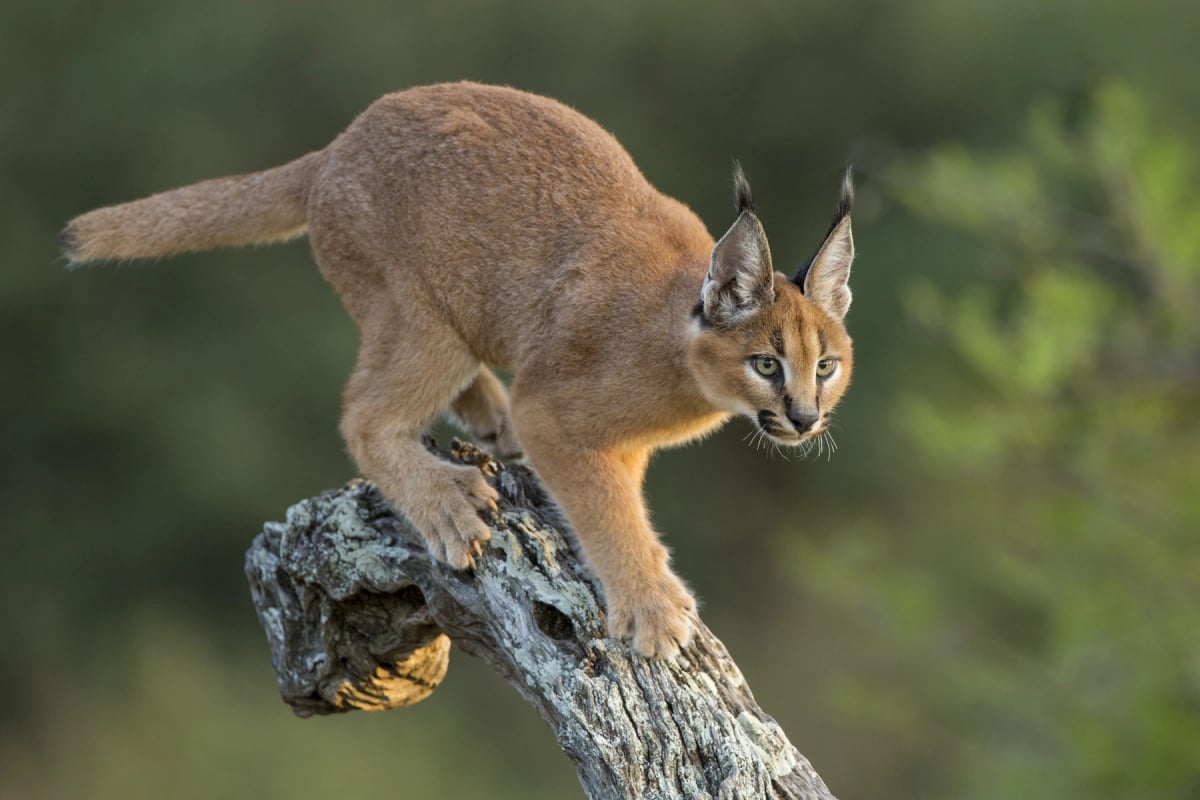
Solitary by nature, caracals come together only to mate, with each individual maintaining a territory it marks through scent glands, urine sprays, and scratch marks on trees or rocks. Activity peaks at night and during the hours around dawn and dusk, though in cooler months or at higher elevations some individuals are active during the day. Hunting relies heavily on stealth: the caracal creeps to within close range of its target before launching a short, explosive sprint. It communicates through a range of vocalizations including hisses, growls, and a distinctive coughing bark used between individuals at distance. Home range size varies considerably with habitat quality and prey abundance, with studies in southern Africa recording territories anywhere from around 30 to over 300 square kilometres for males.
Adaptations
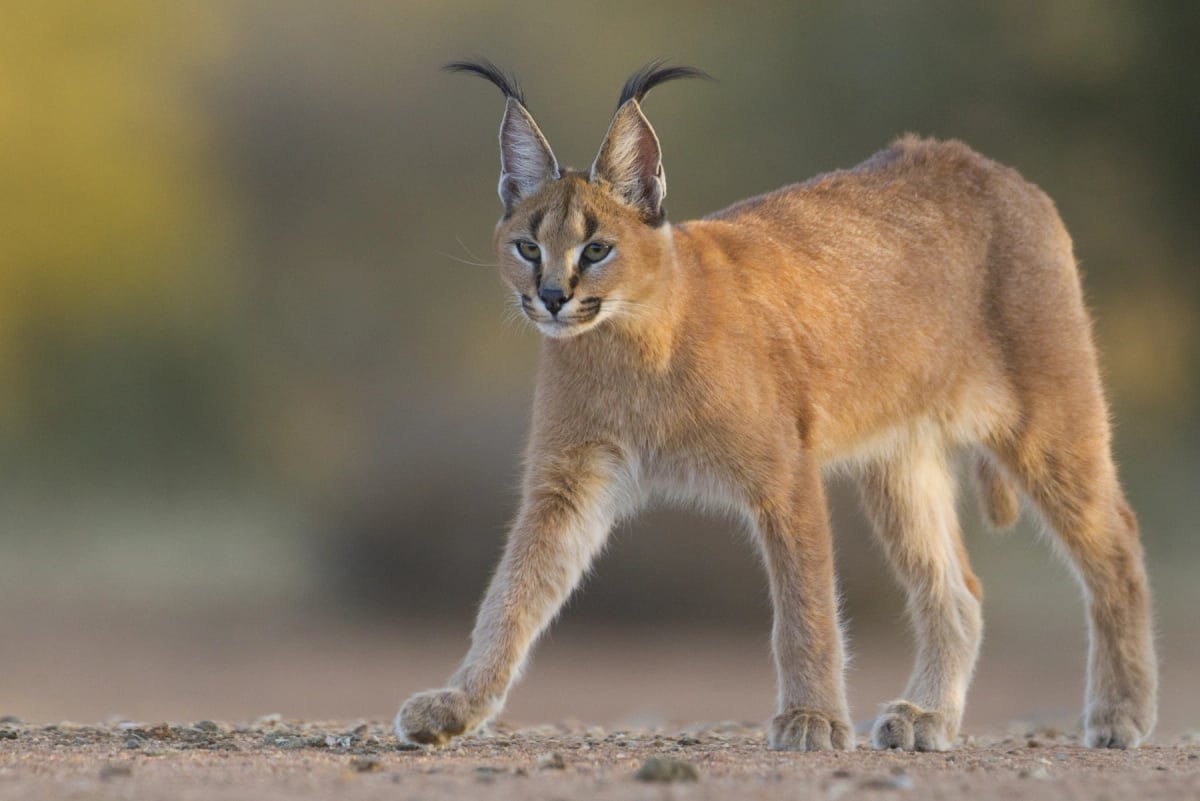
Few medium-sized cats are as physically specialized for explosive movement as the caracal. Its hindlimbs are proportionally longer than its forelimbs, lowering the front of the body and storing energy in the powerful muscles of the lower back and haunches. This arrangement lets it spring vertically to impressive heights, making aerial prey accessible in a way that few other cats can match. The tufts of black hair at the tips of its ears are one of its most recognizable features. Their exact function is debated, but researchers suggest they may help fine-tune the cat's already sharp directional hearing by amplifying subtle sound cues. The tawny coat provides effective camouflage against dry grass and ochre soils, and the species can survive for extended periods without drinking, obtaining much of its water directly from the prey it eats.
Conservation
The IUCN classifies the caracal as Least Concern, reflecting its broad distribution and relatively stable numbers across much of Africa. Outside that continent, however, the picture is more complicated. Populations in North Africa, the Middle East, and Central Asia are smaller, more fragmented, and face greater pressure from habitat degradation and human encroachment. Throughout its range, retaliatory killing by farmers protecting livestock and poultry is one of the most consistent threats the species encounters. Legal protection varies widely by country, and enforcement is often limited. In South Africa, caracals may be killed without restriction on private farmland under certain conditions, a policy that conservation groups continue to contest. Maintaining connected landscapes and reducing conflict with farming communities through non-lethal deterrents are considered the most practical paths to securing the species over the long term.
Where it is found
The Caracal can be found in places such as:
Researched and written by Juan Pablo. Sources: IUCN Red List, scientific literature and regional field guides. Last updated: .
Technical factsheet









Frequently Asked Questions
What does a caracal eat?
Caracals are opportunistic hunters that prey on a wide range of animals. Hares, rodents, and small antelopes form the core of their diet, but they are equally capable of taking birds, reptiles, and insects. Near farms, they sometimes kill sheep, goats, and poultry. They can cache the remains of larger kills under vegetation and return to feed over several visits rather than consuming everything at once.
Where do caracals live?
Caracals are spread across a vast area that includes most of sub-Saharan Africa, North Africa, the Middle East, and parts of Central and South Asia, reaching as far as India and Kazakhstan. They thrive in savannas, dry woodlands, scrublands, and rocky terrain with low to moderate rainfall. They handle arid conditions well but consistently avoid dense tropical rainforest. They have even been recorded in mountainous regions above 3,000 metres.
Can a caracal really catch birds in mid-air?
Yes, and it is one of the most remarkable hunting feats of any wild cat. Caracals can leap vertically to striking heights thanks to their powerful hindquarters, which are proportionally longer than their forelimbs. When a flock of birds takes off, a caracal may launch itself upward and knock several birds down in a single bound before landing. This ability to take multiple prey in one jump sets them apart from most other cats.
Are caracals dangerous to humans?
Caracals are not considered a threat to people. They are shy, solitary animals that avoid contact with humans whenever possible. There are no documented cases of caracals attacking people without provocation. The main tension between caracals and humans arises not from physical danger but from livestock predation, which leads farmers in parts of Africa and Asia to kill them in retaliation. Cornered or injured individuals may scratch or bite in self-defense.
What is the conservation status of the caracal?
The IUCN lists the caracal as Least Concern, reflecting a broad distribution and relatively stable population across much of Africa. However, the situation is more worrying in North Africa, the Middle East, and Central Asia, where populations are smaller and more fragmented. Retaliatory killings by farmers protecting livestock, habitat loss, and limited legal protection in many countries are the main pressures the species faces across its range.
Why do caracals have tufts on their ears?
The exact purpose of the black ear tufts is still debated among researchers. The most widely accepted idea is that they help sharpen the caracal's already keen directional hearing by channeling subtle sound cues toward the ear canal, similar to how a cupped hand amplifies sound. Some researchers also suggest the tufts may play a role in communication between individuals. The caracal shares this feature with the Eurasian lynx and the serval.
Is the caracal related to the cheetah?
Despite some similarities in build and their shared African and Asian range, caracals and cheetahs are not closely related. The caracal belongs to its own genus, Caracal, and genetic studies place it in a lineage alongside the African golden cat and the serval. Cheetahs belong to the genus Acinonyx and are more distantly related. The resemblance between caracals and cheetahs is largely a result of adapting to similar environments rather than shared ancestry.