Okapi
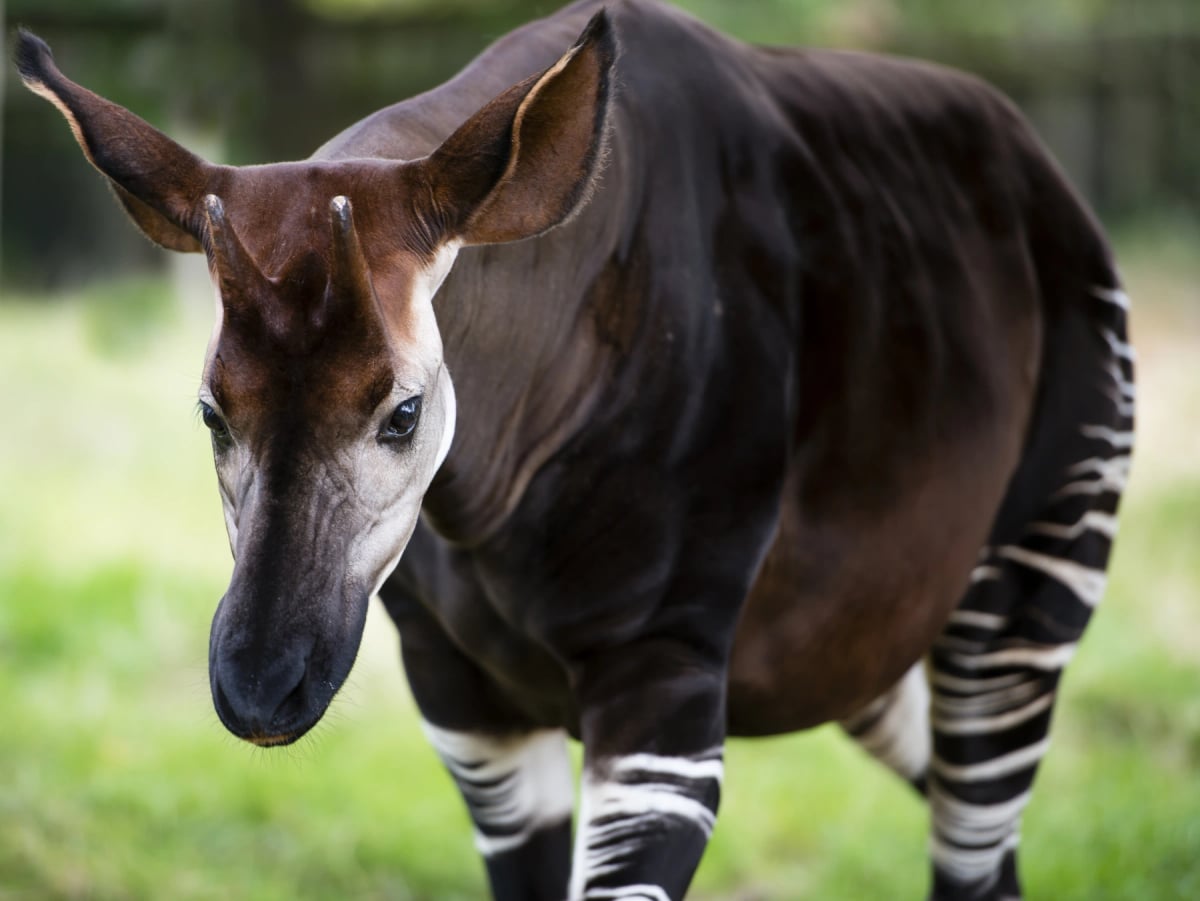
The okapi is the only living relative of the giraffe and lives exclusively in the rainforests of the Democratic Republic of the Congo. Its coat is a rich reddish brown, with bold white stripes across the upper legs that break up its outline among the trees and shadows of the forest floor. Like the giraffe, it has a long, bluish tongue capable of reaching around branches to pull off leaves, buds, and fruit. Okapis are highly secretive and spend most of their lives alone, communicating through low-frequency sounds that travel well through dense forest. Females raise their calves in hidden spots within thick vegetation for several months before the young begin to follow them. Classified as Endangered by the IUCN, the species faces serious pressure from illegal hunting, habitat loss due to logging, and ongoing conflict across its restricted range in Central Africa.
Habitat and distribution
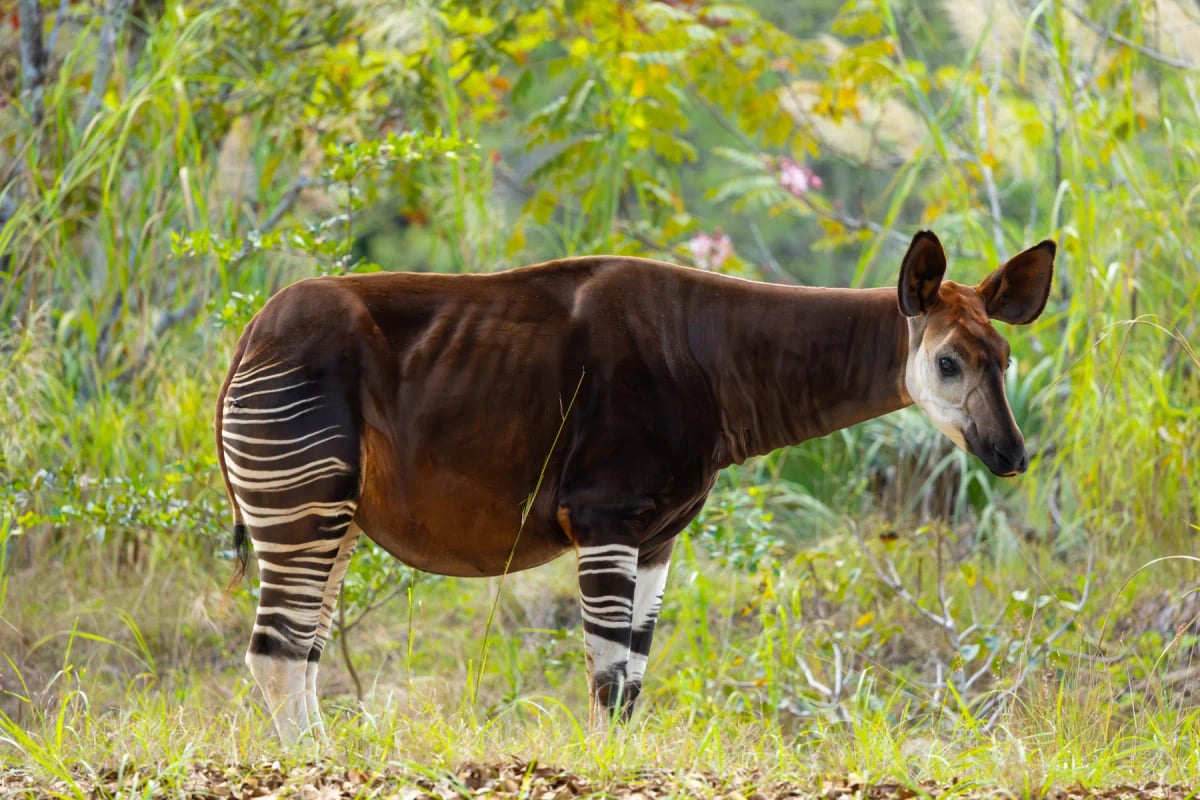
Okapis are found nowhere else on Earth except the tropical rainforests of the Democratic Republic of the Congo. They are most strongly associated with the Ituri Forest in the northeast of the country, a vast and ancient stretch of lowland rainforest that sits between 500 and 1,000 metres above sea level. Within this environment, okapis favour areas with a dense canopy, thick undergrowth, and access to streams or rivers. They tend to avoid open clearings, preferring the deep shade of the forest interior where their striped markings help them blend into the pattern of light and shadow on the forest floor. The Okapi Wildlife Reserve, a UNESCO World Heritage Site, protects a significant portion of their known range.
Diet
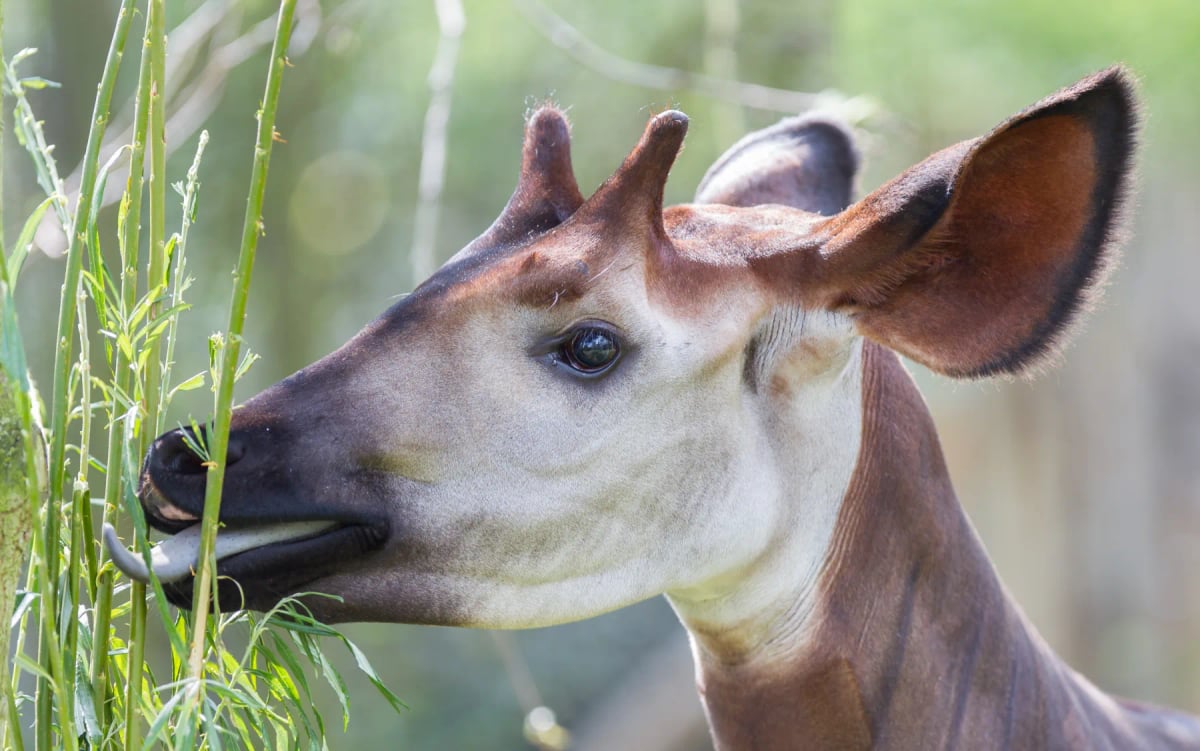
Browsing is the foundation of the okapi's diet. It feeds on the leaves, buds, shoots, and fruit of a wide variety of forest plants, selecting food from dozens of species throughout its daily wanderings. The okapi's tongue, which can reach around 30 centimetres in length, is strong and flexible enough to curl around branches and strip foliage with ease. This same tongue is also used to groom the animal's own face and ears. Okapis have been observed eating clay and charcoal from riverbanks, a behaviour that is thought to provide essential salts and minerals not easily obtained from their plant diet. They are entirely herbivorous, and the specific plant species they consume often reflect what is locally abundant on the forest floor.
Behavior
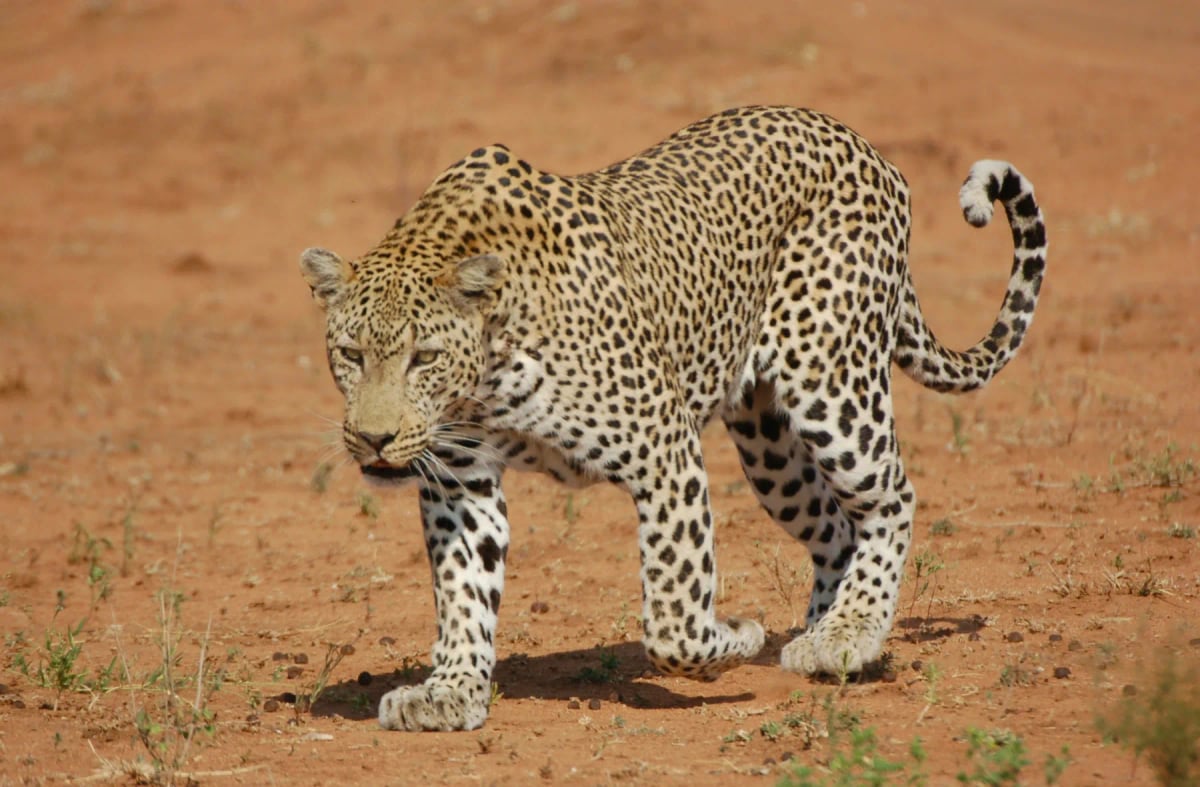
Spending most of its life alone, the okapi is one of the more solitary large mammals in Africa. Adults generally keep to their own home ranges, which they mark using scent glands on their feet and by rubbing their necks against trees. Males and females come together only briefly to mate. Communication happens mainly through low frequency sounds, known as infrasound, which carry well through the dense forest without alerting predators. When a calf is born, the mother hides it in a secluded spot within thick vegetation for weeks, visiting regularly to nurse it. During this period the calf remains almost completely still and silent, a behaviour that keeps it safe from leopards, the okapi's main natural predator.
Relation to giraffes
At first glance, the okapi looks nothing like a giraffe, yet it is the only living member of the family Giraffidae alongside its towering cousin. The two species share a common ancestor, and several physical features make the connection clear on closer inspection. Both animals have a long, bluish grey tongue adapted for pulling leaves from branches, lobed canine teeth called lobes, and skin covered ossicones, the same horn structures found on giraffes, which are present in male okapis. The okapi's legs and body shape also echo the giraffe's proportions, scaled to suit life in a closed forest rather than an open savanna. Fossil evidence shows that the Giraffidae family was once far more diverse, making the okapi and giraffe the surviving representatives of a much larger group.
Conservation
Classified as Endangered on the IUCN Red List, the okapi faces serious threats across its already restricted range. Illegal hunting for bushmeat and skin remains a persistent problem, and the expansion of logging has steadily reduced the area of intact forest the species depends on. Armed conflict across parts of the Democratic Republic of the Congo has also made conservation work extremely difficult and dangerous. The Okapi Wildlife Reserve, established in 1992 and covering around 13,700 square kilometres in the Ituri Forest, is the most important protected area for the species. The Okapi Conservation Project works within this reserve to support anti-poaching patrols and to engage local communities in protecting the forest. Captive populations in zoos around the world also serve as a safeguard for the species over the long term.
Researched and written by Juan Pablo. Sources: IUCN Red List, scientific literature and regional field guides. Last updated: .
Technical factsheet
Frequently Asked Questions
Is the okapi related to the zebra?
Despite the stripes, the okapi is not related to zebras at all. It is actually the only living relative of the giraffe. Both belong to the family Giraffidae and share several features, including a long bluish tongue and bony horn structures called ossicones. The striped pattern on the okapi's legs helps it blend into the light and shadow of the forest floor, which is why the resemblance to a zebra is purely superficial.
Where does the okapi live?
The okapi lives exclusively in the tropical rainforests of the Democratic Republic of the Congo, in Central Africa. It is most commonly found in the Ituri Forest in the northeast of the country. It favours areas with a dense canopy, thick undergrowth, and access to water. The okapi is not found anywhere else in the wild, making the DRC the only place on Earth where you can encounter this animal in its natural habitat.
What does the okapi eat?
The okapi is a browser, meaning it feeds on leaves, buds, shoots, and fruit gathered from a wide variety of forest plants. Its tongue, which can reach around 30 centimetres in length, is strong enough to wrap around branches and pull off foliage with ease. Okapis have also been seen eating clay and charcoal from riverbanks, most likely to obtain salts and minerals that their plant diet alone does not provide.
How long is the okapi's tongue?
The okapi's tongue reaches around 30 centimetres in length, making it one of the longest tongues of any land mammal relative to its body size. It is also remarkably flexible and has a bluish grey colour due to a dark pigment that may offer some protection from sun exposure. The okapi uses its tongue not only to strip leaves from branches but also to clean its own face and ears, which is something very few large mammals can do.
Is the okapi endangered?
Yes, the okapi is classified as Endangered on the IUCN Red List. Its numbers have dropped significantly due to illegal hunting for meat and skin, large-scale logging that destroys the forest it depends on, and ongoing armed conflict across parts of the Democratic Republic of the Congo. Conservation efforts are centred on the Okapi Wildlife Reserve in the Ituri Forest, though protecting the species remains a serious challenge given the difficult conditions in the region.
How does the okapi communicate?
Okapis communicate mainly through sounds at very low frequencies, known as infrasound, which travel well through dense forest without carrying far enough to alert nearby predators. They also use scent to mark their home ranges, releasing secretions from glands on their feet and rubbing their necks against tree trunks. Because they live such solitary lives, these quiet, discreet forms of communication suit them far better than loud calls would.
When was the okapi first discovered by scientists?
Western science did not formally describe the okapi until 1901, when the British explorer Sir Harry Johnston sent samples of skin and skull bones to the Natural History Museum in London. For a long time before that, reports from local Congolese peoples and European explorers described a mysterious forest animal, but it remained unknown to the scientific world. It was one of the last large mammals to be formally documented, which makes it a remarkable example of how much the dense rainforest can conceal.