Aurochs
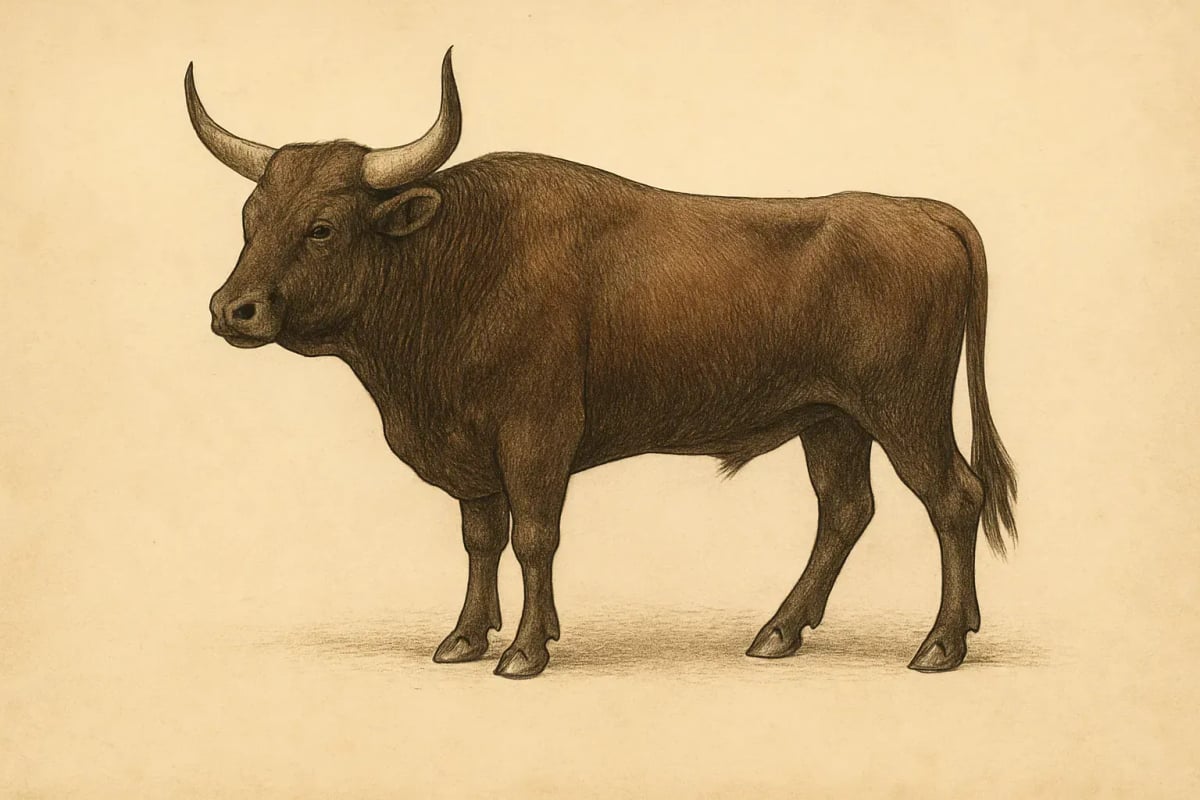
The aurochs was a massive wild bovine that ranged across Europe, Asia, and North Africa, standing up to 180 cm at the shoulder in bulls and 155 cm in cows. It is recognized as the wild ancestor of modern domestic cattle and was one of the largest herbivores of the Holocene. Bulls carried elongated, forward-curving horns reaching up to 80 cm in length and had dark coats, while cows were smaller and reddish-brown. Originally distributed from the British Isles to India and East Asia, its range contracted steadily through the Middle Ages due to overhunting and competition with livestock. By the 13th century it survived only in parts of Poland, Lithuania, and a few neighboring regions. The last known individual, a female, died in Poland's Jaktorów Forest in 1627. Today, the aurochs survives indirectly through every domestic cattle breed on Earth, and its image endures in heraldry, cave paintings, and cultural memory across Eurasia.
Historic range
At its peak, the aurochs occupied a vast territory stretching from the British Isles and southern Scandinavia through most of Europe, across North Africa, the Middle East, Central Asia, and into India and East Asia. It thrived in mixed forests, river valleys, and open grasslands, preferring forest margins and areas near water. As human populations expanded and land was cleared for agriculture, the aurochs was pushed out of most of its range. By the 13th century it was confined to a small region of Poland and neighboring areas, where it was given limited royal protection before finally disappearing in 1627.
Physical traits
The aurochs was one of the largest bovines to have lived in historical times. Bulls could stand up to 180 cm at the shoulder and weigh over 1,000 kg, with a muscular build, a prominent shoulder hump, and a dark coat ranging from black to dark brown. Their horns were massive, elongated, and curved forward and inward, reaching up to 80 cm in length. Cows were noticeably smaller, reaching around 155 cm, and carried a reddish-brown coat. Both sexes had a pale stripe along the spine and a lighter muzzle, features still visible in some primitive cattle breeds today.
Cultural legacy
Few animals have shaped human civilization as profoundly as the aurochs. Its domestication, which occurred independently in the Near East, South Asia, and possibly Africa between 8,000 and 10,000 years ago, gave rise to all modern cattle breeds and transformed how humans farmed, traveled, and built societies. Beyond agriculture, the aurochs held deep symbolic power. It appears in Paleolithic cave paintings at Lascaux and Altamira, was associated with gods and royalty across ancient cultures, and survives in heraldry to this day, most notably in the coat of arms of Moldova and several European noble families.
Extinction
The decline of the aurochs was a process spanning centuries. Overhunting, forest clearance for agriculture, and increasing competition with domestic livestock steadily reduced its numbers through the Middle Ages. By the 13th century it survived only in the forests of Poland, where the Polish crown offered it limited royal protection. Despite these efforts, disease transmitted by domestic cattle, combined with continued habitat loss, proved fatal. The last known aurochs, a female, died in 1627 in the Jaktorów Forest in Masovia, Poland, making it one of the first documented cases of extinction caused by human activity.
Researched and written by Juan Pablo. Sources: IUCN Red List, scientific literature and regional field guides. Last updated: .
Technical factsheet






Frequently Asked Questions
When did the aurochs go extinct?
The aurochs went extinct in 1627, when the last known individual, a female, died in the Jaktorów Forest in Masovia, Poland. By that point the species had already disappeared from most of Europe for centuries, pushed out by overhunting, habitat loss, and disease transmitted by domestic livestock. Its final centuries were spent under limited royal protection in Poland, but the population was too small to recover.
Is the aurochs the ancestor of domestic cattle?
Yes. The aurochs is the direct wild ancestor of all modern domestic cattle breeds. Domestication occurred independently in at least two regions: the Near East, around 10,000 years ago, giving rise to taurine cattle, and South Asia, producing zebu breeds. Some research also suggests a separate domestication event in Africa. Every cow, bull, and ox alive today descends from aurochs that were tamed during the Neolithic period.
How big was an aurochs compared to modern cattle?
Aurochs were significantly larger than most modern cattle breeds. Bulls stood up to 180 cm at the shoulder and could weigh over 1,000 kg, making them comparable in size to a large bison. Cows were smaller, reaching around 155 cm. Their horns were also far more impressive, reaching up to 80 cm in length and curving forward and inward. By comparison, most domestic cattle breeds today stand between 120 and 150 cm.
Where did the aurochs live?
At its peak, the aurochs had one of the widest distributions of any large mammal in the Old World, ranging from the British Isles and southern Scandinavia across Europe, North Africa, the Middle East, Central Asia, and into India and East Asia. It favored mixed forests, river valleys, and open grasslands near water. Its range contracted steadily through the Middle Ages, and by the 13th century the species survived only in parts of Poland and a few neighboring regions.
Are there any efforts to bring back the aurochs?
Yes, several projects are attempting to recreate an animal that resembles the aurochs through selective breeding of primitive cattle breeds that retain ancestral traits. The most notable are the Tauros Programme in the Netherlands and the Heck cattle project, developed in Germany in the 1920s and 1930s. These efforts aim to produce animals that can fill the ecological role the aurochs once played as a large grazing species in European rewilding projects, though the result is not a true genetic reconstruction.
How is the aurochs depicted in ancient art?
The aurochs appears in some of the oldest known works of art in human history. It is painted in the cave of Lascaux in France and Altamira in Spain, both dating back over 15,000 years. These depictions show a large, muscular bovine with prominent horns, consistent with the physical descriptions reconstructed from skeletal remains. The aurochs also appears in ancient Egyptian art and Mesopotamian seals, reflecting its importance across many early civilizations.