Hartebeest
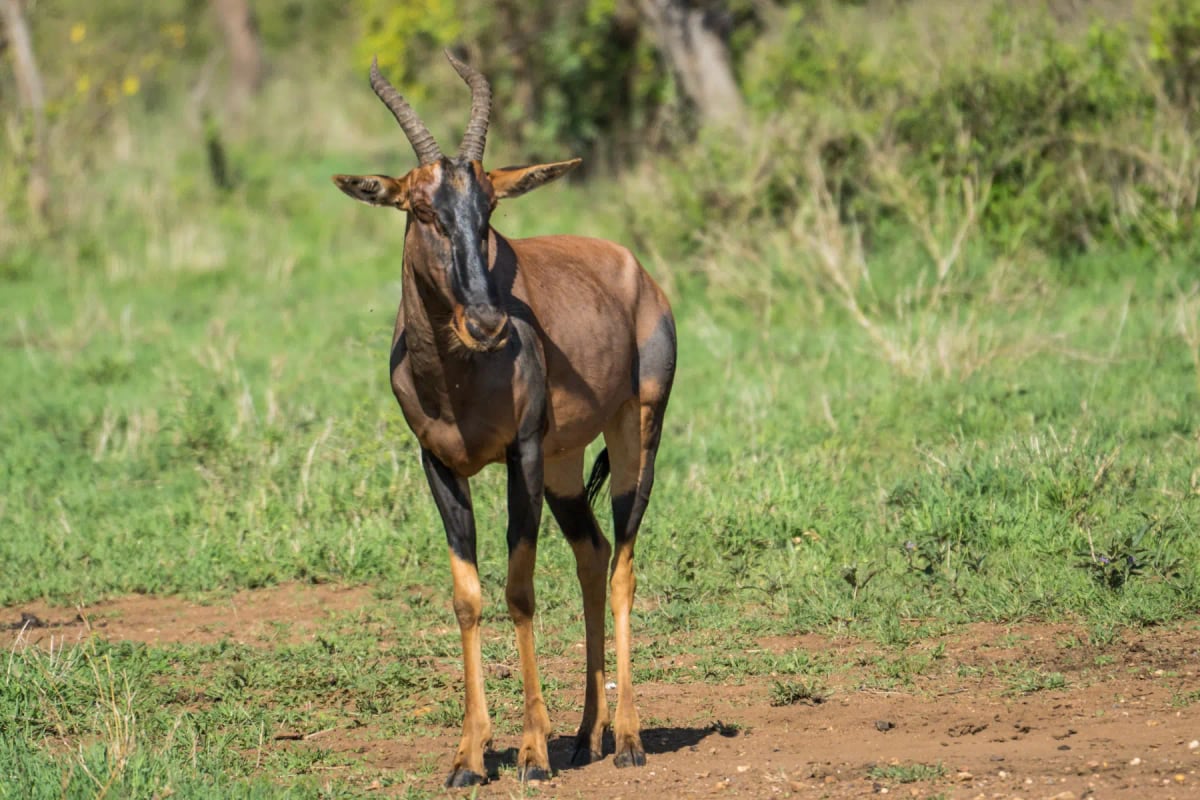
The hartebeest (Alcelaphus buselaphus) is one of Africa's most recognizable antelopes, standing out for its steeply sloping back, unusually long face, and bracket-shaped horns carried by both sexes. Several subspecies are recognized across sub-Saharan Africa, each with slight differences in coat color and horn shape. The coat typically runs from tawny to reddish brown. Hartebeests are dedicated grazers, relying almost entirely on grass, and their deep jaw and tall teeth help them handle coarse, low-quality vegetation that other animals avoid. They are among the fastest antelopes on the continent, capable of reaching speeds near 70 km/h and sustaining a trot over long distances to outpace predators. Herds can number from a handful of individuals to several hundred. Males hold territories and advertise them through scent marking and posturing. Some subspecies, such as the Swayne's hartebeest, are critically endangered.
Habitat and distribution
Across sub-Saharan Africa, hartebeests occupy a broad sweep of open habitats, from dry savannas and open woodlands to floodplain grasslands and the edges of semi-arid scrub. They are found in countries stretching from Senegal and Guinea in the west to Ethiopia and Kenya in the east, and down through Tanzania, Zambia, and into southern Africa. Wide, open terrain suits them well because they rely on long sightlines to spot approaching predators early. They tend to avoid dense forest and areas where tall shrubs limit visibility. Some populations have adapted to drier, harsher landscapes where grass is sparse and coarse. Although they do not migrate on the scale of wildebeest, hartebeests will move seasonally in search of fresh pasture when rainfall shifts the availability of green grass across their range.
Diet
Grass makes up virtually the entire diet of the hartebeest, making it one of Africa's most committed grazers. Its unusually long, narrow face positions the eyes high on the skull, allowing the animal to scan for danger while its muzzle stays close to the ground. The tall, ridged teeth, known as hypsodont molars, are well suited to grinding down the tough, fibrous grasses that many other herbivores pass over. Hartebeests can survive on dry, low-quality grass during the lean months of the dry season, which gives them an edge in habitats that seasonally poor grazing makes difficult for less specialized animals. They rarely browse on shrubs or leaves, and where water is available they drink regularly, though they can also go without free water for considerable periods by relying on moisture in the grass they eat.
Behavior
Social life for the hartebeest revolves around herds that range in size from just a few individuals to gatherings of several hundred animals. Female groups typically move together with their young, while adult males compete for and defend fixed territories. A territorial male will stand on a raised mound or termite hill to survey his ground and make himself visible to rivals and females alike. He reinforces his claim through scent marking with glands in front of the eyes and on the hooves, as well as through posturing and occasional clashes with rival males. Hartebeests are highly alert animals and one of the first species in a mixed herd to notice a predator. When alarmed, they break into a fast, rocking gallop that can reach close to 70 km/h, and they can sustain a steady trot over long distances to tire out a pursuer.
Appearance
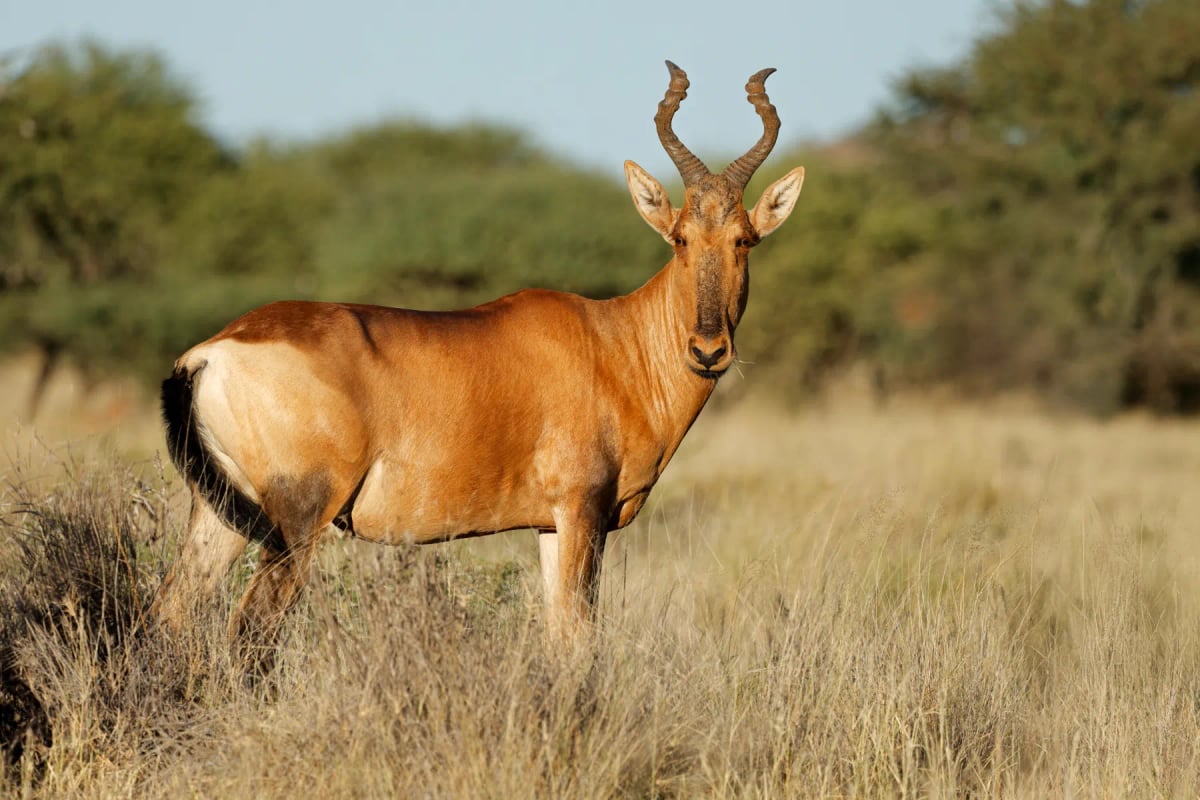
Few African antelopes are as immediately recognizable as the hartebeest. Its back slopes steeply downward from the shoulders to the hindquarters, giving it a hunched silhouette unlike that of most other antelopes. The face is exceptionally long and narrow, almost horse-like, and the forehead rises into a bony pedicle from which the horns grow in a distinctive bracket shape, curving outward and then inward at the tips. Both males and females carry these horns. Coat color varies across subspecies, ranging from warm tawny and reddish brown to paler sandy tones. The legs are often slightly darker than the body, and a faint pale patch is sometimes visible on the rump. Adults stand roughly 1.2 to 1.5 meters at the shoulder and can weigh anywhere from 100 to over 200 kilograms depending on the subspecies and sex.
Conservation
The hartebeest as a species is assessed as Least Concern on the IUCN Red List, but this broad status masks serious problems at the subspecies level. The Swayne's hartebeest, found only in Ethiopia, is listed as Critically Endangered, with its population having collapsed due to heavy hunting, livestock competition, and the conversion of grassland to farmland. The western hartebeest has also experienced steep declines across West Africa. Across the range as a whole, the species has disappeared from several countries where it was once common, and overall population numbers have fallen considerably over the past few decades. Continued pressure from hunting for bushmeat, habitat loss driven by agriculture, and competition with domestic cattle all pose ongoing threats. Protected areas and community conservation efforts remain the best tools for securing the hartebeest's future.
Where it is found
The Hartebeest can be found in places such as:
Researched and written by Juan Pablo. Sources: IUCN Red List, scientific literature and regional field guides. Last updated: .
Technical factsheet



Frequently Asked Questions
What do hartebeests eat?
Hartebeests are dedicated grazers that feed almost entirely on grass. Their long, narrow faces keep their eyes high while their muzzle stays close to the ground, and their tall, ridged teeth are built for grinding coarse, tough grasses that most other herbivores ignore. During the dry season, they can survive on poor, dried-out vegetation and can go long stretches without drinking by drawing moisture from the grass itself.
Where do hartebeests live?
Hartebeests are found across a wide belt of sub-Saharan Africa, from Senegal and Guinea in the west to Ethiopia and Kenya in the east, and south through Tanzania, Zambia, and into southern Africa. They prefer open savannas, grasslands, and the edges of dry woodlands where long sightlines help them spot predators early. They tend to avoid dense forest and areas with thick shrubs that limit visibility.
How fast can a hartebeest run?
Hartebeests are among the fastest antelopes in Africa, capable of reaching speeds close to 70 km/h in short bursts. What makes them especially impressive is their stamina. They can keep up a steady trot over long distances, which helps them wear down predators that rely on a quick burst of speed. Lions and cheetahs need to get close fast, because a hartebeest that gets a head start is very hard to catch.
Are hartebeests endangered?
The hartebeest as a whole is listed as Least Concern by the IUCN, but the picture is more complicated at the subspecies level. The Swayne's hartebeest, found only in Ethiopia, is Critically Endangered after decades of hunting, competition with livestock, and the loss of its grassland habitat to farming. The western hartebeest has also declined sharply. Overall, the species has vanished from several countries where it was once common.
Why does the hartebeest have such a long face?
That unusually long, narrow face is a practical adaptation to life as a grazer. It positions the eyes high on the skull so the hartebeest can keep watch for predators while its muzzle stays close to the ground to feed. The elongated jaw also creates space for the tall, ridged teeth needed to process tough grasses. It may look odd compared to other antelopes, but every part of that face serves a purpose.
How do hartebeests behave in a herd?
Female hartebeests move together in groups with their young, while adult males stake out and defend fixed territories. A territorial male often stands on a raised mound or termite hill to keep watch and signal his presence to rivals. He marks his ground using scent glands near his eyes and hooves. Hartebeests are also among the first animals in a mixed herd to pick up on a threat and sound the alarm for others nearby.
What are the main threats to hartebeests?
The biggest pressures on hartebeests come from hunting for bushmeat, the steady loss of grassland habitat to agriculture, and competition with domestic cattle for grazing land. As farmland expands across Africa, the open savannas these animals depend on continue to shrink. In some areas, unregulated hunting has caused local populations to collapse entirely. Protected areas and community conservation programs are currently the most effective way to keep hartebeest numbers stable.