Bobcat
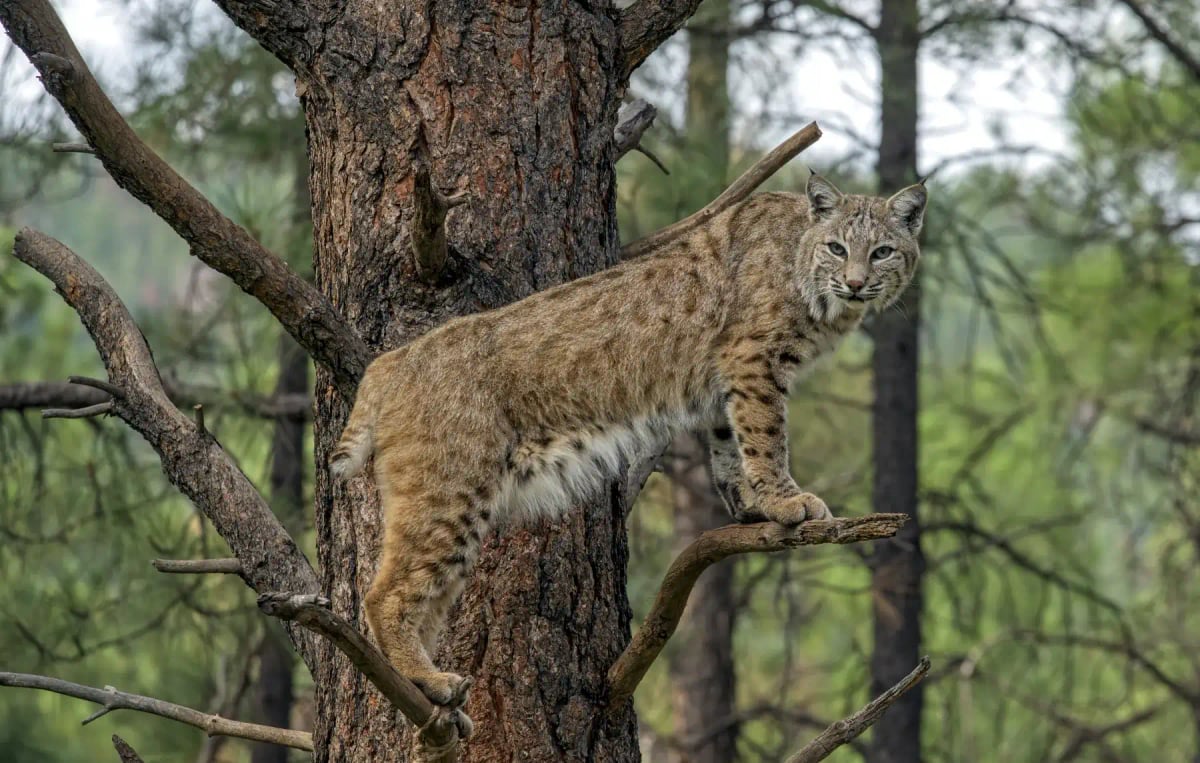
The bobcat (Lynx rufus) is a medium-sized wild cat native to North America, instantly recognizable by its tufted ears, short tail with a black tip, and a coat marked with spots and streaks that vary from tawny brown to grayish. Roughly twice the size of a domestic cat, it is one of the most adaptable predators on the continent, thriving in forests, shrublands, deserts, swamps, and even the fringes of suburban areas. It hunts mainly by stealth, stalking prey at close range before making a precise pounce. Rabbits and hares form the core of its diet, supplemented by rodents, birds, and occasionally deer fawns or reptiles. Bobcats are solitary animals that maintain territories marked with scent and scratches. During the breeding season they produce loud, rasping yowls that carry surprisingly far. The species is widespread and its overall population is considered stable.
Habitat and distribution
The bobcat ranges across most of North America, from southern Canada through the contiguous United States and into central Mexico. It is absent from much of the agricultural Midwest but occupies an impressive variety of environments elsewhere. Forests, chaparral, scrublands, swamps, semi-arid deserts, and the wooded edges of suburban neighborhoods all fall within its tolerance. It favors areas with dense cover for stalking prey and rocky outcrops or thickets for denning. In the eastern United States the species is most common in forests with abundant undergrowth, while in the West it thrives in brushy terrain and canyon country. Individual home ranges vary considerably in size, from a few square kilometers in prey-rich habitat to over 200 square kilometers in leaner landscapes, with males typically holding larger territories than females.
Built for stealth: the bobcat's hunting adaptations
The bobcat is finely tuned for ambush hunting. Its spotted and streaked coat breaks up its outline in dappled light, providing camouflage across a wide range of habitats. Large, padded paws allow nearly silent movement over leaf litter and rocky ground alike. The tufted ears, shared with other lynx relatives, enhance directional hearing and help the cat pinpoint the rustle of a hidden animal. Its eyes have a reflective layer called the tapetum lucidum, which amplifies available light and supports effective hunting at dawn and dusk. Powerful hindquarters give the bobcat the explosive burst of speed needed for a short-range pounce, and strong forelimbs let it pin and dispatch prey quickly. These traits together make it one of the most successful wild cats in North America despite its modest size.
Behavior and social life
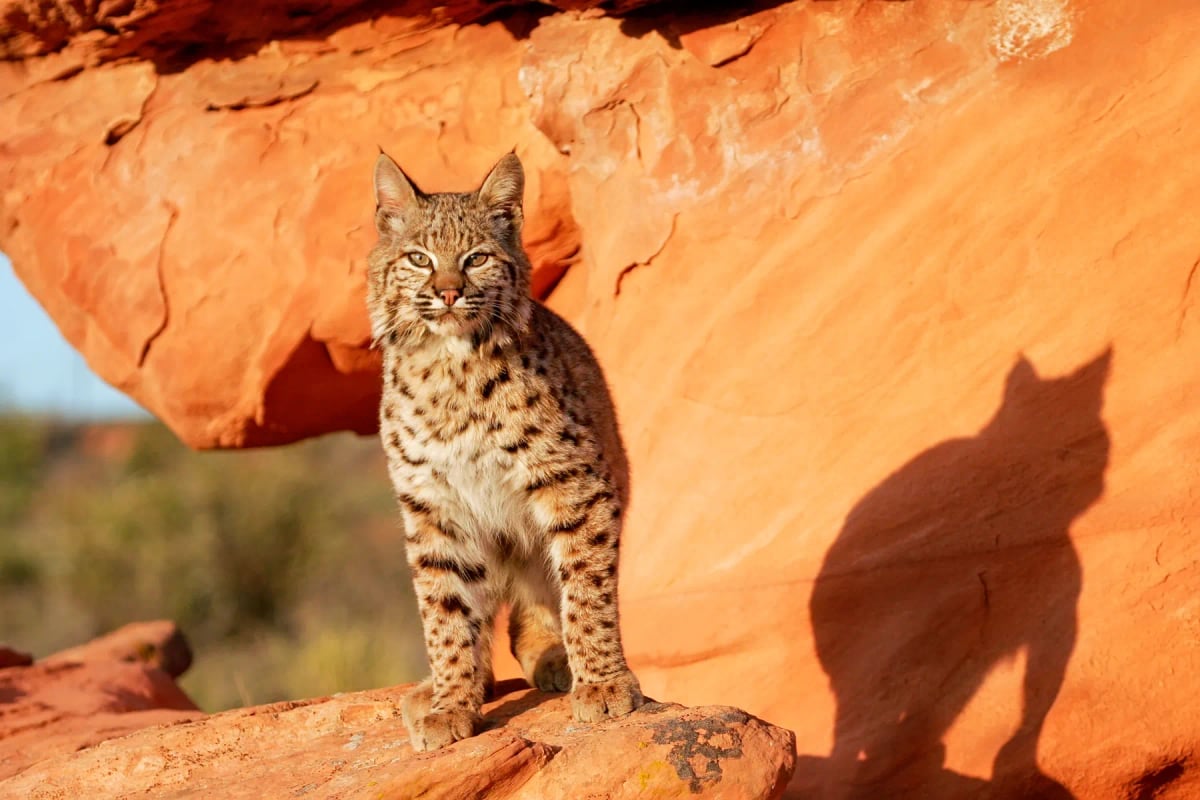
Bobcats are largely solitary outside of the breeding season, and adults rarely tolerate one another within their territories. Each individual marks its range with urine, feces, and claw scrapes on prominent trees or logs. Activity peaks around dawn and dusk, though cats in undisturbed areas may also move through the night. Breeding occurs mainly from late winter into spring, and after a roughly two-month gestation females give birth to litters of two to four kittens. The kittens stay with their mother for about nine to twelve months, learning to hunt before dispersing to establish their own ranges. During the mating season, bobcats produce a variety of loud calls, including yowls and screams, that can startle anyone unfamiliar with the source. Outside that period they are notably quiet animals.
Conservation
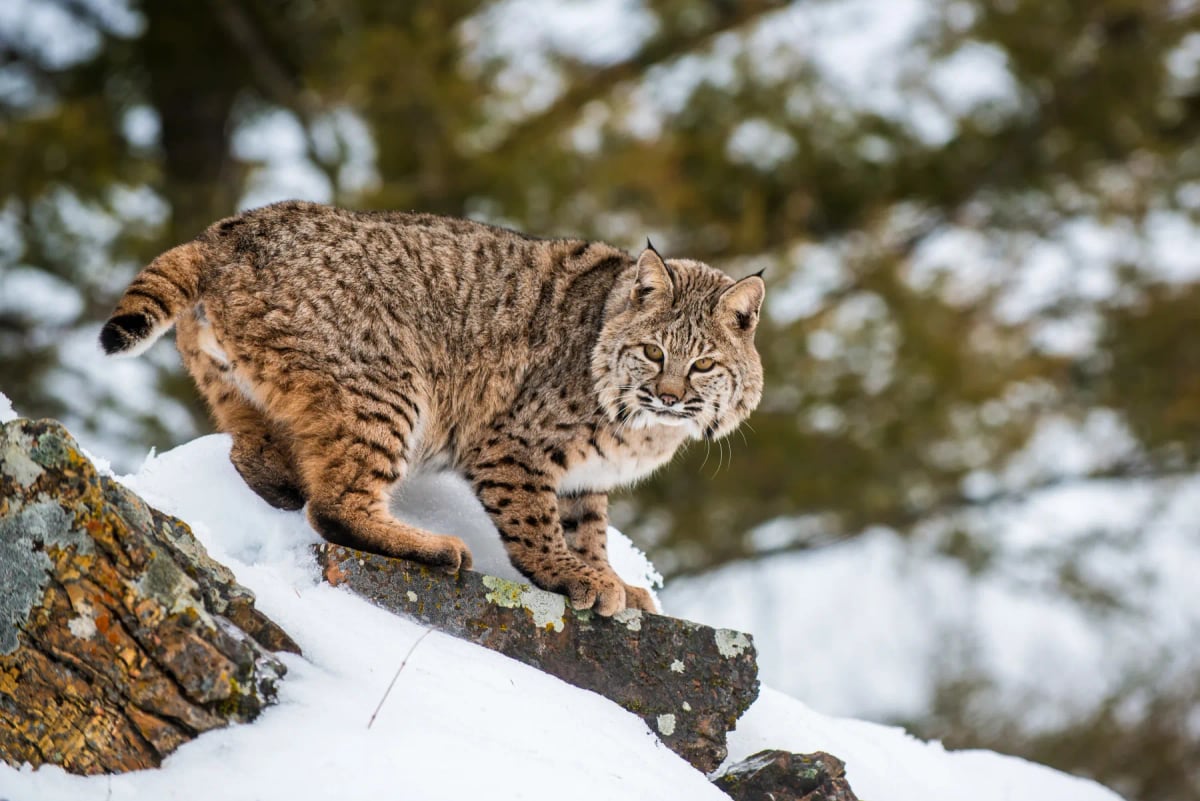
The bobcat is listed as Least Concern on the IUCN Red List, reflecting a population estimated at over one million individuals across North America. It was heavily trapped for the fur trade during much of the twentieth century, but regulated hunting and trapping, combined with the species' high reproductive rate, allowed numbers to recover in most regions. Today the main threats include habitat loss driven by urban expansion, road mortality, and the fragmentation of forested land. In some states, bobcat populations remain targets of legal hunting and trapping seasons managed by wildlife agencies. Poisoning from consuming prey that has ingested rodenticides is a growing concern, particularly near suburban areas. The species has shown a notable ability to persist in human-altered landscapes, which contributes to its overall stability, though localized populations in heavily developed regions face ongoing pressure.
Where it is found
The Bobcat can be found in places such as:
Researched and written by Juan Pablo. Sources: IUCN Red List, scientific literature and regional field guides. Last updated: .
Technical factsheet




Frequently Asked Questions
How big is a bobcat compared to a domestic cat?
A bobcat is roughly twice the size of a typical house cat. Adults generally weigh between 6 and 18 kilograms, with males considerably larger than females. They stand about 30 to 38 centimeters at the shoulder and measure up to 125 centimeters from nose to tail tip. Despite looking manageable in size, they are powerful animals fully capable of taking down prey much larger than themselves.
What does a bobcat eat?
Rabbits and hares are the foundation of the bobcat's diet, and prey availability often shapes where a bobcat settles and how large its territory grows. When rabbits are scarce, bobcats switch readily to squirrels, mice, voles, and other small rodents. They occasionally take birds, reptiles, and even white-tailed deer, especially fawns or weakened adults. This dietary flexibility is one of the key reasons the species thrives across such varied landscapes.
Are bobcats dangerous to humans or pets?
Bobcats are naturally shy and avoid contact with people whenever possible. Unprovoked attacks on humans are extremely rare and almost always involve an animal that is sick or cornered. Small pets left outdoors unsupervised, however, can occasionally be at risk, particularly in areas where bobcat habitat overlaps with residential neighborhoods. Keeping pets indoors at dawn and dusk, when bobcats are most active, is the simplest way to prevent any conflict.
Why does the bobcat have a short tail?
The bobcat's stubby tail, typically just 9 to 20 centimeters long, is one of its most recognizable features and the origin of its common name. The exact evolutionary reason for the short tail in lynx relatives is not fully settled, but it is thought to reduce drag and heat loss in cold environments, as well as offer less surface area that could be grabbed by prey or rivals. The black tip on the tail may also play a role in communication between individuals.
Can bobcats swim?
Yes, bobcats are capable swimmers, though they tend to avoid water when other routes are available. They will cross rivers and streams without much hesitation when hunting or dispersing into new territory. In swampy environments, such as parts of the southeastern United States, individuals regularly navigate wetland areas as part of their normal range. Like most cats, they are not enthusiastic about water, but they are far more comfortable in it than their reputation might suggest.
How long do bobcats live?
In the wild, bobcats typically live between 7 and 10 years, though some individuals have been recorded reaching 12 to 14 years. In human care, where threats like predation, vehicle strikes, and food scarcity are removed, lifespans can extend beyond 20 years. Survival in the wild depends heavily on prey availability, disease, and the risks associated with crossing roads and territorial disputes with other bobcats or larger predators such as coyotes and mountain lions.
Is the bobcat the same as a lynx?
The bobcat and the Canada lynx are close relatives within the same genus, Lynx, but they are distinct species. The Canada lynx is larger, has longer legs, broader paws adapted to deep snow, and a uniformly grayish coat without prominent spotting. The bobcat is smaller, more spotted, and far more adaptable to a range of environments. Their ranges do overlap in parts of Canada and the northern United States, and the two species occasionally compete for prey.