Bateleur
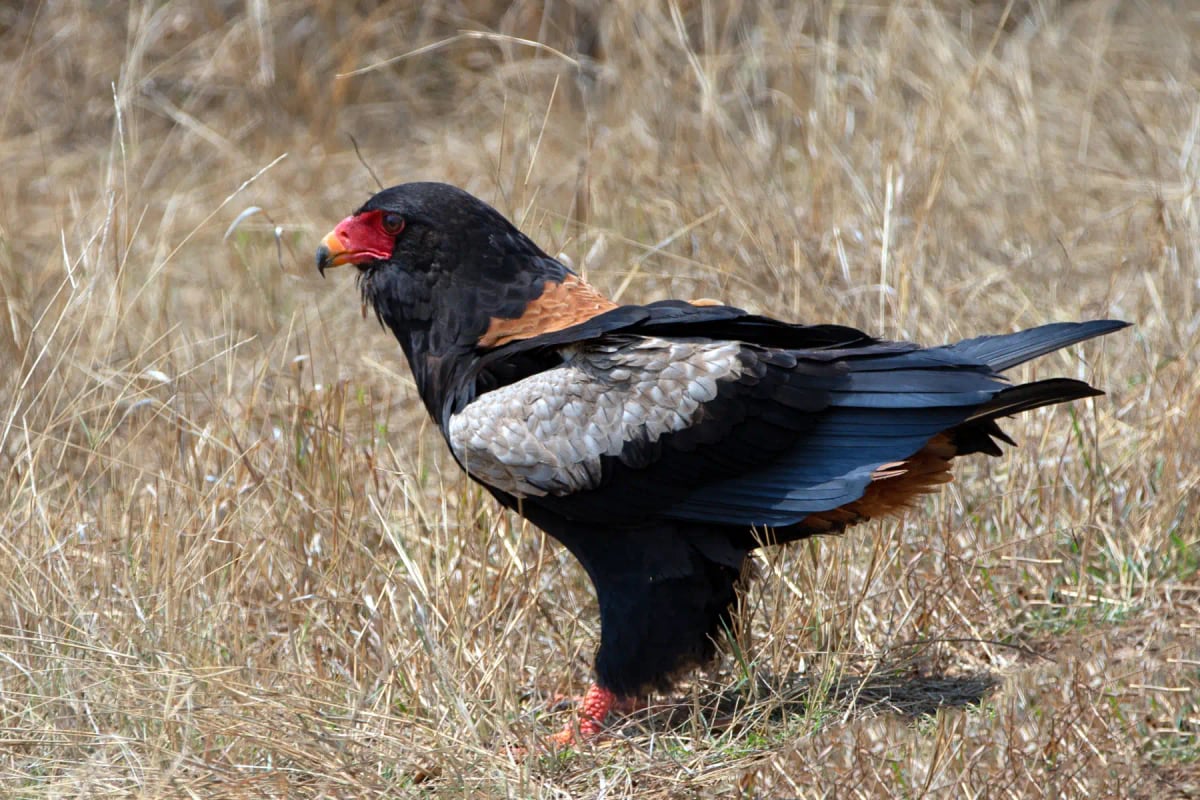
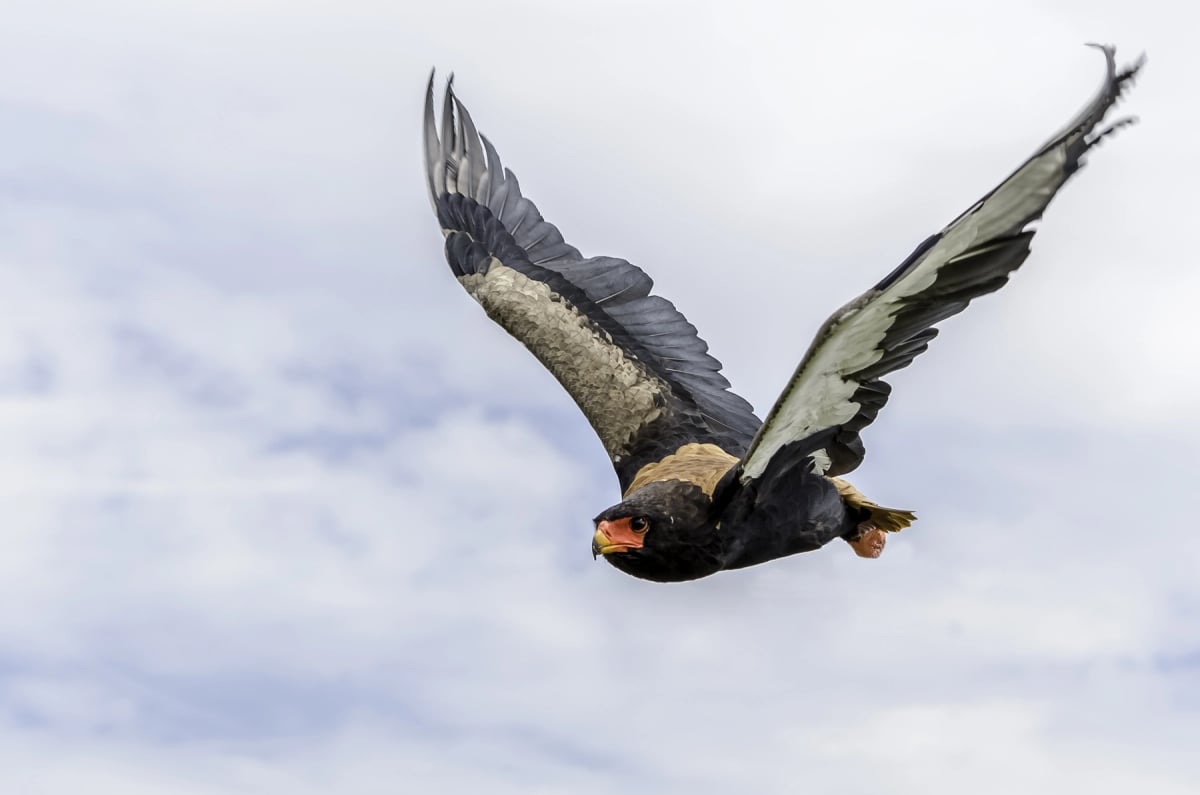
The Bateleur is one of Africa's most recognizable eagles, named after the French word for street performer. Its vivid scarlet face, jet-black body, chestnut back, and a tail so short it is nearly absent give it an unmistakable silhouette in the air. In flight, it tilts and rocks from side to side as it soars, a motion so characteristic that early French observers compared it to a juggler balancing on a tightrope. Across sub-Saharan Africa, it covers up to 300 km per day patrolling open savanna and dry woodland in search of carrion, reptiles, birds, and small mammals. It nests high in large trees, typically laying a single egg that both parents incubate for around 55 days. The chick remains dependent on adults for many months after fledging. Classified as Endangered by the IUCN, it faces serious pressure from poisoning, collision with power lines, and the steady loss of suitable habitat.
Habitat and distribution
The Bateleur ranges across much of sub-Saharan Africa, from Senegal and Gambia in the west to Somalia and Ethiopia in the east, and southward to South Africa and Namibia. It favors open savanna, dry woodland, thornbush, and semi-arid plains where wide, unobstructed skies allow it to soar for hours. Lightly wooded areas with tall trees are essential for nesting. The species largely avoids dense rainforest, though it may appear at forest edges. Historically, its range extended into parts of North Africa and the Middle East, but it has disappeared from those regions. Within its current range, populations have contracted significantly, and the bird is now absent or extremely scarce across large portions of West Africa where it was once regularly recorded. Protected areas such as the Serengeti, Kruger, and Hwange remain strongholds.
Built for the skies: flight and sensory adaptations
The Bateleur's most striking physical feature is its almost completely absent tail, which makes it unique among African eagles. This short tail, combined with exceptionally long wings that can span up to 186 cm, gives the bird extraordinary aerial maneuverability and allows it to soar at speeds of around 50 to 80 km/h for eight or more hours each day. The rocking, tilting flight style is a direct product of this unusual body plan. Its vivid scarlet facial skin and bill are not merely decorative. The coloring intensifies during courtship, serving as a signal of condition and fitness. The Bateleur also possesses keen eyesight well suited to scanning vast areas of ground from altitude, enabling it to spot carrion, lizards, and small animals across a daily patrol route that can exceed 300 km.
Behavior and social life
Bateleurs are monogamous and form pair bonds that endure for years, often returning to the same nest site year after year. Courtship involves spectacular aerial displays in which both birds roll and tumble through the sky together. The female lays a single egg, and both parents share incubation duties over a period of roughly 55 days. After hatching, the chick grows slowly and may remain dependent on its parents for up to a year, one of the longest periods of dependence after fledging among African raptors. Outside the breeding season, Bateleurs are generally solitary foragers. They are opportunistic feeders, taking carrion, snakes, lizards, small mammals, and the eggs and chicks of other birds. They will also steal food from smaller raptors. Individuals communicate with a loud, distinctive bark that carries across the open landscapes they patrol.
Conservation
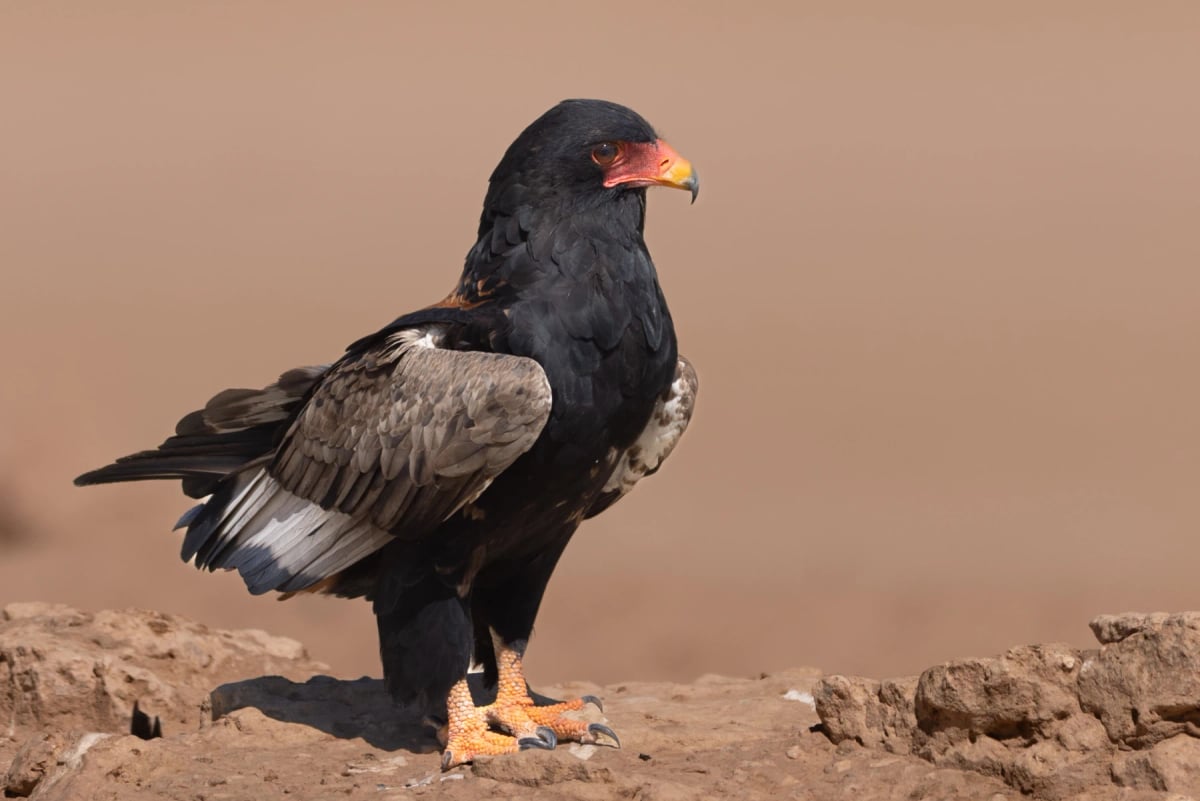
The Bateleur is classified as Endangered on the IUCN Red List, reflecting a population decline estimated at more than 50 percent over the past three generations. Poisoning is the single greatest threat. Farmers and poachers use poisoned carcasses to kill predators, and Bateleurs, as eager scavengers, are especially vulnerable. Collisions with power lines and electrocution on poorly insulated pylons also claim many birds each year. Habitat loss driven by agricultural expansion, overgrazing, and human settlement reduces the open landscapes the species needs to hunt and nest. Outside formally protected areas, Bateleur numbers have fallen sharply. Conservation efforts include working with local communities to reduce the use of poisons, retrofitting power infrastructure to make it safer for large birds, and monitoring known breeding pairs within national parks and game reserves across southern and eastern Africa.
Where it is found
The Bateleur can be found in places such as:
Researched and written by Juan Pablo. Sources: IUCN Red List, scientific literature and regional field guides. Last updated: .
Technical factsheet










Frequently Asked Questions
How did the Bateleur get its name?
The name comes from the French word for street performer or juggler. Early French naturalists watching this eagle soar noticed how it rocks and tilts from side to side in flight, much like a street entertainer balancing on a tightrope. It is one of the most fitting names given to any bird of prey, capturing both the showmanship and the physical skill on display every time the bird takes to the air.
What does the Bateleur eat?
The Bateleur is an opportunistic feeder with a varied diet. Carrion makes up a large part of its meals, which is why it is often seen alongside vultures at carcasses. It also actively hunts snakes and other reptiles, small mammals, and birds. On occasion it will target the eggs or chicks of species that nest on the ground. Its wide daily patrol range of up to 300 km helps it locate food across vast stretches of savanna.
How long do Bateleurs live?
Bateleurs are birds with notably long lifespans. In the wild, individuals are believed to reach 20 to 27 years of age, while those kept in captivity have survived beyond 40 years. They are also slow to mature, not reaching full adult plumage until around eight years of age. This slow development, combined with raising just one chick per year, means that populations recover very slowly when numbers decline.
Is the Bateleur the same as a vulture?
No, though the two are often confused at carcasses. The Bateleur is a true eagle belonging to the group known as snake eagles within the family Accipitridae. While it does scavenge carrion like vultures, it is also an active hunter capable of catching live prey. Its vivid coloring, distinctive short tail, and tilting flight style set it clearly apart from any vulture species found across Africa.
Why is the Bateleur endangered?
The Bateleur faces several serious pressures outside of habitat loss and power line collisions, which have already been well documented. Slow reproduction plays a major role: with only one chick raised per year and a maturity age of around eight years, each bird lost takes a very long time to replace. Demand for birds of prey in traditional medicine markets in parts of Africa also adds to the pressure on already fragile populations.
Can you tell male and female Bateleurs apart?
Yes, and it is one of the easier raptors to sex in the field. Both share the same vivid scarlet face and mostly black plumage, but the secondary feathers on the wing differ clearly. Males have entirely black secondary feathers, while females show a broad band of white across those same feathers. Juveniles are brown overall and take several years of gradual molting before they begin to show any adult coloring.
Does the Bateleur have any cultural significance in Africa?
The Bateleur holds a prominent place in several African cultures. In Zimbabwe, it is closely associated with the Zimbabwe bird, the iconic soapstone raptor that appears on the national flag and coat of arms, though scholars debate the exact species depicted. Across parts of southern and eastern Africa, sighting a Bateleur has traditionally been considered a good omen. Its striking appearance and commanding presence in the sky have made it a symbol of freedom and power in local traditions.