Armadillo
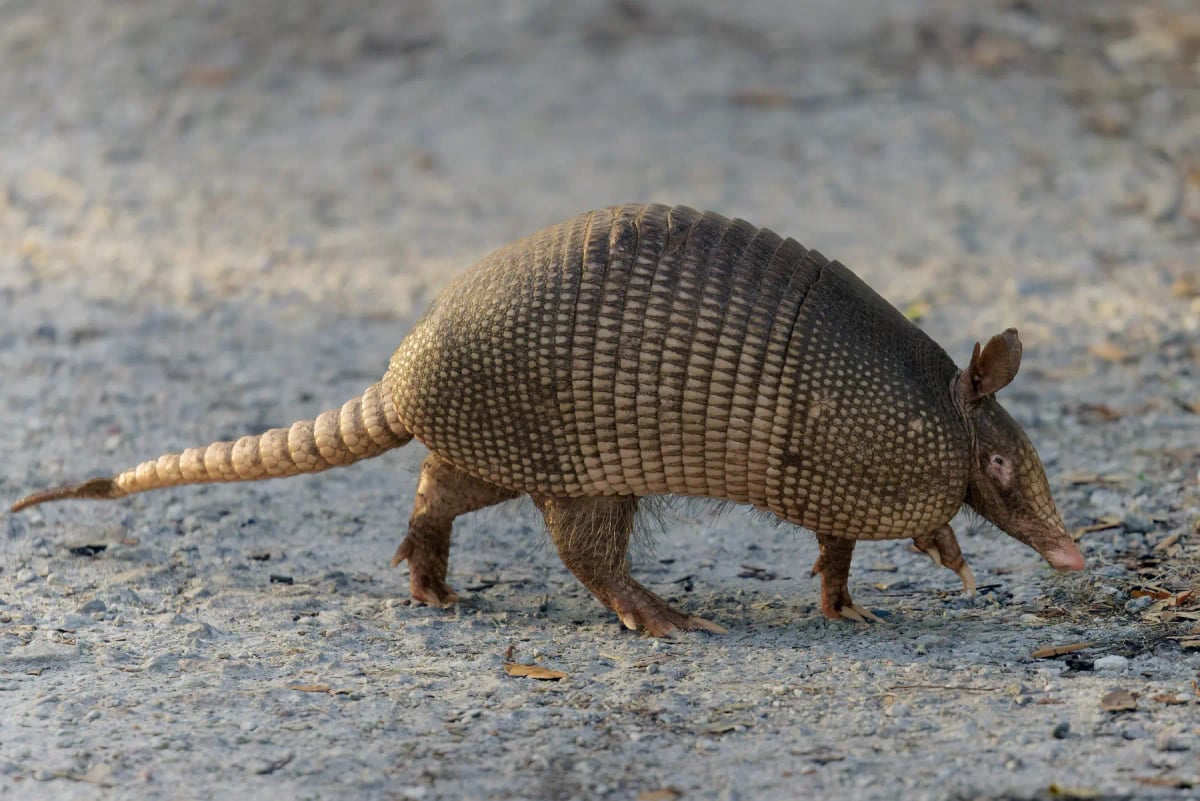
Armadillos are the only living mammals with a bony shell, belonging to the order Cingulata and distributed from the southern United States through Central America to Argentina. More than twenty species exist, ranging in size from the tiny pink fairy armadillo to the giant armadillo, which can weigh up to 50 kilograms. Their armor consists of bony plates covered in keratin, arranged in bands that vary across species. All armadillos are powerful diggers with strong claws, using burrows for shelter and foraging. Diet varies by species but centers on insects, larvae, and other invertebrates found in soil.
Habitat and distribution
Armadillos occupy a wide range of habitats across the Americas, from the dry scrublands and grasslands of the southern United States and Argentina to the tropical forests of the Amazon basin and Central America. Some species, like the nine-banded armadillo, are habitat generalists found in forests, savannas, and agricultural land. Others, like the giant armadillo, are more restricted to humid lowland forests and savanna ecosystems. Most species prefer areas with soft soil for burrowing and a reliable supply of invertebrate prey. The family's range has expanded northward in the United States over recent decades as winters have warmed.
Diet
Armadillos are primarily insectivores, with ants, termites, beetles, and their larvae making up the bulk of most species' diets. They locate prey by smell, rooting through leaf litter and soft soil with their snouts and excavating with their claws. Some species, including the nine-banded armadillo, also consume earthworms, small vertebrates, fungi, berries, and carrion when invertebrates are scarce. The giant armadillo specializes in ants and termites and can consume an entire termite mound in a single feeding session. Armadillos have a relatively low metabolic rate compared to other mammals of similar size, reducing their daily food requirements.
Behavior
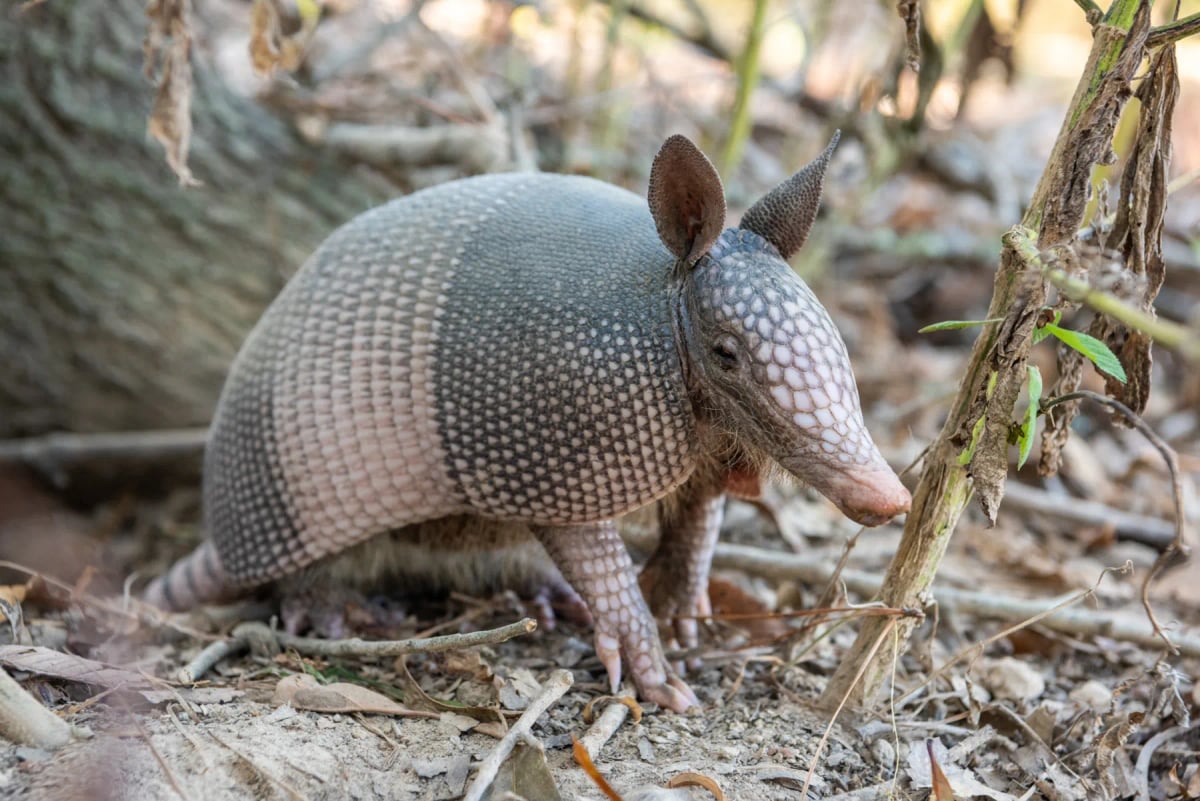
Most armadillos are solitary and nocturnal, spending the day in burrows and emerging after dark to forage. They rely heavily on their sense of smell to locate food, as their eyesight is poor. Burrows serve as shelter from predators and extreme temperatures, and some species maintain several burrows within their home range. The nine-banded armadillo is notable for always giving birth to identical quadruplets from a single fertilized egg. When threatened, most armadillos flee and dig rapidly rather than curling up. Only the three-banded armadillos of South America can roll into a complete ball for defense.
Adaptations
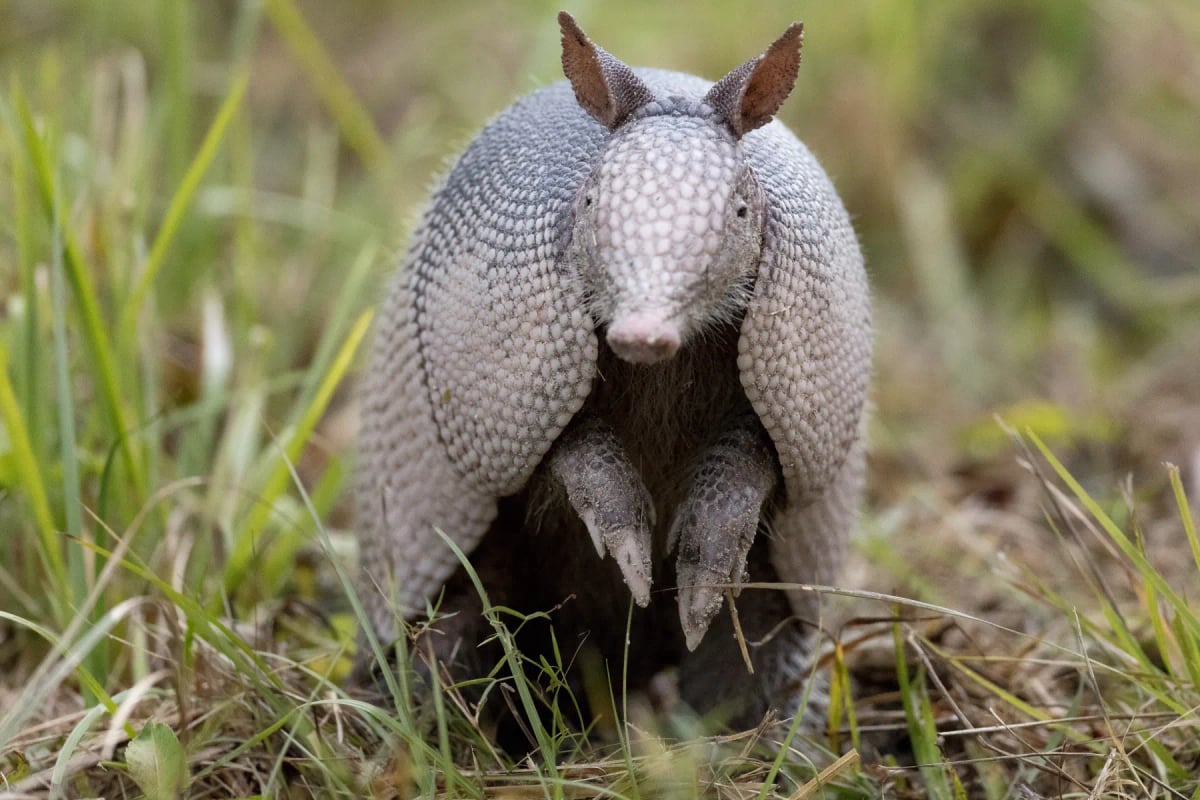
The most distinctive feature of armadillos is their armor, formed by bony dermal plates called osteoderms, covered externally by scales of keratin. The arrangement of these plates, including flexible bands across the mid-body, allows a degree of movement while maintaining protection. Strong forelimbs and curved claws are adapted for digging, both to construct burrows and to extract buried prey. Armadillos can hold their breath for extended periods, allowing them to walk along stream beds or even cross rivers underwater. A low metabolic rate and reduced body temperature compared to most mammals help conserve energy in resource-limited environments.
Conservation
Conservation status varies considerably across armadillo species. The nine-banded armadillo is common and expanding its range, while the giant armadillo is classified as Vulnerable and declining across much of its range. Several smaller species with restricted distributions are listed as Near Threatened or Endangered. The main threats are habitat loss from agricultural expansion, hunting for meat, and road mortality. The giant armadillo is particularly sensitive to deforestation and has been extirpated from large parts of its historical range in Brazil and Argentina. Dedicated conservation programs for the giant armadillo have expanded in recent years across the Brazilian Cerrado and Pantanal.
Where it is found
The Armadillo can be found in places such as:
Researched and written by Juan Pablo. Sources: IUCN Red List, scientific literature and regional field guides. Last updated: .
Technical factsheet











Frequently Asked Questions
Can armadillos really roll into a ball?
Not all armadillos can roll into a ball. Only the two species of three-banded armadillos, found in South America, are physically capable of curling completely into a sphere when threatened. Most other species, including the common nine-banded armadillo, cannot roll up and instead escape by fleeing and digging rapidly into the ground. The three-banded armadillo's shell fits together so precisely when rolled up that it leaves virtually no exposed soft tissue, making it nearly impenetrable to most predators.
How many species of armadillo are there?
There are more than twenty recognized armadillo species, all belonging to the order Cingulata and found exclusively in the Americas. They range greatly in size: the pink fairy armadillo of Argentina weighs around 100 grams, while the giant armadillo of South America can reach 50 kilograms. Each species occupies a different ecological niche, from the dry scrublands of Patagonia to the humid forests of the Amazon. The nine-banded armadillo is the most widespread and the only species found in the United States.
Do armadillos carry leprosy?
The nine-banded armadillo is the only non-human animal known to harbor Mycobacterium leprae, the bacterium that causes leprosy, under natural conditions. This is possible partly because the armadillo has a lower body temperature than most mammals, which suits the bacterium's growth. In the United States, a small number of human leprosy cases have been linked to contact with armadillos, though transmission is considered rare. Handling wild armadillos, particularly in the southern United States, carries a very low but real risk, and direct contact is generally discouraged.
What do armadillos eat?
Armadillos are primarily insectivores that feed on ants, termites, beetles, and their larvae, which they locate by smell and dig out of the soil. Some species, including the nine-banded armadillo, also eat earthworms, small vertebrates, berries, and carrion when insects are scarce. The giant armadillo specializes almost entirely in ants and termites and can consume an entire colony in one visit. Armadillos forage at night, moving slowly and rooting through leaf litter and soft earth with their snouts.
Is the armadillo a mammal?
Yes, the armadillo is a mammal. It belongs to the order Cingulata and is the only living group of mammals with a bony external shell. Like all mammals, it is warm-blooded, gives birth to live young, and nurses them with milk. Its closest living relatives are sloths and anteaters, with which it shares the superorder Xenarthra. Despite appearances, the armadillo's shell is not like a turtle's: it is made of real bone fused to the skin, covered by scales of keratin, and is part of the animal's skeleton.
Why do armadillos jump when scared?
The nine-banded armadillo has a strong startle reflex that causes it to leap vertically when suddenly frightened, sometimes reaching a height of about one meter. This behavior evolved as a defense against ground predators: a sudden upward jump can startle an attacking animal and disrupt its strike. Unfortunately, this same reflex makes armadillos particularly vulnerable on roads, where they leap directly into the path of passing vehicles rather than staying low. Road mortality is one of the leading causes of armadillo deaths in areas where they coexist with human infrastructure.