Bengal Slow Loris
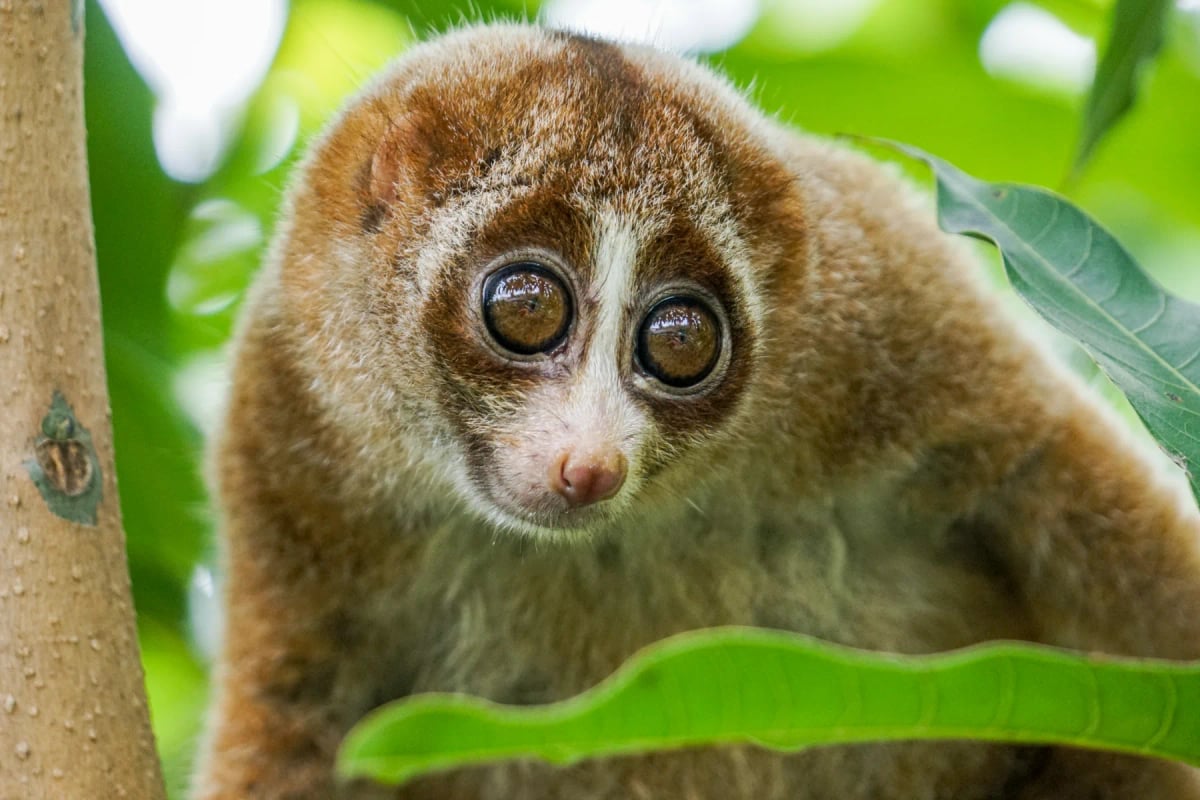
The Bengal slow loris (Nycticebus bengalensis) is the largest of all slow loris species and one of the most remarkable primates in Asia. Native to the forests of northeastern India, Bangladesh, Myanmar, Indochina, and southern China, it spends its nights creeping through dense canopy, gripping branches with a precision grip made possible by a specialized blood vessel network in its hands. Its oversized eyes gather light efficiently in total darkness. What truly sets this animal apart is its venom: a secretion produced by a gland on the inner arm combines with saliva to create a toxic mix that can cause severe allergic reactions in humans and deter natural predators. It feeds on tree gum, nectar, fruit, insects, and small vertebrates. Classified as Vulnerable by the IUCN, it faces serious pressure from deforestation and the illegal pet trade, which has driven steep population declines across its range.
Habitat and distribution
The Bengal slow loris occupies a broad stretch of South and Southeast Asia, ranging from northeastern India and Bangladesh through Myanmar, Thailand, Laos, Cambodia, Vietnam, and into southern China. It favors tropical and subtropical forests, including both evergreen and semi-evergreen types, as well as bamboo groves and forest edges where vegetation is dense enough to support continuous canopy travel. It is most commonly found at lower and mid elevations, though records exist from hilly terrain in northeastern India and Bhutan. The species depends heavily on undisturbed forest with abundant tree gum sources and fruiting trees. Forest fragmentation has pushed some individuals into degraded secondary habitats, but populations in such areas tend to be sparse and under considerable stress from reduced food availability and increased exposure to hunters.
Venom, night vision, and grip: a primate built for the dark
The Bengal slow loris is the only venomous primate known to science. A gland on the inside of each arm produces an oily secretion that, when mixed with saliva during grooming, becomes a toxic substance capable of causing intense allergic reactions and tissue damage. This defense works against both predators and rival lorises. Its enormous eyes are packed with rod cells, giving it exceptional vision in near-total darkness. A reflective layer behind the retina, the tapetum lucidum, amplifies available light further still. Its hands are equipped with a powerful pincer-like grip supported by a network of fine blood vessels, called the rete mirabile, that sustains muscle contractions for hours without fatigue. This allows the animal to cling motionless to branches for extended periods, a key survival strategy when hiding from predators.
Behavior and social life
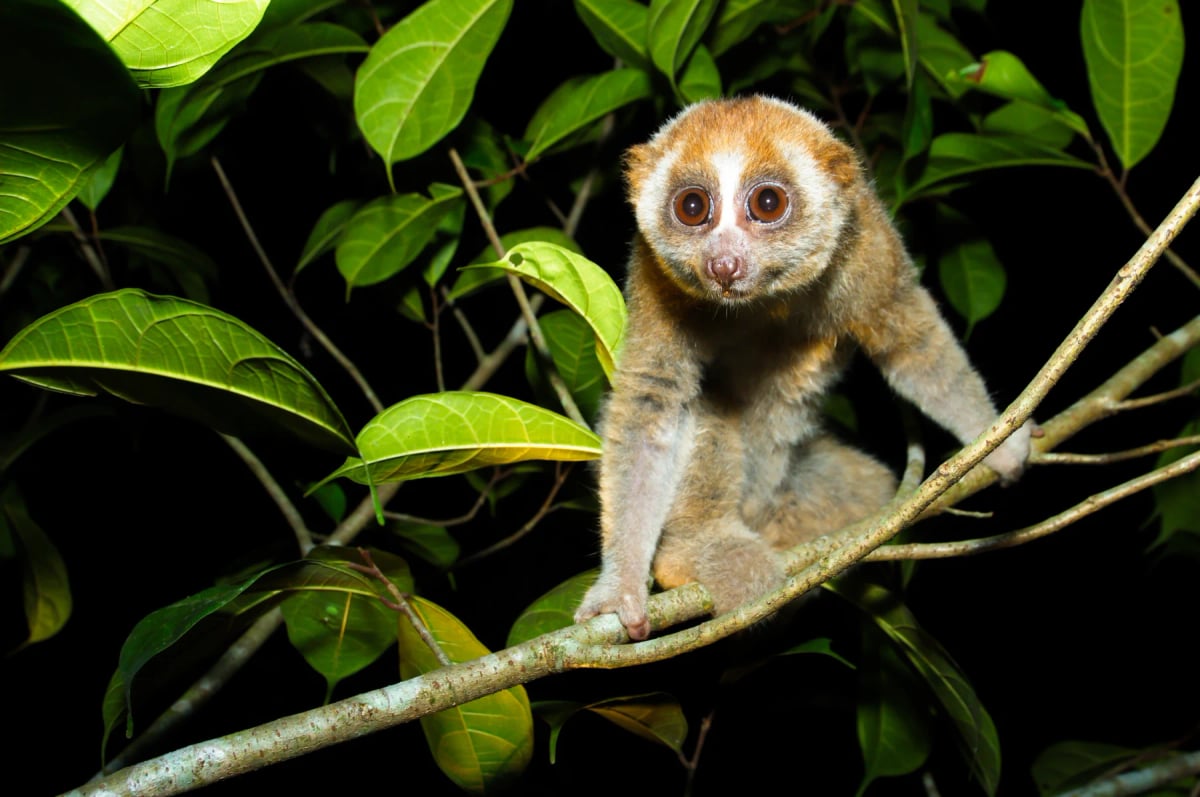
The Bengal slow loris is strictly nocturnal, spending daylight hours curled into a tight ball in dense vegetation or tree hollows, often with its head tucked between its arms. After dark it moves deliberately through the canopy in search of food, covering a home range that can extend several hectares in a single night. Its diet shifts with seasonal availability, encompassing tree gum, nectar, ripe fruit, insects, and occasionally small vertebrates. It is largely solitary, though overlapping home ranges suggest a loose social structure maintained through scent marking and vocalizations. Females raise offspring alone, carrying infants on their backs or parking them on a branch while foraging. Communication includes a range of soft calls and ultrasonic signals not audible to humans. Individuals are known to apply venom to their young as a deterrent against predators.
Conservation
The Bengal slow loris is classified as Vulnerable on the IUCN Red List, with populations in decline across most of its range. The two greatest threats are habitat loss and the illegal wildlife trade. Large-scale deforestation for agriculture, logging, and infrastructure development continues to shrink and fragment the forest cover this species depends on. At the same time, its large eyes and docile appearance make it a target for the exotic pet trade, fueled largely by videos shared on social media. Traders typically pull out the animal's teeth before sale, a procedure that causes infection and often death. It is listed on Appendix I of CITES, banning all international commercial trade, and is legally protected in every country within its range. Conservation efforts focus on habitat protection, law enforcement, and public awareness campaigns aimed at reducing demand for slow lorises as pets.
Where it is found
The Bengal Slow Loris can be found in places such as:
Researched and written by Juan Pablo. Sources: IUCN Red List, scientific literature and regional field guides. Last updated: .
Technical factsheet

Frequently Asked Questions
Is the Bengal slow loris really venomous?
Yes, and it is the only primate on Earth known to produce venom. A gland on the inside of its arm releases an oily secretion that becomes toxic when mixed with saliva. The venom can cause severe allergic reactions in humans, including anaphylactic shock in rare cases, and serves as a deterrent against predators. This trait makes the Bengal slow loris genuinely unique among all mammals in its order.
What does the Bengal slow loris eat?
The Bengal slow loris has a varied diet that changes with the seasons. It feeds on tree gum, nectar, ripe fruit, insects, and occasionally small vertebrates such as lizards or nestling birds. Tree gum is a particularly important food source, and the animal has specialized teeth called a tooth comb that help it scrape gum from bark. This dietary flexibility allows it to survive in forest environments where no single food source is available year round.
Why is the Bengal slow loris endangered?
The Bengal slow loris is currently listed as Vulnerable by the IUCN, one step below Endangered. Its biggest threats are the destruction of forest habitat and the illegal pet trade. Deforestation removes the continuous canopy it needs to move and feed, while demand driven by social media videos has made it a highly sought after animal in illegal markets. Combined, these pressures have caused significant population declines across much of its range.
How big is the Bengal slow loris compared to other loris species?
The Bengal slow loris is the largest of all slow loris species. Adults typically weigh between 1 and 2.1 kilograms and measure around 26 to 38 centimeters in body length. By comparison, the pygmy slow loris weighs less than 500 grams. Despite its relatively larger size, it remains a compact, stocky animal with short limbs built for gripping branches rather than leaping between them.
How long do Bengal slow lorises live?
In the wild, Bengal slow lorises are estimated to live around 20 years, though exact data from wild populations is limited due to the difficulty of studying nocturnal animals in dense forest. In captivity, individuals have lived into their mid-twenties under proper care. Their slow metabolic rate, which is unusually low for a primate of their size, is thought to be one of the factors that contributes to their relatively long lifespan.
Does the Bengal slow loris make a good pet?
No. Keeping a Bengal slow loris as a pet is both illegal and deeply harmful to the animal. Before being sold, traders typically remove their teeth without anesthesia, leading to infection and a shortened life. Slow lorises have complex dietary and environmental needs that cannot be met in a home setting. The species is protected under CITES Appendix I and national laws across its entire range. Demand for them as pets is one of the primary drivers of their population decline.
How does the Bengal slow loris move through the forest?
Unlike many primates that leap between trees, the Bengal slow loris moves in a slow, deliberate crawl through the canopy, gripping branches firmly at each step. It almost never jumps. Its limbs are roughly equal in length, which suits this style of movement rather than bounding or swinging. This cautious approach helps it stay silent and hidden from predators at night, and it can freeze in place for long periods when it senses a threat nearby.