Alpine Ibex
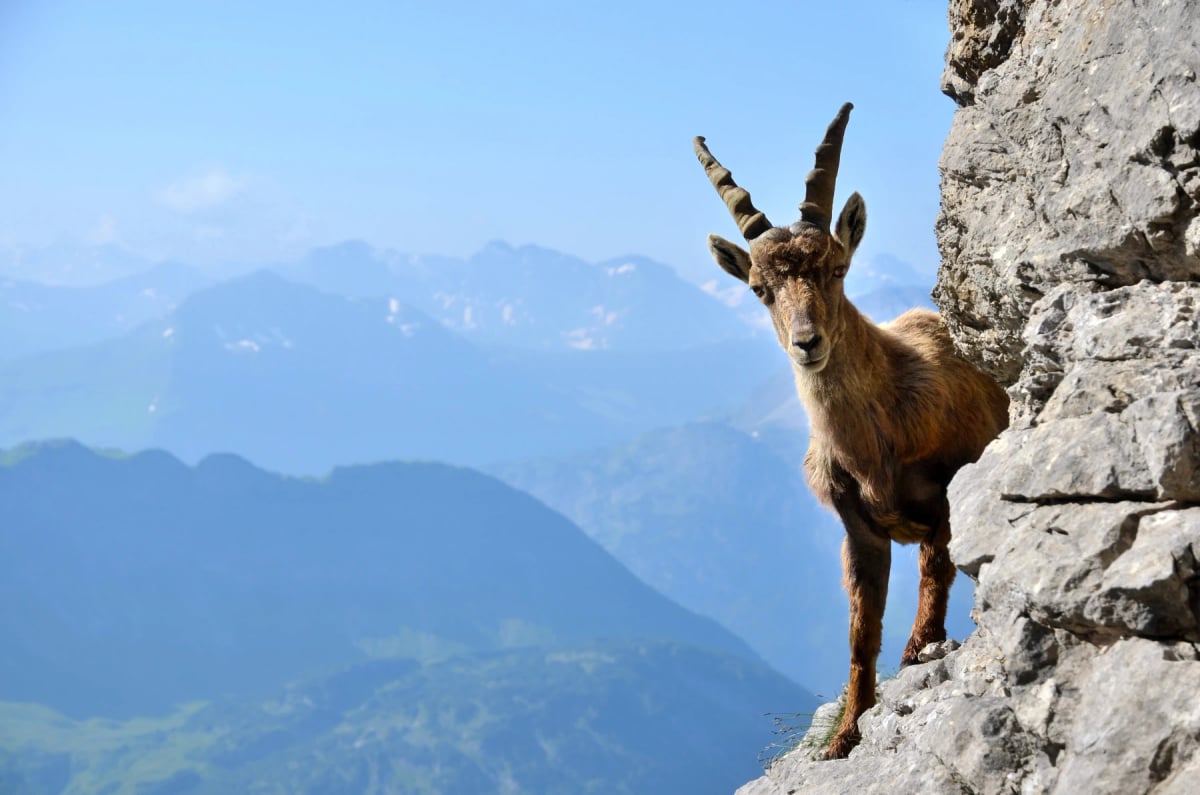
The Alpine ibex is a wild goat native to the European Alps, adapted to steep rocky slopes above the tree line. Males are distinguished by massive horns that curve backward, used in dominance fights during the rut. Once nearly extinct due to overhunting, the species survived in a small Italian refuge and has since been reintroduced across the Alps. Today stable populations live in national parks of France, Switzerland, Italy, Austria, and beyond.
Habitat and distribution
The Alpine ibex lives exclusively on steep rocky slopes of the European Alps, typically between 1,600 and 3,200 meters above sea level. It spends summers at elevations above the tree line, feeding on alpine meadows and rocky outcrops, and moves to lower slopes facing south during winter to find exposed vegetation. The species was originally found across much of the Alps but was hunted nearly to extinction by the early 1800s. Reintroduction programs launched in the twentieth century have restored populations in Switzerland, Austria, France, Italy, Germany, Slovenia, and other countries.
Diet
The Alpine ibex is a selective grazer that feeds mainly on grasses, alpine herbs, sedges, and mosses during the summer months when vegetation is abundant. In winter, when deep snow covers most plants, it shifts to more accessible food such as lichens, bark, and dry woody shrubs found on rocky slopes exposed to the wind. Ibex also visit natural mineral licks that provide essential nutrients including salt and calcium. Unlike many ungulates, they do not migrate to lower valleys in winter but rely on their ability to find food in challenging terrain at high elevation.
Behavior
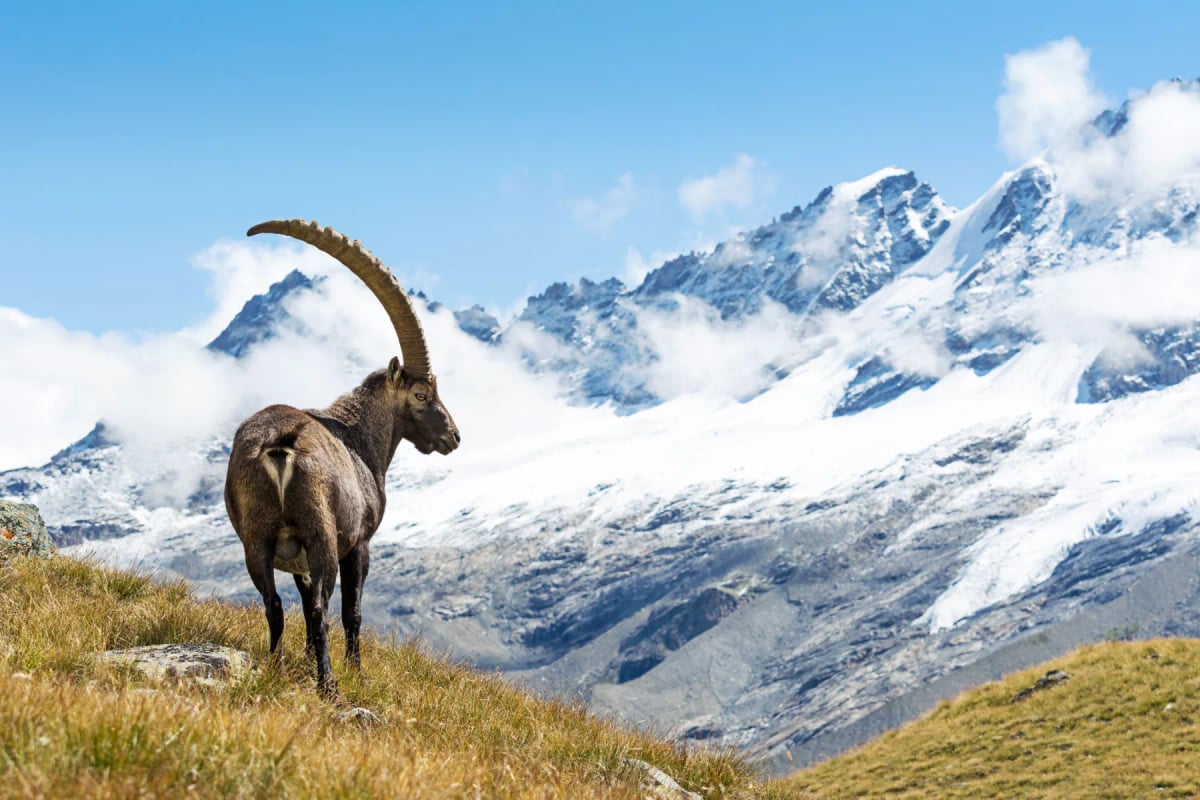
Alpine ibex are highly capable climbers, using strong legs and specialized hooves with hard outer edges and soft inner pads that grip rock surfaces with precision. Males and females live in separate groups for most of the year, coming together only during the winter rut. Males establish dominance through displays of horn clashing that can be intense and prolonged. Ibex are diurnal, most active in the early morning and late afternoon. In protected areas, they have grown accustomed to the presence of hikers over many decades and often show little fear of humans.
Breeding
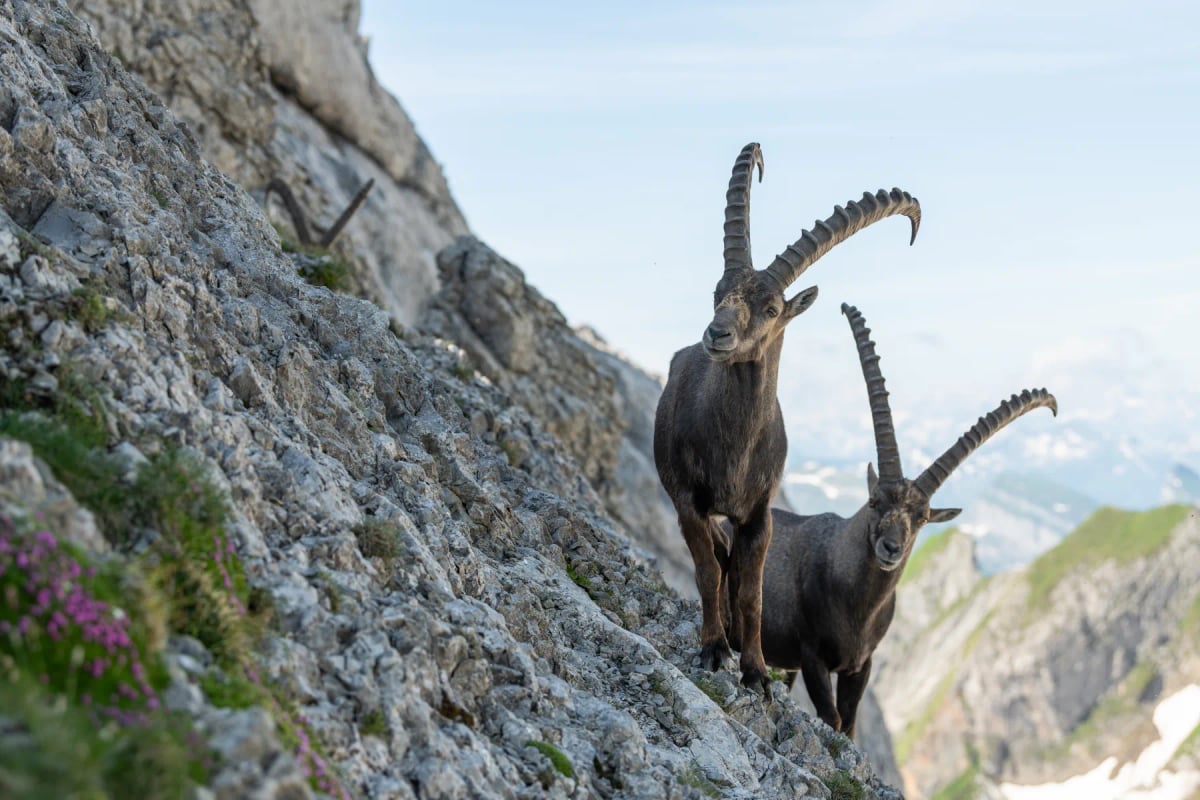
The rut occurs from December to January, when males compete aggressively for access to females through dramatic contests of horn clashing. Older males with larger horns tend to dominate. After a gestation period of around 170 days, females give birth to a single kid, occasionally twins, in late May or June. Kids are mobile within hours of birth and can navigate rocky terrain very quickly. Females raise their young independently, and kids remain with their mothers through the first winter before eventually joining juvenile groups.
Conservation
The Alpine ibex came close to complete extinction in the early nineteenth century, reduced to just a few hundred animals surviving in what is now Gran Paradiso National Park in Italy. Under royal protection and later Italian state management, the population recovered gradually. Starting in the early 1900s, animals were relocated to establish new populations across Switzerland, France, Austria, Germany, Slovenia, and other countries. Today the total population is estimated at around 50,000 individuals and the species is classified as Least Concern by the IUCN, though continued protection of mountain habitats remains essential for long-term stability.
Where it is found
The Alpine Ibex can be found in places such as:
Researched and written by Juan Pablo. Sources: IUCN Red List, scientific literature and regional field guides. Last updated: .
Technical factsheet




Frequently Asked Questions
Where does the Alpine ibex live?
The Alpine ibex lives on steep rocky slopes of the European Alps, typically between 1,600 and 3,200 meters above sea level. It spends summers above the tree line feeding on alpine meadows and descends to south-facing slopes in winter to find exposed vegetation. Populations exist in Switzerland, Italy, France, Austria, Germany, Slovenia, and Bulgaria. Switzerland holds one of the largest concentrations, with around 17,000 individuals across protected mountain areas.
Was the Alpine ibex nearly extinct?
Yes. By the early nineteenth century, centuries of unregulated hunting had reduced the Alpine ibex to just a few hundred individuals surviving in what is now Gran Paradiso National Park in northern Italy. The species owed its survival entirely to royal protection in that area. Starting in the early twentieth century, reintroduction programs relocated animals from Italy to Switzerland, France, Austria, Germany, and Slovenia. Today around 50,000 individuals live across the Alps and the species is classified as Least Concern by the IUCN.
How do Alpine ibex climb such steep rocks?
The Alpine ibex has specialized hooves with hard outer edges that grip rock surfaces and soft inner pads that act like friction material on uneven terrain. This combination allows it to navigate nearly vertical cliff faces and stand on ledges only a few centimeters wide. Strong leg muscles provide the power for rapid ascents. Climbing steep terrain also serves as a defense strategy, as most predators cannot follow ibex onto the most exposed high-altitude rock faces.
What do Alpine ibex eat?
Alpine ibex are selective grazers that eat mainly grasses, alpine herbs, sedges, and mosses in summer when vegetation is abundant. In winter, when snow covers most plants, they shift to lichens, bark, and dry woody shrubs on rocky slopes exposed to the wind. They also visit natural mineral licks that provide essential nutrients including salt and calcium. Unlike many mountain ungulates, they do not migrate to lower valleys in winter but find food in the high terrain year round.
What are Alpine ibex horns used for?
The large curved horns of male Alpine ibex are used primarily in dominance contests during the winter rut. Males clash horns in prolonged and intense confrontations to establish hierarchy and gain access to females. Older males with larger horns tend to dominate. Females also carry horns, though much smaller. Outside the breeding season, horn size serves as a visual signal of age and strength within male groups. Horns continue growing throughout the animal's life.