Red Howler Monkey
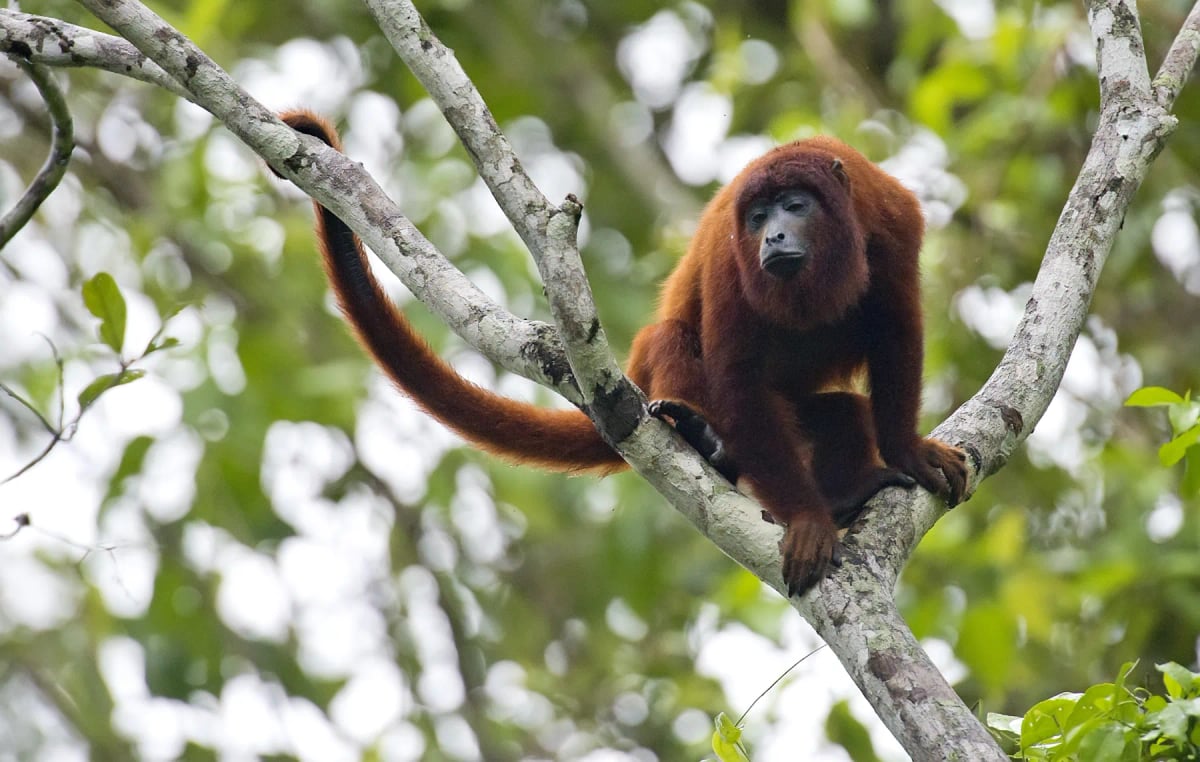
The red howler monkey is one of the most recognizable primates in South America, famous for a booming call that travels more than three kilometers through dense forest. That extraordinary volume comes from an enlarged hyoid bone in the throat, which acts as a resonating chamber. Groups of four to nineteen individuals spend most of the day resting in the canopy, conserving energy because their diet is based largely on leaves, which offer little nutrition. Young leaves, fruits, and flowers round out the menu. Males typically lead the chorus at dawn and dusk, warning neighboring troops to keep their distance without the need for direct confrontation. Their reddish coat ranges from deep chestnut to bright auburn. Despite pressures from deforestation, hunting, and habitat fragmentation, populations across the Amazon and Orinoco basins remain relatively stable.
Habitat and distribution
Across northern and central South America, the red howler monkey occupies one of the most expansive ranges of any New World primate. It is found in Venezuela, Colombia, Ecuador, Peru, Bolivia, Brazil, Guyana, and Suriname, spanning both the Amazon and Orinoco basins. Tropical rainforest is its stronghold, but populations also thrive in gallery forests, flooded várzea forest, and secondary growth where trees have begun to recover. The species favors continuous canopy cover, which allows troops to move and feed while rarely descending to the ground. Elevation plays a role too: individuals have been recorded at altitudes above 3,000 meters in Andean foothills, showing a flexibility that has helped the species persist across a wide variety of forest types throughout the continent.
Diet
Leaves form the foundation of the red howler monkey's diet, making it one of the most committed folivores among primates in the Americas. Young leaves are preferred because they are easier to digest and contain fewer toxins than mature ones, though ripe fruits and flowers are eaten when available and provide bursts of energy and nutrients. To cope with foliage that is often poor in nutrition, the species has evolved a slow, deliberate metabolism and spends a large portion of each day resting in the canopy. This rest is not laziness but a genuine strategy for managing energy. A specialized gut allows fermentation of tough plant material, extracting as much value as possible from each mouthful of leaves the troop consumes throughout the day.
Behavior
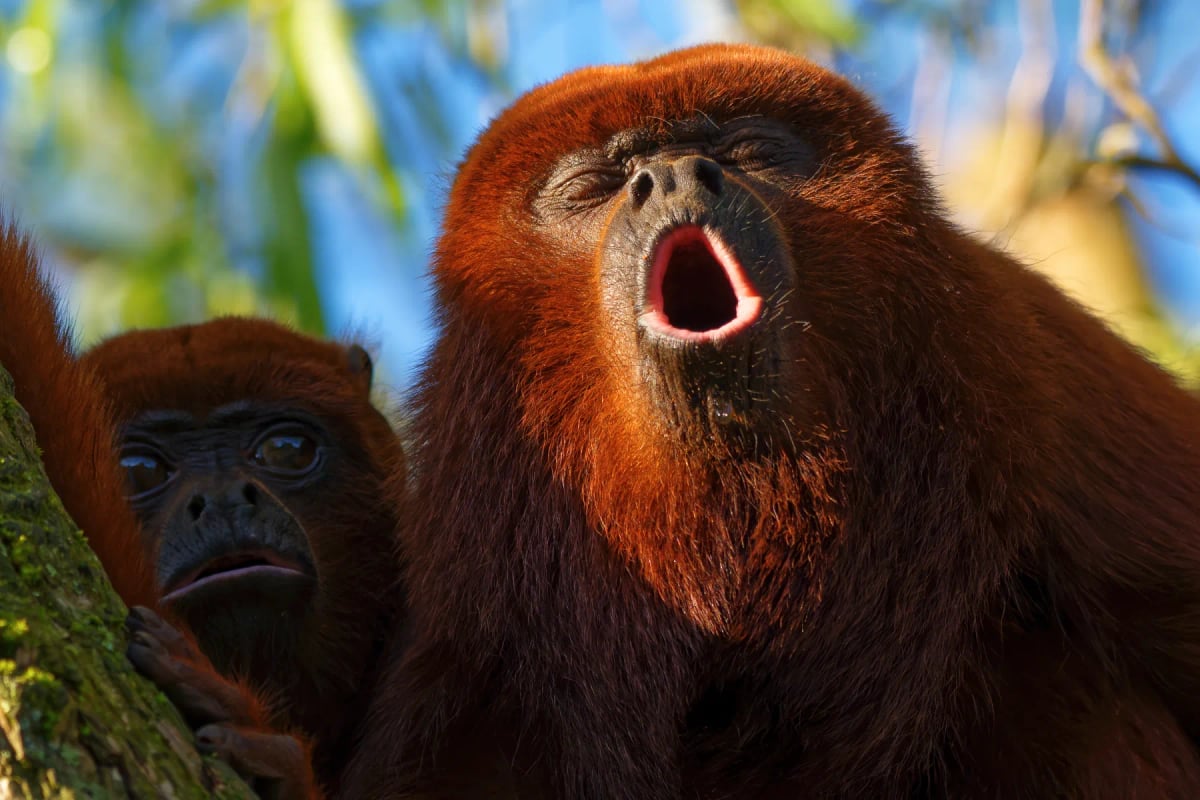
Red howler monkeys are social animals that live in groups typically made up of four to nineteen individuals, usually with one or more adult males, several females, and their offspring. Life in the group revolves around the canopy, where the troop feeds, rests, and travels together through the forest. Social bonds between females tend to be strong, and grooming plays an important role in maintaining group cohesion. Adult males take on the role of sentinels, initiating the chorus calls that keep rival troops at a distance. Direct physical confrontations between groups are uncommon because vocal communication does the work instead. When moving through the trees, howler monkeys are deliberate and unhurried, relying on their prehensile tail as a fifth limb to grip branches securely while they feed or rest.
Vocalizations
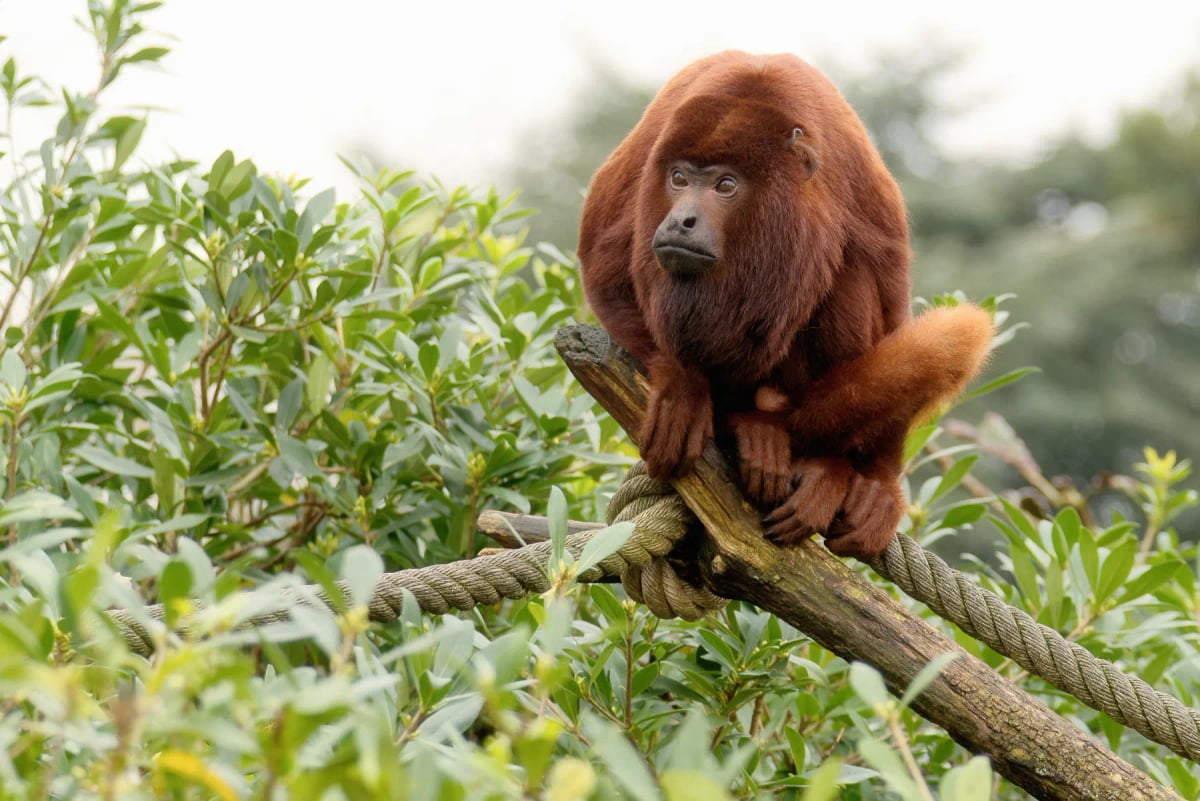
Few sounds in the South American forest are as striking as the roar of a red howler monkey troop at dawn. The call carries more than three kilometers through dense vegetation, a feat made possible by an enlarged hyoid bone in the throat that acts as a resonating chamber, amplifying sound far beyond what the animal's size might suggest. Males produce the deepest and loudest calls, typically leading the chorus at sunrise and again at dusk. These sessions serve a clear purpose: neighboring troops hear the call and understand that a territory is occupied, which reduces the need for physical encounters. Females and younger individuals also vocalize, though less powerfully. The hyoid bone in this species is among the largest, relative to body size, found in any primate anywhere in the world.
Conservation
The IUCN currently lists the red howler monkey as Least Concern, reflecting populations that remain relatively stable across much of its range. That stability, however, should not be mistaken for an absence of threats. Deforestation driven by agriculture, cattle ranching, and logging continues to reduce and fragment the forests these monkeys depend on, cutting off populations from one another over time. In parts of Colombia, Venezuela, and the western Amazon, the species is also hunted for food, which adds pressure in areas where forest loss is already a problem. Red howler monkeys are particularly sensitive to fragmentation because they rely on large, connected stretches of canopy to meet their dietary needs. Protecting forest corridors and enforcing wildlife laws in high-pressure regions remain the most important steps toward securing their future.
Where it is found
The Red Howler Monkey can be found in places such as:
Researched and written by Juan Pablo. Sources: IUCN Red List, scientific literature and regional field guides. Last updated: .
Technical factsheet




Frequently Asked Questions
How loud is a red howler monkey's call?
The red howler monkey is one of the loudest land animals on Earth. Its call can travel more than three kilometers through dense forest, thanks to an enlarged hyoid bone in the throat that works like a resonating chamber. Males lead the chorus at dawn and dusk. That sound is not aggression but a message to neighboring troops: this territory is taken, so there is no need to come closer.
What do red howler monkeys eat?
Leaves make up the bulk of their diet, especially young ones that are easier to digest. When available, they also eat ripe fruits and flowers for a boost in energy and nutrients. Because leaves offer little nutrition, these monkeys have a slow metabolism and rest for long stretches each day. A specialized digestive system helps them ferment tough plant material and get as much as possible out of every meal.
Where do red howler monkeys live?
They are found across a large portion of northern and central South America, including Venezuela, Colombia, Ecuador, Peru, Bolivia, Brazil, Guyana, and Suriname. Tropical rainforest is their preferred home, but they also do well in gallery forests and areas of secondary growth. They spend almost all of their time in the canopy and rarely come down to the ground, relying on a continuous cover of trees to travel and feed.
Are red howler monkeys endangered?
The IUCN classifies them as Least Concern, meaning their populations are stable enough across most of their range. That said, they still face real threats. Deforestation for farming and cattle ranching reduces the forest they depend on, while hunting adds pressure in some regions. Because they need large, connected stretches of canopy to survive, habitat fragmentation is a serious concern even if the species as a whole is not currently at risk of extinction.
How do red howler monkeys move through the trees?
They move in a slow and deliberate way, which suits their low-energy diet perfectly. Their prehensile tail acts as a fifth limb, gripping branches firmly while they reach for food or settle in to rest. This tail grip is strong enough to hold the animal's full weight. Rather than leaping between trees the way some primates do, howler monkeys prefer careful, measured movements through the canopy.
Do red howler monkeys live alone or in groups?
They are social animals and live in groups of four to nineteen individuals. A typical troop includes one or more adult males, several females, and their young. Females tend to form the most stable social bonds within the group, and grooming helps keep relationships strong. Adult males act as sentinels, producing the powerful calls that warn other troops away. Physical fights between groups are rare because the vocal warnings usually do the job.
Why do red howler monkeys rest so much during the day?
Resting is actually a survival strategy. Leaves, which make up most of their diet, are low in calories and take a long time to digest. By staying still for hours at a time, these monkeys conserve the limited energy their food provides. It is the same principle behind why some animals with poor diets move as little as possible. Far from being lazy, a resting howler monkey is doing exactly what its body needs to stay healthy.