Steppe Eagle
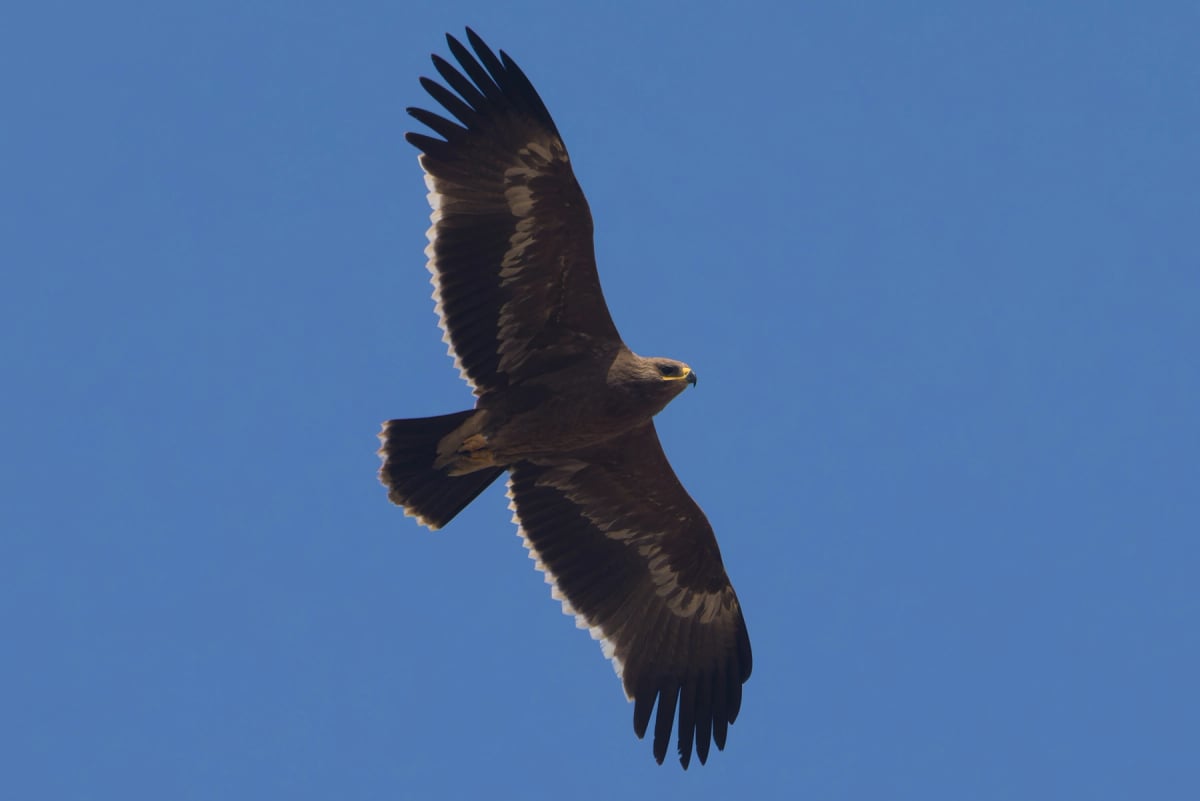
The steppe eagle (Aquila nipalensis) is a large, powerful raptor that breeds across the open steppes and semi-deserts of Central Asia, from Russia and Kazakhstan east into Mongolia. Each autumn it undertakes one of the longest migrations of any eagle, traveling thousands of kilometers to winter quarters in Africa, the Middle East, and South Asia. Adults are mostly dark brown, with a distinctive gape that extends well behind the eye, a feature shared by few other eagles. Wingspan reaches up to 2.15 meters, and birds rely on thermals to cover vast distances efficiently. They feed on small mammals, birds, reptiles, invertebrates, and a great deal of carrion, often gathering in flocks at termite emergences or carcasses. The IUCN lists the species as Endangered, with the global population estimated at around 30,000 individuals and continuing to decline due to electrocution on power lines, poisoning, and habitat loss.
Habitat and distribution
Steppe eagles breed across the vast open grasslands and semi-deserts stretching from southern Russia and Kazakhstan eastward into Mongolia. They favour flat, treeless terrain where visibility is high and ground-dwelling prey is abundant. Once the breeding season ends, these eagles set off on one of the most impressive journeys made by any bird of prey, crossing continents to spend the northern winter in sub-Saharan Africa, the Arabian Peninsula, and South Asia. India receives particularly large numbers during the winter months. The full range of countries where steppe eagles occur, whether breeding, migrating, or wintering, is enormous, spanning from Eastern Europe and the Middle East all the way down through East Africa as far as South Africa.
Diet
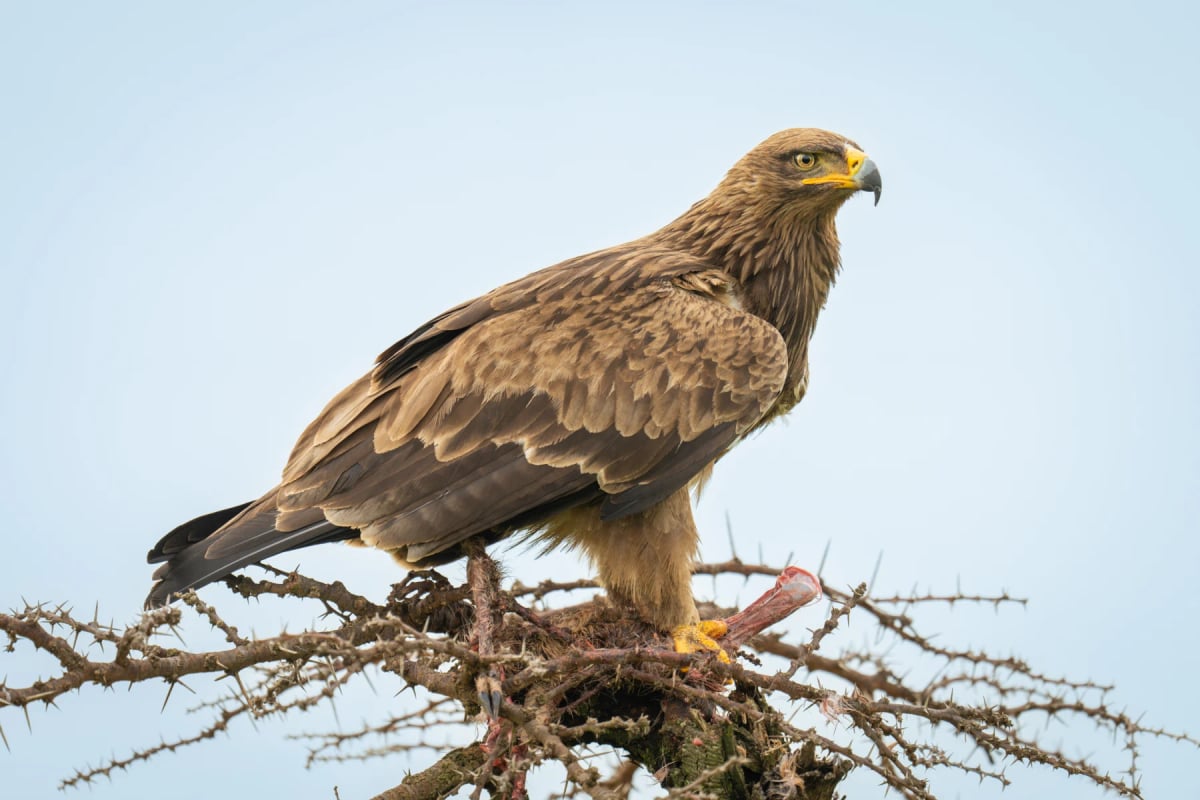
Few raptors eat as wide a variety of food as the steppe eagle. On its breeding grounds it targets small mammals, particularly sousliks and other rodents, along with reptiles and the eggs and chicks of ground-nesting birds. Carrion forms a significant part of the diet throughout the year, and large numbers of eagles will gather at a carcass or follow herds of livestock in anticipation of scraps. One of the most striking feeding behaviours involves termite emergences: steppe eagles congregate in great numbers on the African wintering grounds to snatch flying termites straight from the air or pick them up from the ground. This willingness to exploit almost any food source is a key reason the species can survive such a long annual journey.
Migratory routes
Every autumn, steppe eagles leave their Central Asian breeding grounds and travel thousands of kilometres south. The routes they follow are shaped by geography: birds funnel through well-known bottlenecks where thermals and updrafts make soaring efficient. The Suez Canal corridor in Egypt and the skies over Israel and Jordan see extraordinary concentrations, with tens of thousands of eagles passing within a matter of weeks. Another major flyway crosses through South Asia, with birds pushing through Pakistan and India. In spring the return journey begins, with eagles passing back through the same corridors between March and May. Satellite tracking studies have revealed that individual birds can cover more than 10,000 kilometres each way, making this one of the longest regular migrations undertaken by any eagle species in the world.
Threats
The steppe eagle faces serious pressures across much of its range, and the global population has fallen sharply over recent decades. Electrocution on poorly insulated power lines is one of the leading causes of death, particularly in Central Asia and on the wintering grounds. Poisoning is another major concern: eagles die after eating carcasses laced with toxins, either set deliberately to kill predators or used illegally as rodenticides. The loss and degradation of steppe habitat through agricultural expansion and overgrazing reduces the availability of prey on breeding grounds. Disturbance at nest sites, illegal trapping, and collisions with vehicles and wind turbines add further pressure. Because steppe eagles gather in large concentrations during migration and at food sources, a single harmful event can kill many individuals at once.
Conservation
Listed as Endangered on the IUCN Red List, the steppe eagle is the subject of growing conservation efforts across its range. Retrofitting dangerous power lines with insulated cables and bird guards has proven effective at reducing electrocution deaths in several countries. Conservation organisations work with local governments in Kazakhstan, Russia, and Mongolia to protect key nesting areas and monitor breeding success. Satellite tagging programmes track individual eagles throughout their annual journey, revealing which stopover sites and wintering areas are most critical. Education campaigns in Africa and the Middle East aim to reduce poisoning incidents. International cooperation is essential, since no single country can protect a species that relies on dozens of nations across two continents every year.
Where it is found
The Steppe Eagle can be found in places such as:
Researched and written by Juan Pablo. Sources: IUCN Red List, scientific literature and regional field guides. Last updated: .
Technical factsheet





Frequently Asked Questions
What does the steppe eagle eat?
Steppe eagles are opportunistic feeders. On their breeding grounds they hunt rodents, reptiles, and the chicks of ground-nesting birds. Throughout the year they also eat a lot of carrion, gathering in groups at carcasses. On their African wintering grounds, large flocks will chase and catch flying termites during emergences. This flexibility with food is a big part of what allows them to survive such a demanding annual migration.
How far does the steppe eagle migrate?
Steppe eagles are among the greatest travelers in the eagle world. Each year they fly from their breeding grounds in Central Asia all the way to sub-Saharan Africa, South Asia, or the Arabian Peninsula, and then back again. Satellite tracking has shown that individual birds can cover more than 10,000 kilometres in a single direction. That means some eagles travel over 20,000 kilometres in a full year just between their seasonal homes.
Is the steppe eagle endangered?
Yes, the steppe eagle is listed as Endangered on the IUCN Red List. The global population is estimated at around 30,000 individuals and has been declining steadily. The main threats are electrocution on power lines, poisoning from contaminated carcasses, and the loss of open steppe habitat. Because these eagles gather in large groups during migration and at feeding sites, a single harmful event can wipe out many birds at once.
How big is a steppe eagle?
The steppe eagle is a large and powerful bird. Its wingspan can reach up to 2.15 metres, making it one of the bigger eagles found across Asia and Africa. Adults are mostly dark brown overall, and one of their most recognisable features is a wide gape, the opening of the beak, that stretches unusually far back behind the eye. This gives the face a distinctly broad look compared to most other eagles.
Where do steppe eagles breed?
Steppe eagles nest across the open grasslands and semi-deserts of Central Asia. Their breeding range stretches from southern Russia and Kazakhstan all the way east into Mongolia. They prefer flat, treeless landscapes where they have a clear view of the ground and can spot prey from a distance. Nests are built on the ground or on low rocky outcrops, and pairs return to the same territories year after year.
Why do steppe eagles gather in such large flocks?
Steppe eagles are far more social than most eagles. They come together in huge numbers wherever food is plentiful, such as at animal carcasses, termite emergences in Africa, or favourable thermal currents along migration routes. Hundreds or even thousands of birds can be seen together at key bottlenecks during spring and autumn. This social behaviour is unusual for such a large raptor but makes perfect sense when food appears in abundance and conditions for soaring are ideal.
What is being done to protect the steppe eagle?
Conservation work for the steppe eagle is happening across many countries. One of the most effective measures has been fitting dangerous power lines with insulated covers and bird guards to prevent electrocution. Scientists use satellite tags to follow individual birds and identify which stopover and wintering sites need protection. Governments in Kazakhstan, Russia, and Mongolia are working to safeguard key nesting areas. Education campaigns also aim to reduce poisoning, which remains one of the biggest killers.