Golden Eagle
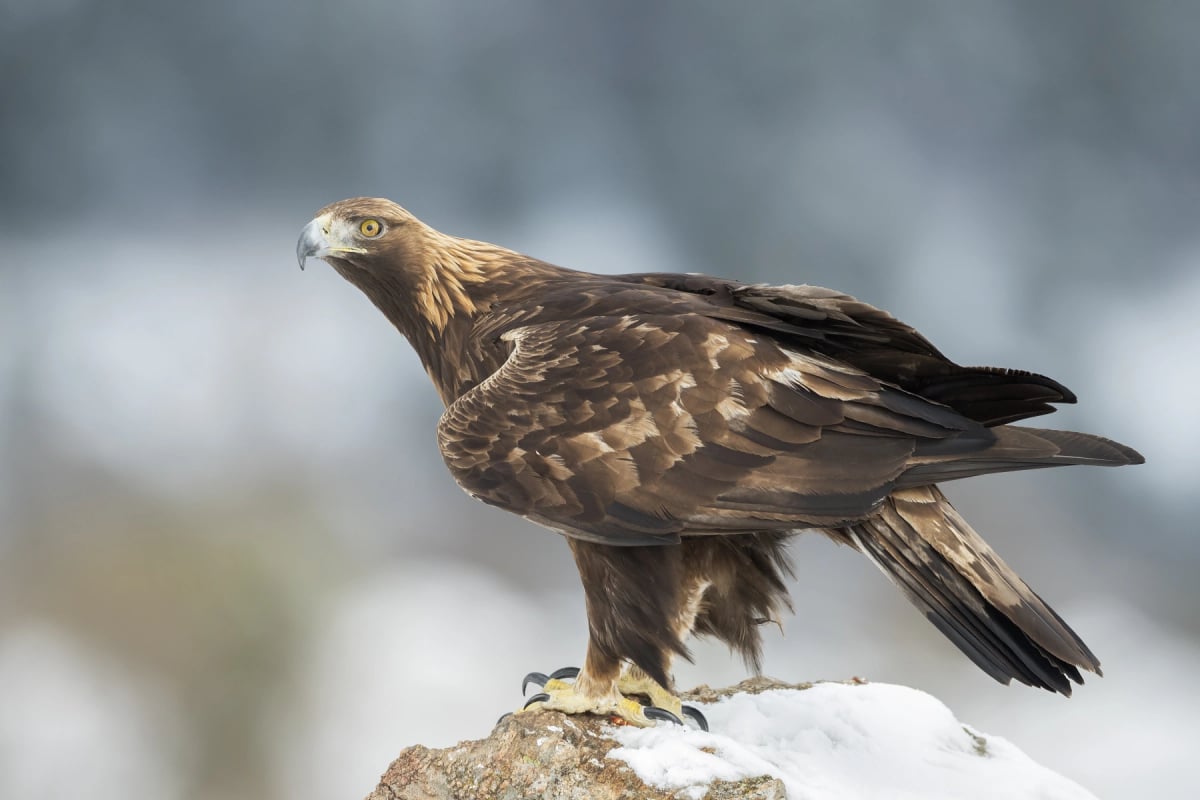
The golden eagle is one of the largest and most powerful birds of prey in the Northern Hemisphere. Adults are covered in dark brown feathers with a warm golden wash across the back of the head and neck, giving the species its name. It lives in mountains, open moorlands, and high plateaus, nesting on cliff ledges or in large trees, often returning to the same nest site for many years. Its range spans North America, Europe, Asia, and North Africa. A skilled hunter, it targets rabbits, hares, marmots, and occasionally young deer or other medium sized animals. It spots prey from great heights, then drops in a fast, controlled dive to make the kill. Pairs bond for life and together defend territories that can stretch over dozens of square kilometres. The IUCN lists it as Least Concern, though it remains sensitive to human disturbance near nesting sites.
Habitat and distribution
Few birds match the golden eagle's reach. It breeds across an enormous band of the Northern Hemisphere, from western North America through Europe, Central Asia, and parts of East Asia, with additional populations in North Africa and the Middle East. Within this range it gravitates toward open, rugged country: mountain ranges, high plateaus, rocky coastlines, and moorlands where the sky is wide and the terrain offers good hunting. It generally avoids dense forest and flat, intensively farmed land. In North America it is most abundant in the western states and Canada, while in Europe Scotland, Scandinavia, the Iberian Peninsula, and the Alps hold some of the strongest breeding populations. Resident birds tend to stay within a fixed territory year round, while northern breeders may move to lower elevations in winter.
Diet
Rabbits and hares form the backbone of the golden eagle's diet across much of its range, but this bird is a remarkably flexible hunter. Ground squirrels, marmots, prairie dogs, and voles are taken regularly depending on what the local landscape offers. Where larger prey is available, golden eagles will target young deer, mountain goats, and foxes, though healthy adult ungulates are generally too large to overpower. Birds, reptiles, and even large insects round out the menu when conditions demand it. Carrion is eaten too, particularly in winter when live prey is harder to find. The eagle hunts mainly by soaring at altitude, scanning the ground below, and then folding into a steep dive that can exceed 150 kilometres per hour before it strikes with powerful talons.
Behavior
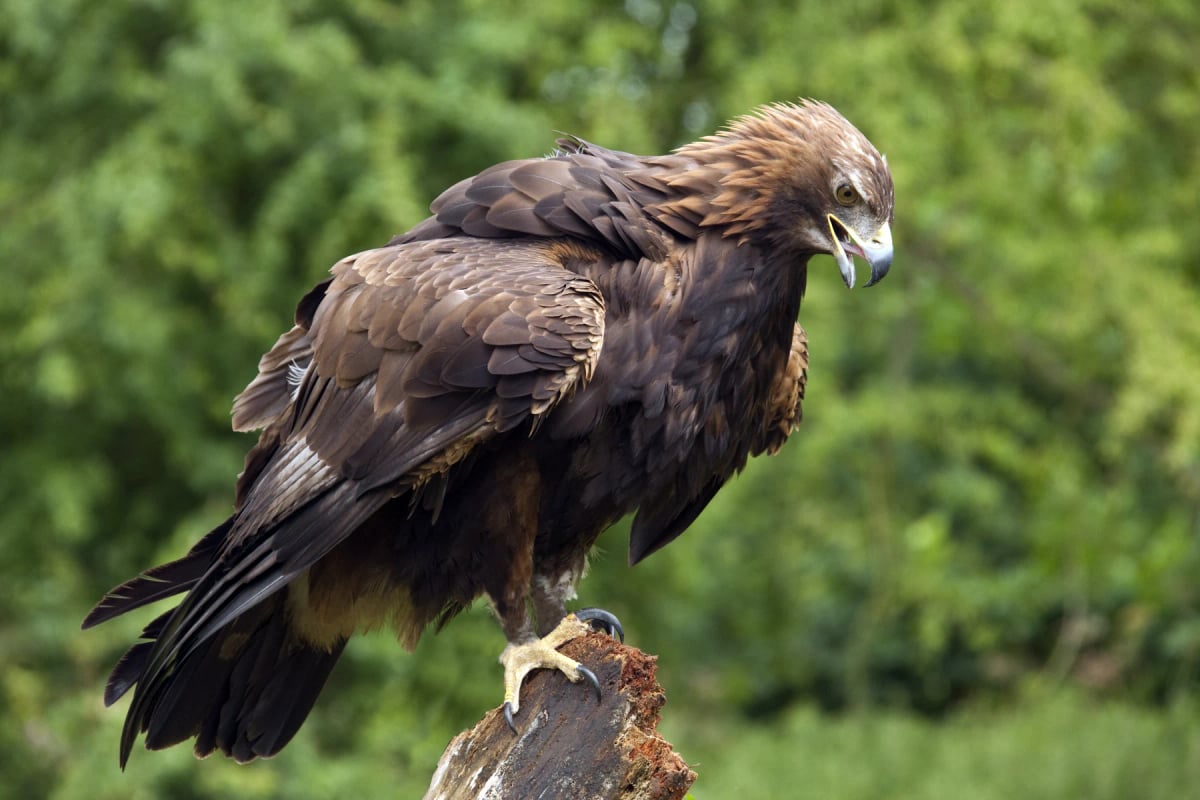
Spending hours aloft without apparent effort is one of the golden eagle's defining traits. It exploits thermal currents and updrafts along ridgelines to cover enormous stretches of ground while searching for prey, rarely needing to flap its broad wings. Pairs defend territories that can span well over 100 square kilometres, and they are vigorous in driving out rivals, other raptors, and even ravens that stray too close to the nest. Outside of the breeding season the birds are generally quiet and solitary. Golden eagles communicate through a range of calls, though they are far less vocal than many other large raptors. Their eyesight is exceptional, estimated to be four to eight times sharper than human vision, which allows them to spot a rabbit moving in the grass from more than a kilometre away.
Breeding
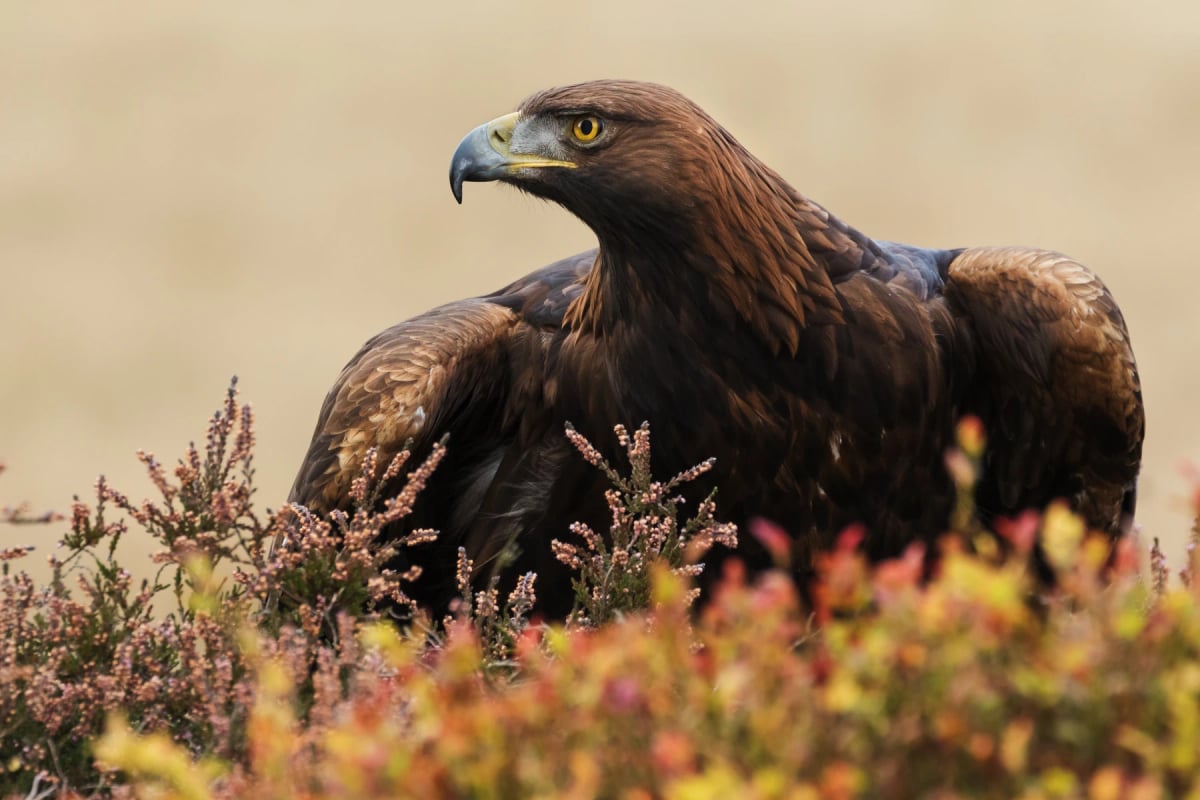
Pairs bond for life and begin courtship displays early in the year, performing dramatic undulating flights over their territory. Nests, known as eyries, are built on sheltered cliff ledges or in the crowns of tall trees, and the same structure may be added to and reused for decades until it grows to an impressive size. Most pairs maintain two or more nests within their territory and rotate between them across seasons. Eggs are laid between late January and early April depending on latitude, with clutches typically containing one or two eggs, rarely three. Incubation lasts around 40 to 45 days. Usually only one chick survives to fledge, since the older nestling often outcompetes its sibling for food. Young eagles reach sexual maturity at around four or five years of age.
Conservation
The IUCN classifies the golden eagle as Least Concern, reflecting a global population estimated at several hundred thousand individuals. Even so, the species faces real pressures in parts of its range. Illegal shooting and poisoning, often linked to the protection of livestock or game birds, continue to reduce numbers in some regions of Europe and the Middle East. Collisions with wind turbines and power lines are a growing concern, particularly in areas where renewable energy infrastructure is expanding rapidly. Lead poisoning from ingesting carcasses shot with lead ammunition affects birds across North America and Europe. Disturbance near active nests during the breeding season can cause pairs to abandon eggs or chicks. Conservation efforts include satellite tracking programs, power line modifications, and legal protections that have helped stabilise or recover populations in several countries.
Where it is found
The Golden Eagle can be found in places such as:
Researched and written by Juan Pablo. Sources: IUCN Red List, scientific literature and regional field guides. Last updated: .
Technical factsheet



Frequently Asked Questions
How fast can a golden eagle fly?
When diving after prey, a golden eagle can reach speeds above 150 kilometres per hour. In level flight it typically cruises at 45 to 80 kilometres per hour. Much of its time in the air is spent gliding on thermal currents rather than flapping, which lets it cover huge distances while burning very little energy. That combination of speed and endurance makes it one of the most capable hunters in the sky.
How good is a golden eagle's eyesight?
A golden eagle's vision is estimated to be four to eight times sharper than that of a human. It can spot a rabbit moving through grass from more than a kilometre away. Its eyes are large relative to its skull and are packed with light-sensitive cells that pick up fine detail across a wide field of view. This extraordinary sight is what allows it to hunt so effectively from great heights.
What do golden eagles eat?
Rabbits and hares are their main prey across most of their range, but golden eagles are flexible hunters. They also catch ground squirrels, marmots, voles, and occasionally young deer or foxes. In winter, when live prey is scarce, they will feed on carrion. The exact diet depends on what is available locally. They hunt by soaring high and dropping into a fast, controlled dive to strike with their powerful talons.
Do golden eagles mate for life?
Yes, golden eagles form bonds that last a lifetime. A pair will court early in the year with impressive aerial displays over their territory, then share the work of building and maintaining their nest. They often return to the same nest site year after year, adding new material each season. Both parents take part in incubating the eggs and raising the chick, making them one of the more devoted pairs among birds of prey.
Is the golden eagle endangered?
The golden eagle is listed as Least Concern by the IUCN, with a global population estimated at several hundred thousand individuals. However, it still faces serious threats in parts of its range. Illegal shooting, poisoning, lead contamination from ammunition in carcasses, and collisions with power lines and wind turbines all take a toll. Disturbance near nests during the breeding season can also cause pairs to abandon their eggs or chicks.
Where in the world do golden eagles live?
Golden eagles have one of the widest ranges of any bird of prey. They are found across North America, Europe, Central and East Asia, and parts of North Africa and the Middle East. They prefer open, rugged landscapes such as mountains, moorlands, and high plateaus, and generally avoid dense forests and flat farmland. Some populations are resident year round, while birds that breed at higher latitudes tend to move to lower elevations in winter.
How long do golden eagles live?
In the wild, golden eagles typically live between 20 and 30 years, though reaching that age requires surviving the difficult early years. Many young birds do not make it past their first year. In captivity, with a reliable food supply and no predators, some individuals have lived beyond 30 years. They do not reach sexual maturity until around four or five years of age, which means they spend several years as independent juveniles before breeding.